


Sustainability

Amino acids are substances often referred to as "the building blocks of life." They form the proteins that make up our bodies and play a crucial role in our health and daily activities. They are also widely used in the food industry as a component to influence nutritional value and flavor.
Amino acid analyzers are devices used for accurately measuring types and quantities of amino acids. Hitachi High-Tech has been involved in developing these devices since the early 1960s, supporting advancements across various industries, including the food and healthcare sectors, by reducing analysis times and improving precision.
The fields in which these devices are used have expanded globally in recent years. They are increasingly being used in new medical and pharmaceutical fields, gaining prominence in areas that support life and health, such as for nutrition improvement projects in developing countries, and for the formulation of peptides, in which significant growth is expected.
Hitachi High-Tech's amino acid analyzers are continually evolving, based on technologies and expertise gained through the development of various analytical systems. By analyzing the building blocks of life with greater precision, we are contributing toward improving the well-being of people and society, and realizing a sustainable future.
"Amino acids" is the collective term for the various molecules that support life, which are often called the "building blocks of life." To date, approximately 500 types have been identified, with the most well-known among them being the amino acids that make up proteins.
The human body contains around a hundred thousand different types of protein, which make up the skin, hair, muscles, and internal organs. These proteins are formed through varying sequence patterns combining just 20 types of amino acids.
Of these 20 types, nine are known as "essential amino acids," including isoleucine, valine, and leucine. They must be obtained from food, as the body cannot produce them.

Amino acids play a role that goes beyond simply being the building blocks of proteins. For example, glutamic acid functions as an important neurotransmitter involved in memory and learning. Cysteine has antioxidant properties and is essential to the recovery of cells damaged by stress or ultraviolet rays.
Amino acids support human life in a variety of ways, such as the above.
Momoko Miyano, from the Hitachi High-Tech Analysis Field Application Center, explains:
"Amino acid analyzers are used for measuring the types and quantities of amino acids present in foods and pharmaceutical products. This process, known as qualitative and quantitative analysis, is extremely important to the development of foods, supplements, and pharmaceutical products, as well as biotechnology research."
For example, in the case of health foods, identifying the types and quantities of amino acids they contain helps ensure quality. You may have seen products labeled with the number of amino acid types they contain, and their quality control involves rigorous analysis using amino acid analyzers.
Glutamic acid, mentioned earlier, is also known as the umami flavor component found in seafood and in seaweed such as kelp, and is a familiar ingredient in seasonings. Amino acid analyzers play a role not only in improving health and nutritional value, but also in enhancing flavor.
The amino acid analyzer was invented in the United States in 1958. In 1972, two American researchers who devised the principles of amino acid analysis were awarded the Nobel Prize in Chemistry. Visualizing these amino acids, which are the building blocks of life, has long been a goal of humanity.
In 1962, Hitachi High-Tech (Hitachi's Naka Plant at that time) released Japan's first domestically produced model. Over the course of more than 60 years of progress, the time required for a single analysis—which initially took 22 hours—has been reduced to around 30 minutes using the latest models, or even around 10 minutes under certain conditions.
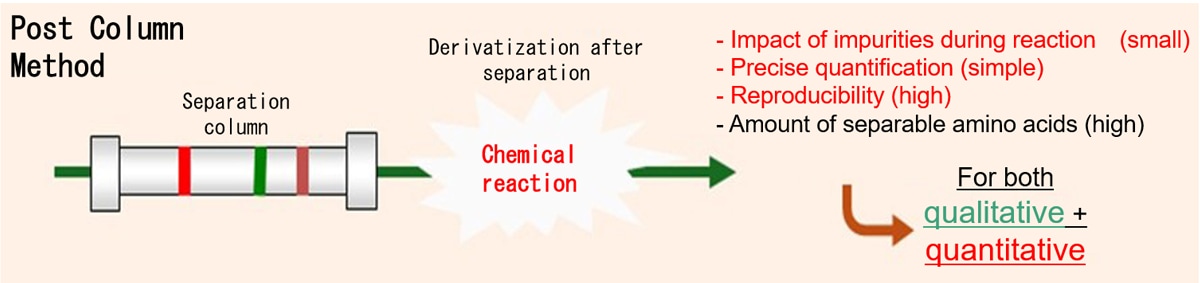
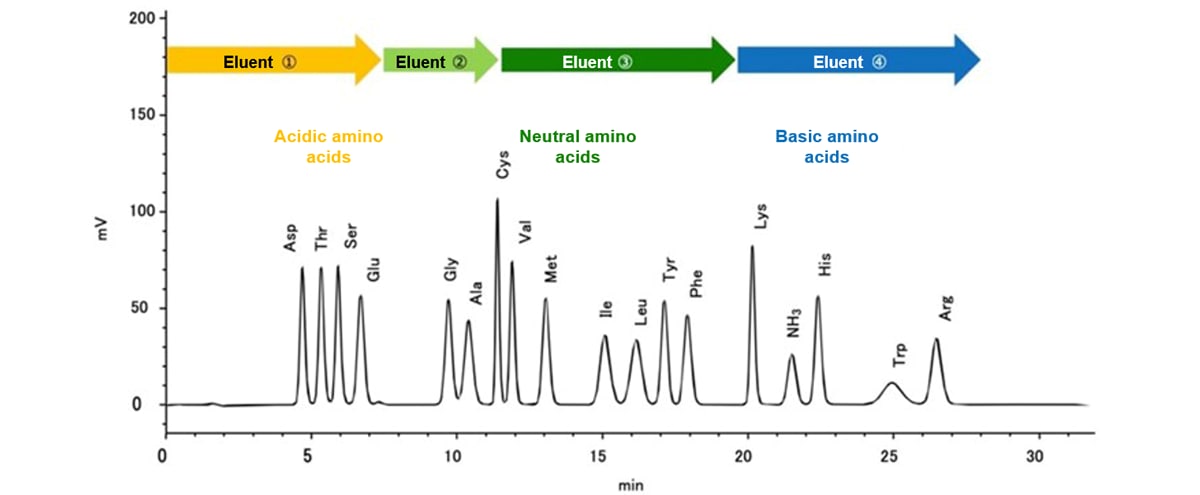
At the heart of this is the post-column ninhydrin method. In this method, amino acids in the sample are first separated using a cylindrical component known as a column, and then qualitative and quantitative analysis is performed by coloring them with a reagent called ninhydrin.
Since different types of amino acids elute from the column at different times, the type of amino acid can be identified by measuring that time. In addition, amino acids can be difficult to detect as they are colorless and absorb almost no visible light, so they are stained to enable visualization. The post-column ninhydrin method is a specialized method for amino acids with these characteristics.
While new methods such as mass spectrometry, which measures the weight of molecules, have become more widespread in recent years, Hitachi High-Tech has consistently used the post-column ninhydrin method.
One reason for this is that this method has been established as a global standard. It is also employed in regulations such as pharmacopeias in various countries, and using the same analytical method is essential when comparing results with historical data.
Another reason is the accumulation of expertise over many years. This enables stable measurements, standardized reagents and analytical conditions, and creates an environment in which analysis can be easily implemented and operated.
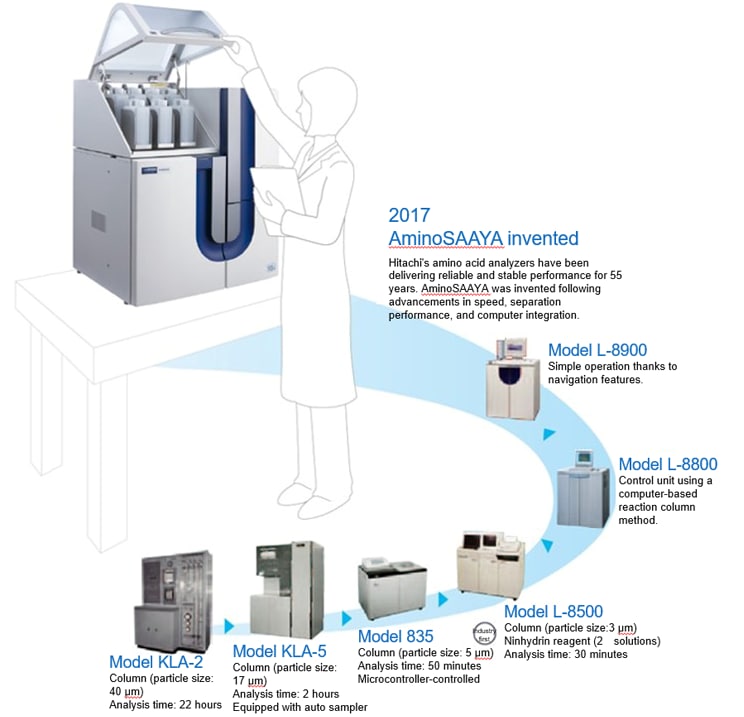
The latest model, LA8080 AminoSAAYA introduced in 2017, builds on previous technology while bringing further advancements.
The compact design has a footprint approximately 30% smaller than previous models, allowing it to be installed on a tabletop instead of on the floor. In addition, its ergonomic design positions the reagents at eye level, allowing operators to work without needing to bend down.
Ikuko Narimatsu, a developer of AminoSAAYA at Hitachi High-Tech Analysis Field Application Center, explains how the device has evolved to become more user-friendly and accessible.
"The number of female analysts has grown in recent years. This includes expectant mothers, so there has been a growing demand for devices that can be used in more comfortable positions. In addition, space is often limited in laboratories, so devices that are more compact are also appreciated."
Another important point is that reproducibility has been improved. In food and pharmaceutical manufacturing, the same results are expected regardless of who performs the measurements, when they are performed, or under what conditions. This device delivers high reproducibility through its improved analytical precision.

Hitachi High-Tech's amino acid analyzers are used in a wide variety of fields, including food and beverages, pharmaceutical product development, and life sciences research.
In the food industry, they play an important role in product development and quality control. In particular, as people have become more health-conscious in recent years, an increasing number of products are highlighting their amino acid content, and so having the data to back these claims has become increasingly important.
They are also increasingly being used by local governments developing brands based on locally produced goods. In order to further add value to agricultural and fishery products, more and more products have started promoting their richness in specific amino acids. As a result, more and more analyzers are being supplied to agricultural research stations and fisheries research institutes that provide analytical support.
These use cases are not just limited to Japan. Hitachi High-Tech's amino acid analyzers hold around 30% of the global market share, with overseas markets accounting for the bulk of this. In addition, in developing countries, particularly in Asia and Africa, amino acid analyzers play an important role in safeguarding people's lives and health.
In these regions, children often face health challenges such as growth and developmental problems, underweight, and anemia, many of which are linked to protein deficiency. Nutrition improvement programs are being undertaken by health organizations and research institutes to address these issues, and amino acid analyzers are being used to create the baseline data.
These initiatives are also aligned with the SDGs of Zero Hunger, and Good Health and Well-Being.
Narimatsu shares her impressions of Japan and other countries:
"There is no other country in which the term "amino acid" has become so deeply ingrained in society or more widely recognized amongst its people than in Japan. Japan has long been leading the development of the amino acid industry, with the first seasoning using amino acids being launched over 100 years ago. Against this background, Hitachi High-Tech's amino acid analyzers have continued to evolve."
Miyano goes on to explain:
"A customer once asked me how they would even go about measuring amino acids in the first place, so we provided them with comprehensive support from preparation right through to analysis. I believe it's crucial to not only provide equipment, but to also understand the challenges our customers face and work together with them to find solutions."
Amino acid analyzers are widely used not only in the food industry, but also in the healthcare sector. For example, they have been used in product development and quality control due to the fact that intravenous fluids (IV drips) and injectable medications used to provide nutritional support to patients always contain amino acids.
In recent years, there has been growing demand for peptide-based formulations in particular. Peptides are compounds consisting of several to several dozen amino acids linked together, and peptide-based formulations use these as active ingredients. Notable examples include GLP-1 receptor agonists used to treat diabetes, peptide-based medications used in oncology to suppress hormone activity, and others that are showing promise in the field of infectious diseases.
The peptide pharmaceuticals market is projected to double in size by the early 2030s, making it one of the most noteworthy areas in pharmaceutical development.
Producing peptide formulations requires strict control over the types and amounts of amino acids that make up the peptides, meaning analysis is even more critical. In addition, demand for amino acids and peptides is growing in other fields such as dietary supplements and cosmetics, further expanding the applications of amino acid analyzers.
Moreover, we are seeing progress in integration with AI and data analysis technologies. This is expected to create new value, such as in process optimization and quality forecasting based on analytical data. Going forward, amino acid analyzers could evolve beyond simply being analytical instruments to become data-driven solutions.

Hitachi High-Tech Group has formulated five Sustainability Focus Areas for solving social issues, based on five SDGs (Sustainable Development Goals).

Amino acid analyzers are deeply connected with "Contributing to Healthy, Safe, Secure Lives" and "Contributing to the Sustained Development of Science and Industry."
In recent years, meat substitutes have been attracting attention as new sources of protein. These foods are made from plant-based ingredients or cultured cells and also generate lower greenhouse gas emissions during production than beef or pork. The amino acid analyzers that aid in the production of these products are also closely linked to "Contributing to a Sustainable Global Environment."
Amino acids are expected to become even more widely used in a variety of fields, including food and healthcare. Hitachi High-Tech's amino acid analyzers play a key role in visualizing the building blocks of life, thereby contributing to improving the well-being of people and society.