

including disease prevention, diagnosis, treatment, nursing care, and health promotion
The healthcare industry is expanding rapidly as transformation across medical and health‑related businesses accelerates. The spread of COVID‑19 reshaped people’s behavior and further propelled structural changes that were already underway.
The expansion of digital health has become a central trend. Telemedicine is now well established, mobile health solutions such as wearable monitoring devices are becoming commonplace, and AI‑assisted diagnostics are helping reduce the burden on physicians while improving accuracy. Personalized medicine, tailored to individual patients using genetic information, is also advancing in clinical practice. Interest in pandemic preparedness remains high, and global collaboration frameworks led by the WHO continue to evolve. The number of healthcare and technology‑focused startups is rising quickly, and companies from other industries are increasingly entering the field, underscoring the growing importance of this sector.
At the same time, environmental challenges within the healthcare industry are becoming more serious, just as in other industries. Sustainable healthcare aims to maintain high‑quality medical services while minimizing environmental impact. Initiatives such as green hospitals, sustainable procurement, and responsible equipment use are gaining momentum as the industry works to balance medical quality with environmental responsibility.
-
Increasing greenhouse gas emissionsMajor sources of emissions include the energy consumed by medical facilities and the development and manufacturing of pharmaceuticals and medical devices, which require numerous experiments and prototypes -

Increasing medical waste and disposal issuesThe large‑scale use of disposable instruments and packaging contributes to growing volumes of waste, and the disposal of masks, gloves, and other items has surged since the COVID‑19 pandemic -
Water pollution from pharmaceuticalsUnused or unmetabolized pharmaceuticals discharged from hospitals and households can remain in water systems, creating concerns about their impact on aquatic ecosystems -
Environmental impact of supply chainsGreenhouse gases are emitted through the global transportation of medical devices, pharmaceuticals, and consumables. Cold‑chain logistics for the pharmaceutical and biotechnology sectors are especially energy‑intensive, adding further environmental burden -
Improving resource efficiency is an urgent priorityThere is a pressing need to introduce reusable medical devices and energy‑efficient medical equipment, develop products designed for modular replacement, and promote the recycling of materials
Solved IssuesNature Positive- By detecting lesions previously difficult to identify, it enables early disease detection, accurate diagnosis, and analysis of antibiotic Sensitivity, supporting rapid decision-making in clinical settings
- Surface structure and physical property evaluation of medical materials and biomaterials, and utilization in the development of next-generation medical technologies such as regenerative medicine and drug delivery systems
Solved IssuesDecarbonization- We provide solutions by combining advanced control and sensing technologies with AI
→Reduces large-volume water and energy consumption in cultivation and cleaning processes
→Minimizes reprocessing caused by quality defects and prevents increased waste - Used for advanced operation, anomaly detection, and predictive maintenance via AI
→Supporting stable and optimized manufacturing processes
Solved IssuesNature Positive- AI makes predictions on optimal materials and formulations
→There is no need to repeat multiple experiments like in the past, which significantly reduces energy consumption and CO2 emissions associated with such experiments
→Enables performance to be maximized with the minimum required amount of materials by optimizing the formulation and usage amounts of raw materials
Solved IssuesDecarbonization- Designs energy-efficient, streamlined manufacturing processes that omit unnecessary heating and cooling processes
- Evaluates the thermal stability and mechanical properties of materials used in regenerative medicine and similar fields, thereby supporting the development of medical materials that will lead to enhanced durability and reduced environmental impact
- Evaluates the impact of degradation on the recyclability of medical plastics and composite materials, thereby helping to encourage the reduction and reuse of medical waste
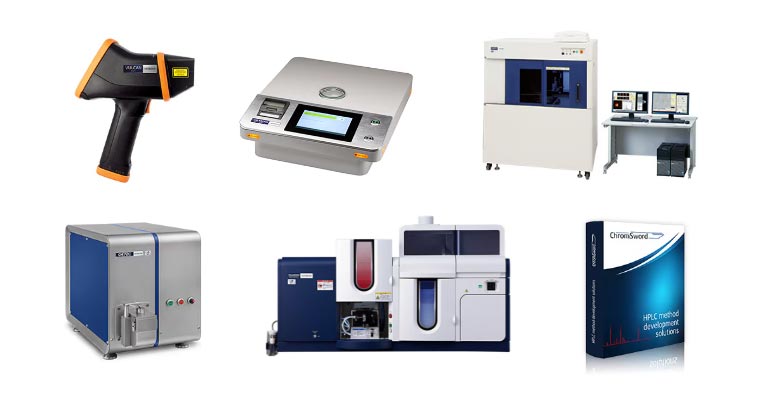
Solved IssuesCircular Economy- Measures components in pharmaceuticals and pharmaceutical ingredients
→Supports measurements compliant with standards such as the Japanese Pharmacopoeia - Energy-saving design, supports electronic records
→Supports sustainable operation (software compliant with FDA 21 CFR Part 11)
Solved IssuesNature Positive- Offers screening for phthalates and other harmful substances that may be contained in trace amounts in medical devices and pharmaceutical packaging materials without sample preparation
- Uses nitrogen as the carrier gas
→Minimizes the consumption of scarce resources, such as helium
Solved IssuesNature Positive- Highly sensitive, high-precision measurement of trace metals contained in pharmaceuticals, medical devices, and water used in manufacturing
→Ensures product safety
→Reduces environmental impact from wastewater and waste liquids - Energy-efficient design that minimizes power consumption
- Improved analytical throughput due to multi-element sequential measurement (rapid sequential) (ZA4800)
Solved IssuesNature Positive- High-precision detection of trace amounts of organic compounds and other harmful substances contained in products and raw materials
- Reduced product variation and retesting due to highly sensitive, high-reproducibility analysis
→Minimizes the amount of reagents and resources used - Space saving and built-in temperature control, as well as an energy-efficient design that reduces power while in standby mode
Solved IssuesCircular Economy- Fully automatic titrator: All stages are automated, from weighing samples to titration and electrode cleaning
→Minimizes product variation and reduces defective products and retesting - Titrator: Accurately measures the composition of water used in manufacturing and wastewater
→Complies with environmental standards and optimizes wastewater treatment - Karl Fischer Titrator: Rapidly measures moisture content in pharmaceuticals and raw materials
→Ensures preservation and safety