


Hydrogen energy is gaining global attention as the world works toward achieving a decarbonized society. Hitachi High-Tech initially began by carrying components for fuel cell vehicles (FCVs) before expanding its business domain into the water electrolyser sector, and it is now planning to get involved in CO2 electrochemical reduction technologies.
Akane Yamamoto of the Marketing Strategy Business Group, Qinyi Zhu of the Industrial & Social Infrastructure Business Group, and Biyun Xin of Hitachi High-Tech (Shanghai) Co., Ltd.'s Advanced Materials Department explain Hitachi High-Tech's initiatives in the hydrogen market, which is expected to see further growth going forward.
Knowledge Base
Back to List
Interview
Articles & Reports
Building a Hydrogen Value Chain and the Power of Co-creation
Articles & Reports
Interview
Energy
Mobility
Value Chain Solutions
Decarbonization
Hitachi High-Tech Corporation Marketing Strategy Business Group
Akane Yamamoto

Hitachi High-Tech Corporation Industrial & Social Infrastructure Business Group
Qinyi Zhu

Hitachi High-Tech (Shanghai) Co., Ltd. Industrial Solution Div. Advanced Materials Dept.
Biyun Xin
Contents
- Developing the hydrogen business as a new pillar of our trading business
- The expanding global hydrogen market led by China
- Collaborating with a precision metal mold manufacturer to establish our business foundation
- Expanding business by leveraging domain knowledge
- Striving to contribute to a sustainable society
Developing the hydrogen business as a new pillar of our trading business
Hitachi High-Tech is currently developing businesses aimed at building a hydrogen value chain. The hydrogen value chain comprises the cycle of producing, storing/transporting, and using hydrogen, and our present focus is on the two areas of producing hydrogen using water electrolysers and using hydrogen in fuel cell vehicles (FCVs), fuel cells, and other applications.
Of the four solutions-focused business groups within Hitachi High-Tech, three are engaged in manufacturing devisions. The remaining group, the Industrial & Social Infrastructure Business Group, serves as our trading arm, with hydrogen-related activities positioned as part of our trading operations. Our greatest strength lies in our ability to draw upon extensive products and assets of the entire Hitachi Group to deliver comprehensive, One Hitachi solutions that address our customers’ challenges in the hydrogen sector.
Hitachi High-Tech’s hydrogen business first began with supplying thin metal plates known as separators used in fuel cells to FCV manufacturers. A fuel cell is a device that generates electricity through the chemical reaction between hydrogen and oxygen. Each cell comprises multiple components such as separators, membrane electrode assemblies (MEAs), gas diffusion layers (GDLs), and gaskets, and approximately 300 cells are stacked to form a single fuel cell. In contrast, water electrolysers generate hydrogen and oxygen through the electrolysis of water, a mechanism based on the reverse reaction of fuel cells. While their respective cell structures share common components (e.g., separators and gaskets), the properties required for their MEAs, coatings, and materials differ significantly. Therefore, Hitachi High-Tech is expanding its business domain by applying and extending its expertise developed in the area of fuel cell components to support manufacturers of water electrolysers as well.
The expanding global hydrogen market led by China
Currently, various countries have set targets to achieve carbon neutrality by 2050, with hydrogen use is expected to play a key role in this transition. Specifically, there has been a strong focus on replacing processes in steel and chemical plants that have until now emitted large amounts of CO2 with hydrogen-based processes. Furthermore, chemical plants that produce ammonia and other chemical substances require large amounts of hydrogen, resulting in a growing movement to produce hydrogen domestically using water electrolysers instead of relying on the import of hydrogen*1. In the mobility sector, fuel cells are more suitable than lithium-ion batteries (LiBs) for vehicles that traverse long distances such as trucks, buses, ships, and aircraft, as they enable longer ranges on a single refueling*2. Global hydrogen demand is predicted to grow five times from 2022 to 2050, with support measures and systems currently being put in place to achieve a hydrogen society*1.
China is one of the largest hydrogen markets in the world. Since 2018, many manufacturers have entered the FCV sector in China, leading to the construction of a supply chain that has grown to encompass over 2,000 companies today, making China a market leader. China’s vast land area makes it easy to access renewable energy sources through the installation of solar panels and the use of wind power, enabling the mass production of green hydrogen through water electrolysis using such power. Furthermore, a main factor behind this development is China’s robust subsidy system for renewable energy facilities and green hydrogen production facilities *3,4.
While China leads the hydrogen market in terms of scale, Japan leads the market in terms of technology. The technologies of Japan’s FCV manufacturers and component manufacturers are attracting attention, with Hitachi High-Tech also focusing on expanding sales and the market for fuel cell components in collaboration with such partners. Currently, we are primarily engaged in marketing activities and business development in the Chinese market, while also considering expansion into North America, Europe, India, and other parts of Asia in the future.
Collaborating with a precision metal mold manufacturer to establish our business foundation
The quality of individual components directly impacts the performance and lifespan of fuel cells and water electrolysers. For example, variations in the flow channel shape or height of the separator, or warpage of the separator itself, can affect the flow of hydrogen and oxygen gases. If the gas flow in the simulation cannot be replicated in reality, the cell’s performance will be degraded, and the target output cannot be achieved. Warpage of the separator can also cause defects in subsequent processes such as coating treatment and gasket installation, which in turn affects the entire process of cell and stack manufacturing. Therefore, the greatest challenge is ensuring consistent quality assurance in a manner that integrates multiple technical elements. Hitachi High-Tech has established a collaborative framework with suppliers that clearly defines our respective responsibilities while closely aligning our inspection conditions and sharing information to enhance quality.
In FY2018, we began collaborating with NISHIMURA Co., Ltd. (Toyota City, Aichi Prefecture; hereinafter “NISHIMURA”), a precision metal mold manufacturer. NISHIMURA launched its hydrogen business in around 2000, manufacturing metal separators (metal separators / bipolar plates) for fuel cells. Its excellent technical capabilities were highly rated, resulting in a series of offers from domestic and international manufacturers. Our collaboration with NISHIMURA, with whom we had prior business engagements in the materials business, began with Hitachi High-Tech acting as the sales front for their hydrogen-related business.
NISHIMURA’s advanced technical capabilities allow them to meet demands that challenge the very limits of press working. For example, it can respond to requests such as increasing the height of gas or coolant flows, or reducing the spacing between flow channels, through its high-precision metal mold design and processing technology. Furthermore, while metal plates typically warp when pressed and stretched, total warpage of the plates produced by NISHIMURA can be capped at a maximum of 2 mm. These technical capabilities serve as the foundation that supports the performance and quality of the entire cell.
As NISHIMURA's global contact point, Hitachi High-Tech currently provides sales support and engages in joint development while building a system that ensures the stable supply of high-quality metal separators to fuel cell manufacturers and water electrolyser manufacturers both in Japan and overseas.
Expanding business by leveraging domain knowledge
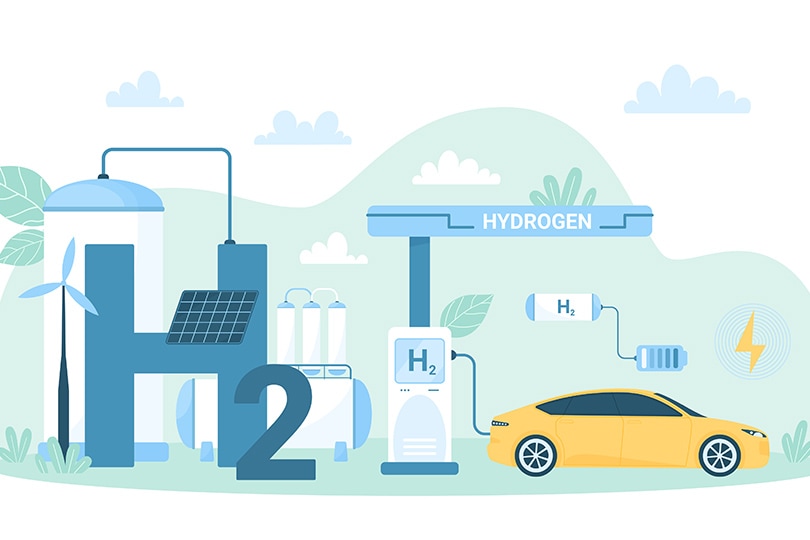
Our sites in China have accumulated domain knowledge (expert knowledge) in the hydrogen sector through our separator business. We have even started to receive specific consultation requests to help customers search for components other than separators and to introduce them to good alternative manufacturers as we continue to maintain connections with dozens of fuel cell manufacturers in China. These broad dialogues have led to new projects, further strengthening our capabilities.
In 2025, we also began handling additional components such as catalysts and ion‑exchange membranes.
Striving to contribute to a sustainable society
Besides carrying separators and catalysts, Hitachi High-Tech also supports electrolyte membrane technology for water electrolysers. We are also undertaking research in collaboration with overseas manufacturers to convert CO2 into ethylene, methanol, and other useful substances. Achieving a recycling-oriented society powered by clean energy requires the integration of the three cycles of electricity, hydrogen, and carbon neutrality. We will continue contributing to tackling environmental issues by applying water electrolysers technology not only to hydrogen production, but also to areas such as CO2 emissions reduction and carbon recycling.
Our strength lies in our ability to propose holistic solutions that leverage the assets of the entire Hitachi Group under the concept of One Hitachi. We proactively foster connections with customers and accumulate domain knowledge as part of our trading business, enabling us to provide value beyond the mere supply of components. By building a hydrogen value chain alongside our existing battery-related business, we seek to create synergies across our environmental and energy-related businesses, paving the way for business expansion into a wide range of sectors.
Expanding our business in the hydrogen sector will help accelerate the realization of a hydrogen society as part of global decarbonization efforts. We aim to achieve both corporate growth and societal decarbonization. We will continue working with our partners in Japan and overseas toward a sustainable society by leveraging our domain knowledge and networks developed in the hydrogen sector.
Sources
*1.Website of the Ministry of Economy, Trade and Industry of Japan. “目前に迫る水素社会の実現に向けて~『水素社会推進法』が成立(前編)サプライチェーンの現状は? (Toward the Imminent Realization of a Hydrogen Society—Enactment of the Hydrogen Society Promotion Act (Part 1): What Is the Current State of the Supply Chain?).” (Japanese only)
*2.Website of the Ministry of Economy, Trade and Industry of Japan. “スマートモビリティ社会構築に向けた動向について (Trends toward Building a Smart Mobility Society).” (Japanese only)
*3.New Energy and Industrial Technology Development Organization. “中国における水素に関する動向 (Hydrogen-Related Developments in China).” (Japanese only)
*4.Japan Science and Technology Agency (JST). “中国における水素エネルギーの発展動向 (Trends in the Development of Hydrogen Energy in China).” (accessed on 2026/Feb/18th). (Japanese only)