Shinichi Taniguchi
Ph.D.
General Manager of Production Engineering and MONOZUKURI Innovation Center
Research & Development Group
Hitachi, Ltd.
The natural world around us is facing an onslaught of multiple simultaneous global-scale environmental challenges—from rising sea levels to the increasing severity of natural disasters—that demand comprehensive solutions. One approach for objectively characterizing the impact of human activity on Earth's environment involves the notion of planetary boundaries1), which identifies nine areas in which human behavior affects the workings of planetary systems—and posits that, in each case, there exists a certain degradation threshold (or “planetary boundary”) beyond which irreversible destructive changes become inevitable. In four of these areas—climate change, loss of biological diversity, land system change, and the biogeochemical cycle—the planetary impact of human behavior, and the associated risks, have already crossed into crisis territory, with analyses suggesting that the human activities in question can no longer be safely pursued.
At the same time, the goal of securing stable supplies of resources will require resilience in the face of trends such as resource localization and the increasing difficulty of procuring resources due to block economies—a reality that is vividly illustrated by growing rates of resource consumption and the skyrocketing cost of metals2-6).
Here we describe the key roles that circular economies (CEs) can play in addressing these challenges. One is to make planetary systems more robust by combatting climate change; one estimate suggests that CEs can reduce carbon emissions by 39%7). The transition from conventional linear economies to novel circular economies will also furnish a wellspring for stable procurement of resources (Figure 1) 8).
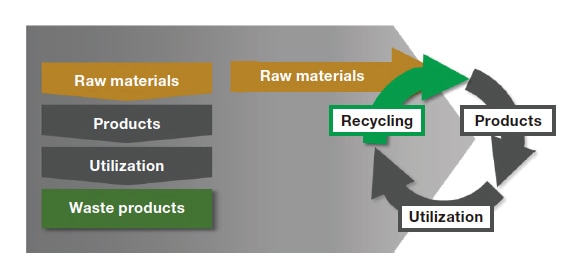
Fig. 1 Transition from conventional linear economies to novel circular economies.
The establishment of rules and ecosystems to facilitate circular economies is already well underway in regions around the world. In Europe, the Green Deal industrial plan has promoted local procurement of energy and resources; in Japan, the notion of Japan-Asia supply chains as a joint development strategy has bolstered visions of an economic sphere that expands in tandem with Asia. In the U.S., the continuing enactment of “Buy American” legislation has been accompanied by growing discussions of Right To Repair and efforts to strengthen domestic procurement and lengthen product lifetimes. Businesses that fail to align with these new rules and ecosystems are at risk of discovering that they are no longer viable.
Beyond economic activity and research projects the most important driver will be the values and priorities of end users. Growing environmental awareness and burgeoning demand for environmentally-conscious products, together with the shift in emphasis from products to services, will increase the frequency of contact between service providers and users.
Given the situation and challenges outlined above, Hitachi is working toward societies based on circular economies to maximize the life-cycle value of resources while minimizing energy consumption. In these societies, it will be possible to
Of course, achieving these goals will require overcoming a number of challenges, which we can organize into three categories directly related to everyday life (Table 1). First, in the Energy sector we face the risk that the additional energy required to implement circulation will worsen our impact on the environment. Next, in the Materials and Products sector we must acknowledge that naive circulation of resources typically degrades quality, creating risks that users will be ultimately unsatisfied. Finally, the key challenge of global Rules and Ecosystems is that, at present, corporate activity is evaluated largely on the basis of cost and quality; “contribution to achieving circular economies” is almost nonexistent as a metric for corporate performance. Promoting circularity will require establishing new rules, implementing new societal protocols, and forming new ecosystems.
Table 1 Three sets of challenges to be overcome.

Hitachi is developing innovations to overcome these challenges (Figure 2). Life-cycle management systems—for modeling circulation networks in cyberspace and monitoring and controlling flows of resources and data—will help optimize the functioning of circulation networks. Upcycling techniques will increase the value of resources on each iteration through the circulation loop. Finally, promoting rule-based strategies will ensure proper distribution of resources and data. By pursuing these initiatives as a unified, comprehensive effort, our goal is to establish the rules and provide the solutions that our customers—and society at large—will need.
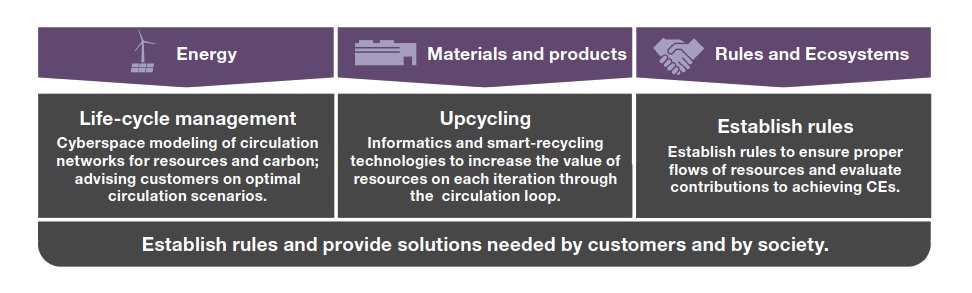
Fig. 2 The challenges we are pursuing.
To address the challenges outlined above, we are pursuing R&D initiatives targeting circular economies through digital activity; in particular, we aim to design cyber-physical systems that combine Lumada with Hitachi's accumulated base of knowledge (Figure 3). To communicate our vision and the new rules we hope to establish, Hitachi has partnered with Japan's National Institute of Advanced Industrial Science and Technology (AIST) to establish the Hitachi-AIST Circular Economy Cooperative Research Laboratory, a research collaboration based at AIST's Tokyo Waterfront Center dedicated to realizing the promise of circular-economy societies9). The goals of this collaboration include: developing grand designs for circular-economy societies and the digital solutions required to implement them; drafting policies and proposing strategies to promote standardization; and communicating these ideas to the broader public. Descriptions and results of research projects carried out by this collaboration will be shared with the public through open forums and proposal documents.
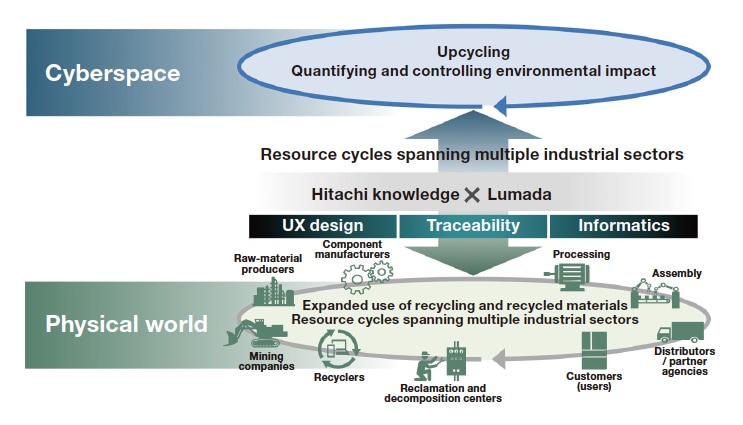
Fig. 3 R&D initiatives targeting circular economies through digital activity.
We begin by discussing our initiatives related to life-cycle management. As noted above, the key challenge is to make effective use of limited resources to satisfy a diverse array of user needs. This includes, for example, providing products and services that users will want to use for many years, as well as implementing circulation networks in which making effective use of circulated items becomes easy and automatic; ultimately, the challenge is to create environmental and economic value simultaneously. The basic approaches to achieving circular economies involve techniques for using products and components as they are whenever possible; of these, we will here distinguish and discuss two approaches in particular: recycle (the "1 R") and reuse, repair, and remanufacture (the "3 Rs") (Figure 4).
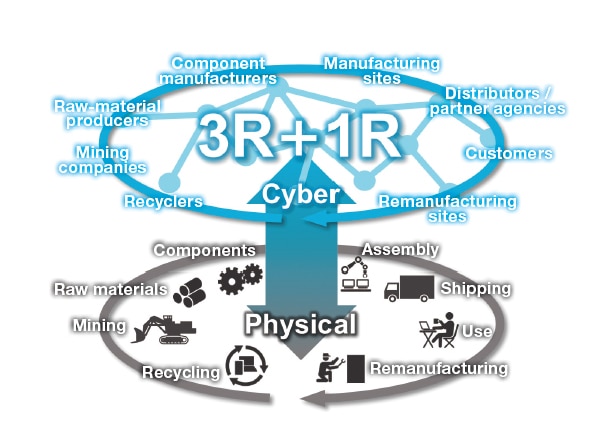
Fig. 4 Life-cycle management.
Among the 4 Rs, the question of which circularity strategies are most appropriate for a given situation depends on many interrelated factors and is extremely complicated. To this end, we will provide solutions for measuring, visualizing, and controlling data—including circularity, carbon emissions, and cost—throughout entire life cycles, thus facilitating resource circulation while minimizing energy consumption for society as a whole. Our Circular-Scenario Generation Solutions initiative will advise customers on quantifying carbon emissions and costs throughout product life cycles and implementing optimal circulation scenarios. The central challenge in this effort is to empower customers to select product-circularity strategies that are optimal from the perspectives of cost and carbon emission.
The solution we chose to implement is a service for recommending customized circularity scenarios to customers, based on automated calculations of cost and CO2 emissions over entire product life-cycles and accounting for variations in products and markets (Figure 5). The core technology auto-generates circularity scenarios based on product, data, and performance insights gleaned from multiple inputs, including: BOM / BOP data resulting from product designs, supplier primary data, performance data reflecting operation and maintenance track records, and environmental base units. For example, we might estimate the cost required for a customer to implement product renewal, then optimize hypothetical scenarios and present a timeline for the renewal effort that reduces CO2 while accounting for associated economic costs.
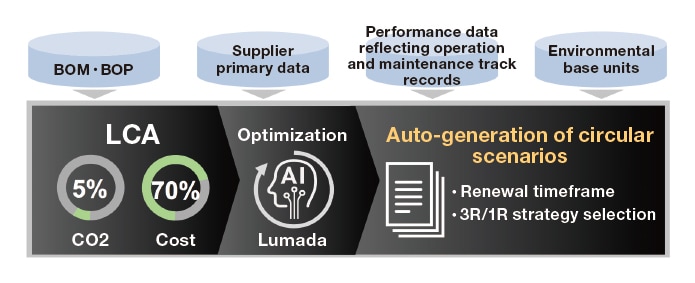
Fig. 5 Our solution for auto-generating circular scenarios.
We next discuss strategies for upcycling (Figure 6) and present practical case studies illustrating this technique. Product upcycling is a more sophisticated version of the conventional paradigm known as reuse, repair, remanufacture; the idea is to combine high-precision measurement and diagnosis of recovered products and components with precision processing techniques to achieve recycling with upgraded capabilities (Section 4-1).
Similarly, material upcycling is a more sophisticated version of conventional recycling. Modern user-experience(UX) design techniques, in combination with methods of informatics, can enhance the value of recycled materials and expand their range of applicability; our exploration of this approach began with applications to in-house products(Section 4-2).
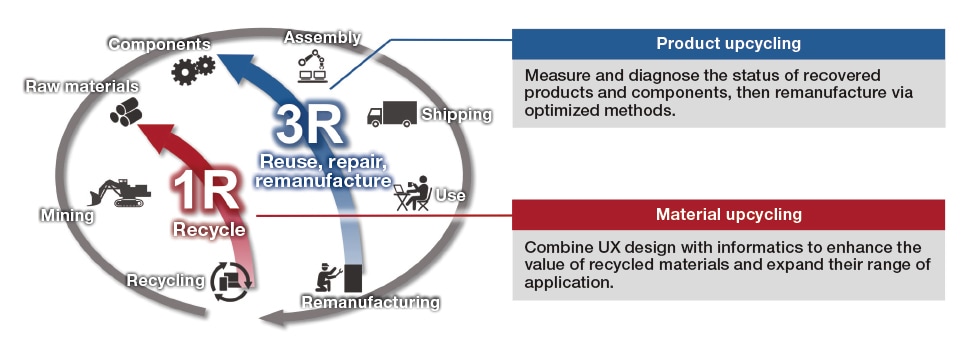
Fig. 6 Upcycling strategies.
Upcycling at the product level, or at the component level, requires diagnostic tools and regeneration processes for recovered components.
High-precision measurement and diagnostic techniques: The interior structures of hydraulic devices and engine components for automobiles, aircraft, or construction machinery often involve fluid-flow surfaces, or sliding surfaces, designed with intricate patterns of small, closely-spaced holes. Because the inner-wall structures of these holes can directly affect system uptime and energy efficiency, their quality control is of particular importance; however, the structures of these miniature hole patterns are difficult to measure by conventional methods. For this reason, Hitachi developed a technique capable of high-precision non-contact measurement of the 3D morphologies of miniature hole patterns11). In addition to quality control for components with miniature hole patterns—which directly affect product performance—this technique enables diagnosis of recovered components, a necessary prerequisite for circular economies. By irradiating the target component with light and rotationally scanning a sensing probe, Hitachi's technique measures 3D morphologies of miniature hole patterns (Figure 7).
In the future, we hope to use measurement results obtained with this technique to improve production processes, reducing waste by increasing yield. We also note that measurement and diagnosis of recovered products and components opens the door to further advances in recovery processes, reducing environmental impact across entire product lifecycles and helping to achieve sustainable societies.
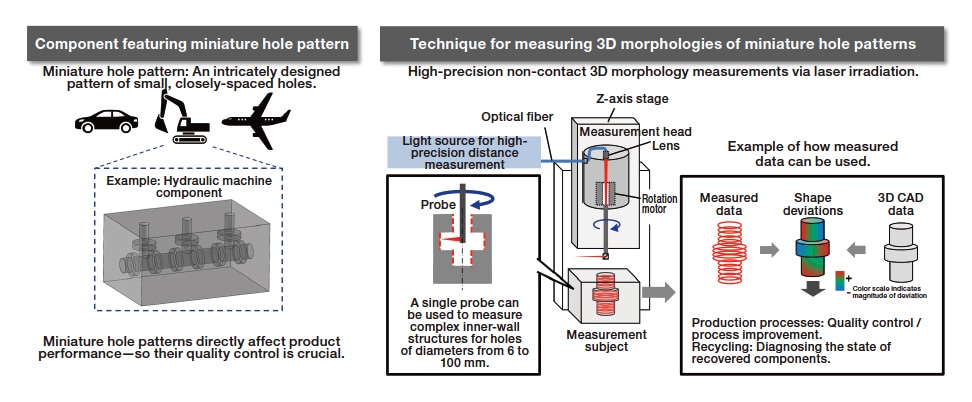
Fig. 7 High-precision measurement and diagnostic technique10b).
As a first target of our material-upcycling efforts, we chose to focus on plastics. The consequences of large-scale consumption of plastics, which include greenhouse-gas emissions, depletion of fossil-fuel resources, and environmental pollution, are widely recognized as major problems that increase the risk of transgressing planetary boundaries, spurring worldwide efforts to promote plastic recycling. Because recycled plastics are produced from a broad variety of waste products, they require techniques for reducing the variations in material quality and coloration expected for recycled materials. We propose to address this issue by fusing quality controls for materials and products with design techniques capable of imparting a sense of luxury, thus replacing the conventional goal of hiding defects with the new strategy of decorating them. To this end, we are combining design with manufacturing informatics to make effective use of recycled plastics (Figure 8); as one example, we have used recycled plastics to define the external appearance of Hitachi products12).
Using sensors installed on injection molds for recycled materials, we successfully extracted features for use in machine learning and demonstrated that the quality of products formed from recycled materials with varying properties can be automatically stabilized13). We are applying digital technologies to advance the use of process informatics for injecting molding of recycled plastics. In general, making effective use of recycled materials is difficult because the properties of the materials may vary significantly from one lot to the next; for the specific case of products formed from plastics, this problem has typically required expert process engineers to fine-tune process conditions by hand based on the properties of the recycled input materials, making the process difficult to implement in practice. Hitachi has addressed this problem by developing an AI technique that automatically optimizes formation conditions for recycled plastics (Figure 9).
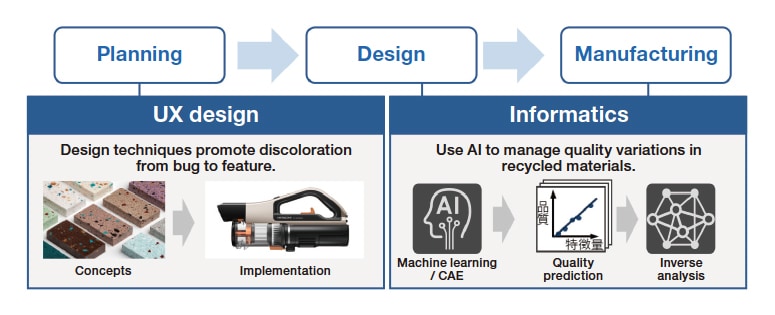
Fig. 8 Solution combining UX design with informatics.
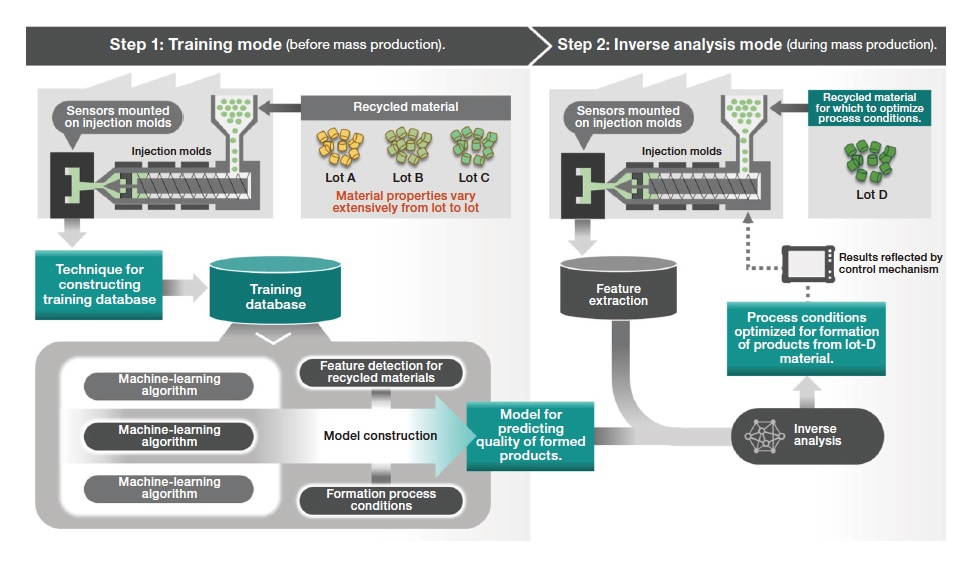
Fig. 9 Machine-learning technique for automatically determining optimal formation conditions.
This article has described our efforts to implement circular economy innovations that maximize the life-cycle value of resources while minimizing energy consumption. We are developing both life-cycle management systems—for modeling circulation networks in cyberspace and monitoring and controlling flows of resources and data—and upcycling techniques for increasing the value of resources on each iteration through the circulation loop. Together with the Hitachi-AIST Circular Economy Cooperative Research Laboratory, founded in October 2022, we are working to advance the goals of adopting grand designs for circular-economy societies, developing digital solutions, and drafting policies and proposing strategies for standardization. Going forward, we remain committed to meeting the challenge of building circular economies capable of simultaneously delivering economic and environmental value.
Acknowledgements
It is a pleasure to offer our deepest gratitude to the researchers of the Production Engineering and MONOZUKURI Innovation Center within the Research & Development Group of Hitachi, Ltd., whose diligence and dedication are responsible for the technologies presented in this article.
References
See more