
Katsuhiko Naoi
PhD
Professor Emeritus, Specially Appointed Professor
Tokyo University of Agriculture and Technology
The rapid rise of generative artificial intelligence has triggered an unprecedented expansion of AI-focused data centers worldwide. At the heart of this transformation are GPU processors, which demand not only large amounts of energy but, more critically, extremely high instantaneous power density delivered repeatedly and reliably. During both training and inference, GPUs generate sharp, recurrent power surges associated with parallel computation,memory access, and rapid switching. These power spikes are accompanied by harsh thermal environments, with local temperatures often approaching operational limits. Under such conditions, conventional energy-storage devices—designed primarily for capacity rather than power—are fundamentally mismatched to the task. What is required is not simply another battery, but a power facilitator integrated directly into the power architecture of GPU racks: a device capable of instantaneously delivering large spike currents, stabilizing voltage fluctuations, and relieving stress on the upstream power supply. In effect, such a device functions as an “artificial heart” for AI systems, supplying rapid bursts of power exactly when demanded and recovering energy just as quickly once the load subsides. This need is not confined to data centers alone. Similar transient power demands arise across a wide range of emerging technologies, including high-speed robotic actuation, catenary-free electric trams operating without overhead lines, drone take-off and vertical propulsion, and sudden-load scenarios in satellite communications and space platforms. In each case, the ability to deliver ultrafast, repeatable power pulses with high reliability is paramount. Importantly, industrial demand for such solutions is both concrete and immediate, with many companies actively seeking deployable technologies rather than speculative concepts. Thus, the development of ultrafast redox materials represents not merely an academic challenge, but a strategically important initiative with a clear and realistic path toward societal implementation.
Addressing these challenges requires a research framework that transcends traditional boundaries between academia and industry. To this end, we have established a bidirectional collaboration model in which industrial expertise is systematically translated into academic understanding, while fundamental discoveries made at the university are rapidly transferred back into practical development. In this framework, empirical know-how accumulated through industrial experience is reconstructed into scientific principles, enabling deeper insight into why certain technologies succeed, while academic advances are immediately evaluated through the lens of manufacturability, scalability, and real-world performance.
A central outcome of this approach is the development of proprietary nanocomposite processing technologies by K&W Inc., a startup company originating from Tokyo University of Agriculture and Technology. Among these technologies, Ultracentrifugation (UC) has emerged as a powerful and versatile method for fabricating ultrafast redox nanocomposite materials. UC applies an extremely strong centrifugal field—up to 75,000 G—to liquid suspensions containing carbon nanotubes, enabling the mechanical separation of strongly bundled structures such as single-walled carbon nanotubes (SWCNTs). Unlike conventional dispersion techniques that rely on aggressive chemical treatments or excessive sonication, UC disentangles nanotube bundles without introducing structural damage, thereby preserving the intrinsic electrical conductivity and mechanical integrity of the SWCNTs.
Beyond simple dispersion, UC reveals a deeper and more unexpected functionality. When metal-oxide precursors—for example, those used to synthesize lithium titanate (Li4Ti5O12, LTO)—are introduced into a well-dispersed SWCNT suspension, chemical reactions preferentially occur on the nanotube surfaces. The high surface energy and abundant reaction sites of the disentangled SWCNT network promote localized nucleation, resulting in the uniform formation of nanoscale precursor particles anchored directly onto the nanotubes. In this process, SWCNTs serve multiple roles simultaneously. They act as highly conductive electron highways, structural scaffolds that prevent nanoparticle agglomeration, and reactive platforms that guide the spatial distribution of precursor species. This multifunctional behavior enables the formation of highly homogeneous nanocomposites, in which redox-active materials are intimately integrated with a continuous conductive network at the nanometer scale. To convert these precursor-decorated nanotubes into functional crystalline materials, we employ a rapid flash annealing process. By briefly exposing the nanocomposites to elevated temperatures for extremely short durations, amorphous precursors are transformed into highly crystalline LTO while suppressing excessive grain growth. Maintaining small particle sizes is essential, as lithium-ion diffusion lengths scale directly with crystallite dimensions, and oversized particles inevitably lead to sluggish kinetics. The resulting nanostructures exhibit distinctive morphologies, including thin plate-like nanosheets and three-dimensional “nanobook” architectures. These forms are not incidental; rather, they reflect a balance between surface energy, crystallographic anisotropy, and confinement by the SWCNT network. Critically, these architectures provide short diffusion pathways for lithium ions, continuous electronic conduction, and excellent electrolyte accessibility—all key requirements for ultrafast electrochemical response.
Electrodes fabricated from these UC-derived nanohybrid materials demonstrate outstanding performance characteristics. They can be charged and discharged at rates hundreds to over a thousand times faster than those of conventional battery electrodes, while maintaining structural and electrochemical stability over more than 100,000 cycles. Such performance bridges the traditional gap between batteries and capacitors, enabling hybrid devices that combine the energy density of redox systems with the power density and durability of electrochemical capacitors. This combination of ultrahigh rate capability and long cycle life is particularly critical for applications involving repetitive power spikes, where devices may experience millions of shallow charges–discharge events over their operational lifetime. In such regimes, conventional batteries suffer from rapid degradation, while purely capacitive systems lack sufficient energy density. Ultrafast redox nanocomposites offer a compelling alternative by operating efficiently in this intermediate yet strategically important domain.
To gain deeper insight into the formation mechanisms underlying these materials, we employed high-resolution transmission electron microscopy (HRTEM) to observe crystallization processes in real time. Using a specially designed heating holder, we directly visualized the transformation of precursor material into crystalline LTO within the SWCNT network. These experiments required exceptional experimental control, including precise regulation of temperature, electron-beam intensity, and electrical current for heating W-wire, to avoid beam-induced artifacts while maintaining sufficient temporal resolution. Despite these challenges, we successfully captured time-resolved image sequences showing crystal nucleation and growth occurring within seconds. One of the most striking findings is that crystallization proceeds at significantly lower temperatures and on much shorter timescales than in conventional solid-state synthesis. Whereas traditional LTO preparation typically requires prolonged heat treatment at temperatures approaching 900 °C, our approach achieves crystallization at approximately 670 °C in less than one minute, without sacrificing crystallinity or size uniformity. This observation highlights the profound impact of nanoscale confinement, interfacial chemistry, and rapid thermal processing on phase formation kinetics. It also underscores the importance of direct observation in understanding and rationally designing advanced nanomaterials. These results demonstrate a viable pathway for transforming nanoscale redox materials into robust, high-performance building blocks for next-generation power architectures. By integrating ultrafast ion transport, continuous electronic conduction, and long-term structural stability, UC-derived nanocomposites enable energy-storage systems capable of responding instantaneously to power demands while maintaining reliability over extended lifetimes.
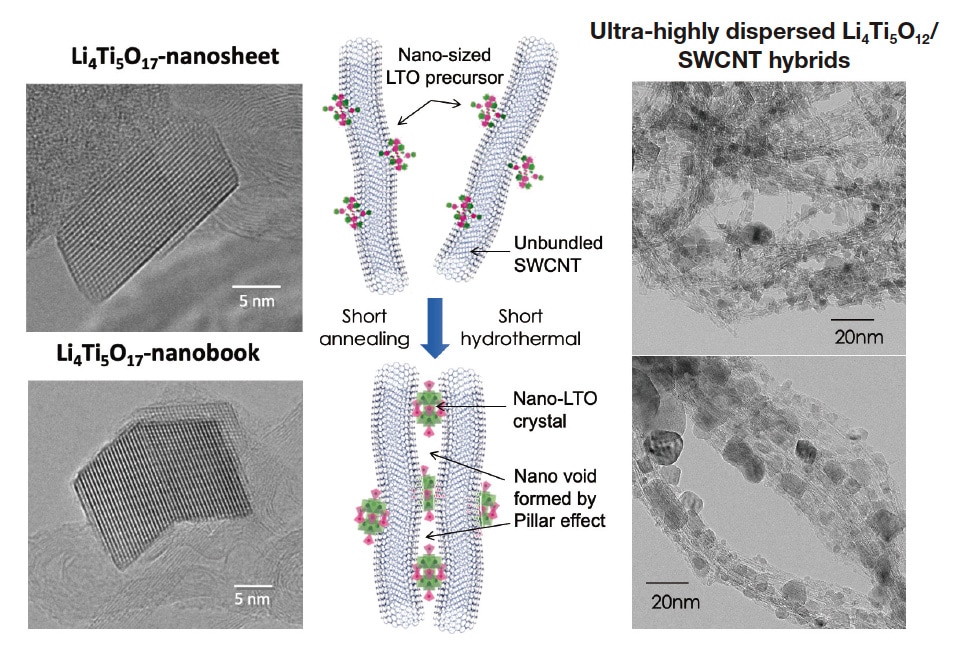
Fig. 1 TEM images acquired using a Hitachi H-9500 transmission electron microscope. Left: Spinel-structured lithium titanate (LTO, Li4Ti5O12 ) crystals synthesized via ultracentrifugation-based nanohybridization. Distinct crystallization conditions yield clearly differentiated morphologies: a two-dimensionally grown nanosheet structure (upper) and a non-planar, folded “nanobook” structure (lower), both unambiguously resolved in the TEM images. Right: TEM images of carbon materials precision-hybridized with nanometer-scale spatial control. The resulting LTO/SWCNT hybrid architecture enables crystallization of the LTO precursor without any accompanying particle-size growth. Consequently, the particle coarsening traditionally regarded as unavoidable during thermal treatment is completely suppressed, yielding structurally stable LTO crystals that retain nanometer-scale dimensions.
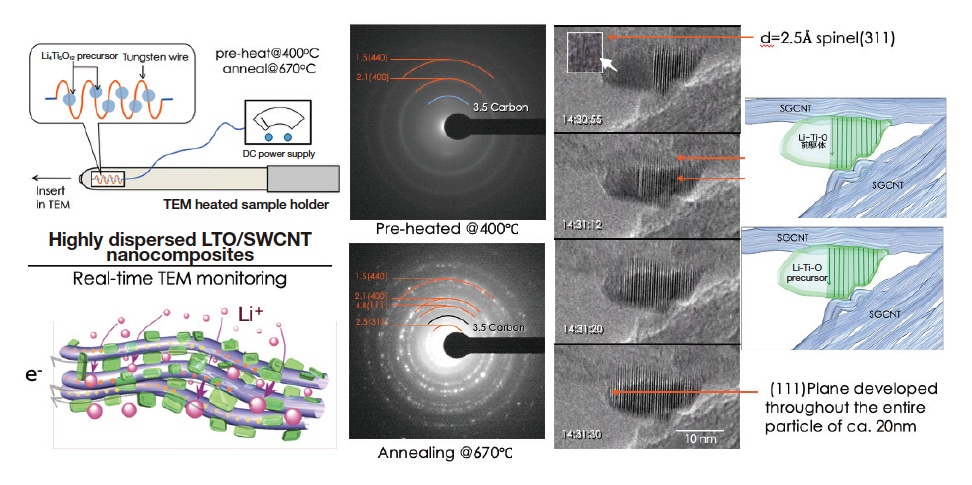
Fig. 2 Time-resolved TEM images, recorded at 10-s intervals during the annealing stage at 670 °C, reveal the dynamic crystallization of nanometer-scale spinel-structured lithium titanate (Li4Ti5O12) from a precursor preheated at 400 °C. The images capture the progressive nucleation and growth of LTO nanocrystals within a high-density, percolating network of single-walled carbon nanotubes (SWCNTs), which provides intimate electronic contact during crystallization. These in situ observations were enabled by a heated TEM sample holder and acquired using a Hitachi H-9500 transmission electron microscope. Image acquisition was performed by Wako Naoi (K&W Inc.), with technical guidance provided by Takeo Ueno (Hitachi High-Tech).
Spinel Li4Ti5O12 (LTO) has long been recognized as a model anode material for high-power electrochemical energy-storage systems due to its unique zero-strain lithium insertion mechanism, flat operating potential, and excellent thermal and structural stability. These advantages make LTO particularly attractive for applications requiring long cycle life and high safety margins. Nevertheless, the practical deployment of LTO in ultrafast charge–discharge systems has been severely constrained by its intrinsically poor electronic conductivity, which originates from its wide band gap and the localized nature of Ti3+/Ti4+ redox states within the spinel lattice. Conventionally, this limitation has been addressed through the addition of conductive carbon additives or metallic coatings; however, such approaches inevitably dilute the active material content and introduce interfacial resistances that limit rate performance.
Here, we propose a fundamentally different concept, termed “structural conductivity enhancement”, in which the LTO crystals themselves are transformed into electronically conductive entities. Rather than externally supplying conductive pathways, this strategy directly modifies the crystal surface and near-surface structure of LTO to generate intrinsic electronic conduction channels while preserving the bulk spinel framework responsible for zero-strain Li-storage behavior. The key to this approach lies in the preparation of well-defined nanohybrid architectures, in which two-dimensional LTO nanosheet crystals are intimately hybridized with carbon materials in precisely controlled configurations. Subsequent high-temperature treatment of these nanocomposites triggers a coupled sequence of physicochemical processes at the LTO edge–carbon interface. Partial combustive loss of carbon occurs preferentially at contact points, while the carbon simultaneously acts as a local reducing agent. This interfacial redox environment promotes the selective extraction of lattice oxygen from the LTO surface, leading to the formation of oxygen-vacancy defects concentrated at energetically favorable regions, particularly along nanosheet edges and defect-rich facets.
As the oxygen-vacancy concentration increases locally, portions of the LTO spinel lattice undergo structural reconstruction. This reconstruction is accompanied by a partial reduction of Ti4+ to lower-valence states and a transition from the insulating spinel structure toward electrically conductive Magnéli-type phases (Figure 3). Importantly, this transformation is spatially confined to edge regions, while the interior of the LTO crystals remains structurally intact. As a result, the fundamental advantages of LTO—zero strain, structural robustness, and thermal stability—are retained, while a highly conductive surface network is simultaneously established. Magnéli phases are a well-known class of nonstoichiometric transition-metal oxides characterized by ordered crystallographic shear planes arising from periodic oxygen vacancies. In titanium oxides, these phases are typically described by the general formula TinO2n-1 (4 ≤ n ≤ 10), with representative examples including Ti4O7, Ti5O9, and Ti6O11. Among them, Ti4O7 is particularly notable for its metallic-like conductivity, which can reach values comparable to those of carbonaceous materials. The in-situ formation of such Magnéli phases along the edges of two-dimensional LTO crystals creates continuous electronic conduction pathways that are crystallographically integrated with the active material itself.
This edge-engineered Magnéli-phase network effectively eliminates the need for external conductivity-enhancing agents, reducing inactive mass while minimizing interfacial resistance. Moreover, because the conductive domains are chemically bonded to and crystallographically coherent with the LTO host, electron transport to redox-active Ti sites is highly efficient, even under extreme current densities. This structural conductivity enhancement thus provides a powerful route to unlock the intrinsic high-rate capability of LTO, transforming it from a kinetically limited insertion compound into a viable ultrafast redox material suitable for next-generation hybrid supercapacitors and power-assist energy-storage devices.
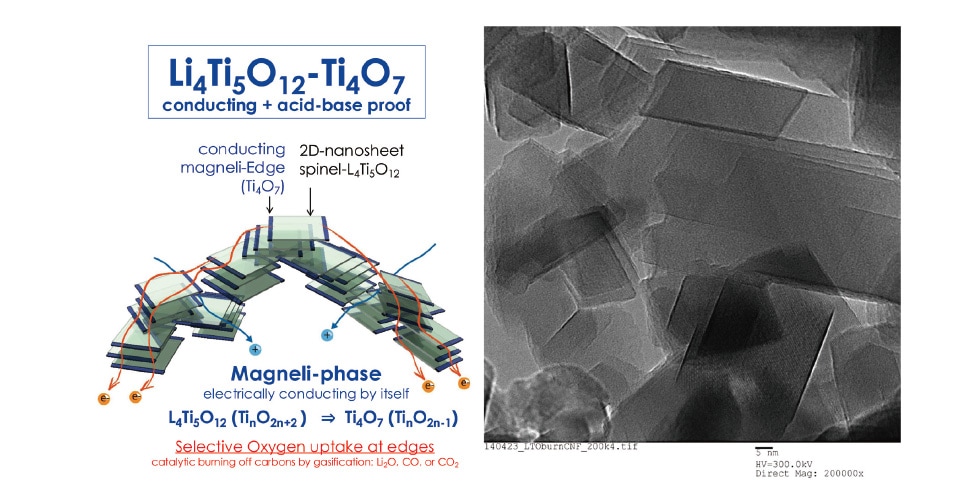
Fig. 3 Schematic illustration of the strategy used to impart high electronic conductivity to intrinsically insulating LTO. Nanohybrid architectures are first prepared by precision hybridization of two-dimensional LTO nanosheet crystals with carbon materials. Subsequent high-temperature annealing induces localized chemical reduction at the LTO–carbon interfaces, leading to the preferential generation of oxygen vacancies at crystal along edge regions. The associated change in the effective titanium valence triggers partial reconstruction of the spinel lattice and the in-situ formation of an electrically conductive Magnéli phase (Ti4O7). This phase, structurally intermediate between TiO2 and metallic Ti, provides highly efficient electronic conduction paths directly integrated into the LTO crystal, thereby eliminating the need for external conductive additives.
Further compelling evidence supporting the above mechanism is provided by X-ray absorption fine-structure (XAFS) analysis. Conversion-electron-yield (CEY) spectra acquired at a low X-ray incidence angle (10°) reveal a distinct signature of oxygen-vacancy formation localized at the crystal surface, providing direct and unambiguous evidence for both the generation and the spatial confinement of Magnéli phases. CEY-XAS is a surface-sensitive variant of X-ray absorption spectroscopy that selectively probes the near-surface region of materials, typically within a depth of only a few nanometers. Its exceptional surface sensitivity arises from the detection of low-energy electrons—primarily Auger electrons and secondary electrons—emitted following inner-shell excitation by incident X-rays. Because these electrons escape from the sample without undergoing significant inelastic scattering, their detection intrinsically suppresses bulk contributions. As a result, CEY-mode measurements provide substantially higher surface sensitivity than conventional transmission or fluorescence-yield XAS, making this technique particularly well suited for resolving nanoscale structural and electronic variations at surfaces and interfaces. In the present study, Ti K-edge X-ray absorption spectra acquired in CEY mode clearly capture both the characteristic oxygen-vacancy–related spectral features and a measurable reduction in the effective titanium valence from Ti4+ toward Ti3+. These observations are fully consistent with the formation of Ti4O7-type Magnéli phases confined to the surface region of Li4Ti5O12 (LTO) crystals. The localized nature of this phase transformation confirms that the bulk spinel structure of LTO remains intact, while electronically conductive domains are selectively introduced at the surface.
These spectroscopic insights are further corroborated by high-resolution scanning transmission electron microscopy (STEM). As shown in the dark-field image in the right panel of Figure 4, acquired using a spherical-aberrationcorrected JEOL ARM-300F microscope, nanoscale Ti4O7 strips are directly observed at the edges of LTO nanosheet crystals. These conductive domains exhibit thicknesses on the order of 5–7 atomic layers and extend continuously along edge regions, providing direct structural evidence for the formation of coherent Magnéli-phase networks integrated with the LTO host lattice. The concept of structural conductivity enhancement (SCE) fundamentally simplifies electrode design by enabling a single active-material body to simultaneously exhibit high electronic conductivity and outstanding electrochemical activity, without the need for external conductivity-enhancing additives.
To evaluate the intrinsic electrochemical behavior of Magnéli-enhanced LTO, cyclic voltammetry measurements were performed using cavity microelectrodes (CMEs). This technique allows direct assessment of the electrochemical properties of powder materials by eliminating the influence of binders, conductive additives, and composite electrode architectures. As shown in Figure 5, the CME measurements reveal exceptionally high-rate capability. Stable voltammograms with sharp and well-defined redox peaks are maintained over an extremely wide scan-rate window, ranging from 10 up to 2000 mV s-1, corresponding to ultrafast charge–discharge conditions. Remarkably, this high-rate performance is achieved without any detectable loss of capacity or peak distortion, underscoring the effectiveness of the Magnéli-phase network in facilitating rapid electron transport. These results strongly indicate that surface-integrated Magnéli phases function as efficient electronic conduction networks, accelerating interfacial charge-transfer reactions and simultaneously promoting lithium-ion diffusion at LTO surfaces. This dual enhancement of electronic and ionic transport represents a decisive departure from conventional hybrid electrode strategies and points toward a new class of intrinsically conductive redox crystals. While the present discussion focuses on LTO, the Magnéli-phase–based structural conductivity enhancement strategy is broadly applicable to a wide range of transition-metal oxides, including titanium- and vanadium-based systems. As such, SCE has the potential to become a general design principle for next-generation energy-storage materials, enabling ultrafast kinetics without sacrificing structural integrity or long-term stability.
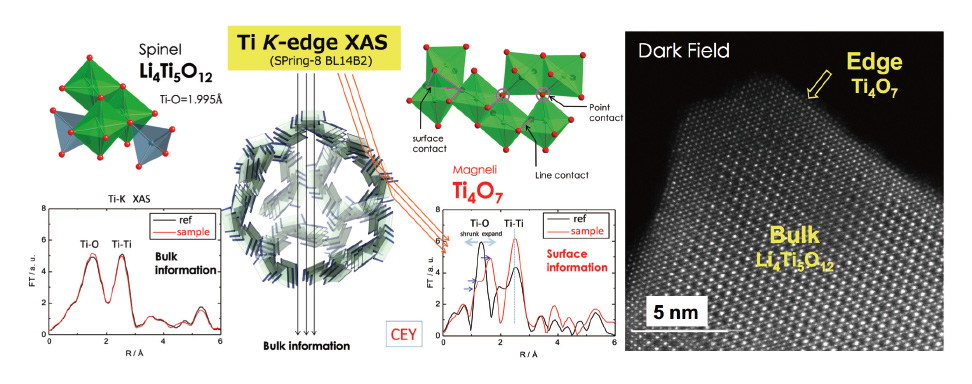
Fig. 4 Left: Schematic of the experimental configuration used for Ti K-edge X-ray absorption spectroscopy (XAS) measurements. The surface-sensitive XAS spectra reveal distinct local structural variations associated with the formation of Magnéli phases. Analysis of Ti–O and Ti–Ti interatomic distances clearly distinguish surface-modified regions from the bulk spinel lattice, confirming the presence of a Ti4O7 Magnéli layer localized near the crystal surface. Right: Dark-field scanning transmission electron microscopy (STEM) image of a Magnéli–LTO sample, acquired using a spherical-aberration-corrected JEOL ARM-300F system. High-contrast, nanometer-scale Magnéli layers are directly observed along the edges of Li4Ti5O12 crystals, providing visual confirmation of the surface-confined formation of conductive Magnéli domains.
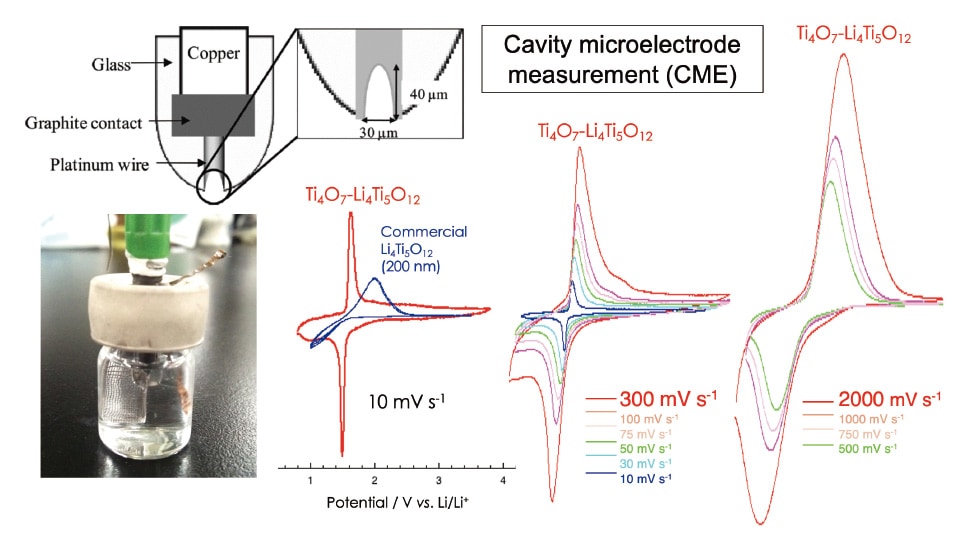
Fig. 5 Cyclic voltammograms acquired using cavity microelectrodes (CMEs) filled exclusively with active material powders, without the use of binders or conductivity-enhancing additives. This configuration ensures that the measured response reflects the intrinsic electrochemical behavior of the material. Stable and well-defined redox peaks are preserved over an exceptionally wide range of scan rates, from 10 to 2000 mV s-1, encompassing ultrafast charge–discharge conditions. The retention of sharp redox features even at the highest scan rates directly demonstrates that the Ti4O7 Magnéli layers formed at the edges of Li4Ti5O12 crystals provide highly efficient electronic conduction pathways, enabling rapid electron transport and outstanding rate capability.
The structural conductivity enhancement strategy introduced in the preceding section—based on the selective formation of surface-confined Magnéli layers—enables a fundamental simplification of capacitor electrode architecture. By endowing the active material itself with high electronic conductivity, this approach eliminates the conventional dependence on external conductive additives, thereby preserving the intrinsic electrochemical advantages of the host material while reducing structural complexity. For capacitor designers, this represents a decisive shift: performance gains are achieved not through increasingly elaborate composite electrodes, but through intrinsic functionality embedded within the redox crystal itself.
This conceptual advance directly motivated the development of a new class of hybrid energy-storage devices, termed the nanohybrid capacitor (NHC), schematically illustrated in Figure 6. In the NHC configuration, a structurally conductive LTO/Ti4O7 serves as the anode, paired with an activated-carbon cathode (YP-50) and an LiBF4/propylene carbonate (PC) electrolyte. The integration of a Magnéli-phase–enhanced insertion anode with a high-surface-area capacitive cathode enables efficient charge storage across complementary time and energy scales. As a result, the NHC delivers an energy density approximately three times higher than that of conventional electric double-layer capacitors (EDLCs), while simultaneously maintaining exceptional power capability. Notably, the device supports ultrafast operation at 300 C, corresponding to full charge–discharge cycles within 12 s. This combination of high energy density and ultrafast kinetics exemplifies the evolutionary transition from materials-level innovation to device-level functionality and underscores the potential of structurally conductive redox crystals as a foundation for next-generation hybrid capacitors.
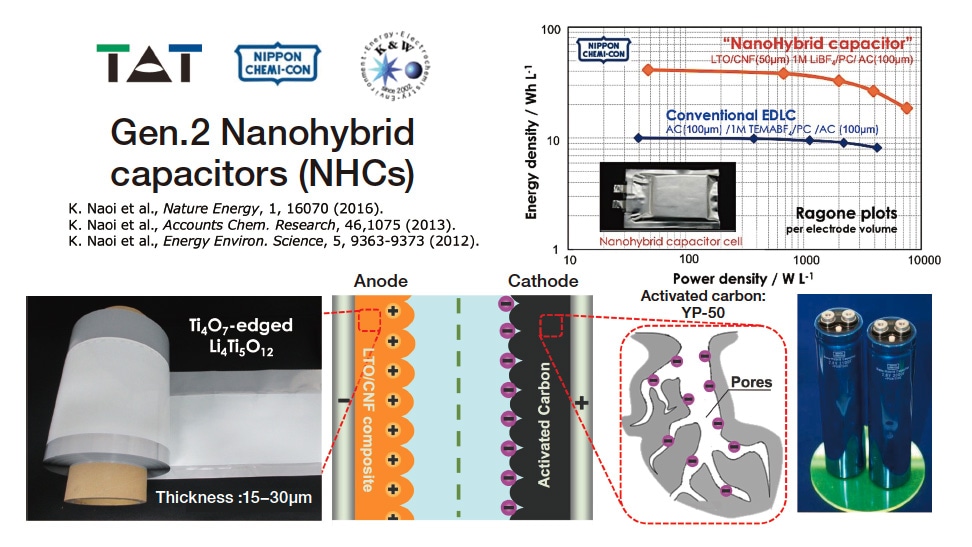
Fig. 6 In 2009, we developed the world’s first hybrid capacitor system, termed the nanohybrid capacitor (NHC). The NHC integrates an activated-carbon cathode with an electrically conductive Li4Ti5O12/Ti4O7 nanohybrid anode and an LiBF4/propylene carbonate (PC) electrolyte. By combining capacitive charge storage with fast insertion-type redox reactions enabled by the Magnéli-phase–enhanced anode, the NHC achieves energy densities approximately three times higher than those of conventional electric double-layer capacitors (EDLCs), while retaining ultrahigh-rate capability. Notably, stable operation is demonstrated at 300 C, corresponding to full charge–discharge cycles of approximately 12 s.
Having successfully demonstrated the high performance of nanohybrid capacitors (NHCs), we next turned our attention to the far more demanding challenge of establishing practical routes toward large-scale production. It soon became evident that translating laboratory-scale success into manufacturable technology posed a series of formidable technological and industrial barriers. Key challenges included achieving uniform dispersion of nanoparticles, suppressing undesired crystal growth during processing, ensuring robust interfacial compatibility between active materials and conductive matrices, precisely controlling slurry viscosity, and maintaining electrode integrity during coating and post-processing. Collectively, these issues underscored the complexity of scaling hybrid electrode materials and highlighted the inadequacy of conventional manufacturing approaches. The magnitude of these challenges prompted the formation of a dedicated industry–academia consortium to address them systematically. This tripartite collaboration, comprising Tokyo University of Agriculture and Technology, Nippon Chemi-Con Corporation, and K&W Inc., was supported by the Japan Science and Technology Agency under the NexTEP program (2013–2018). The central objective of the consortium was the development of scalable, continuous mass-production technologies for LTO–carbon hybrid electrode materials. As a first step, a pilot-scale production facility was designed and constructed to enable continuous synthesis and processing under industrially relevant conditions.
Beyond the immediate goal of fabricating capacitor cells suitable for practical deployment, this initiative also provided an early opportunity to explore system-level integration of NHCs with renewable solar energy sources. In parallel with a national demonstration program led by Japan’s Ministry of the Environment focused on CO2 reduction (2018–2020), we undertook the development of a proof-of-concept distributed energy system designed for stable, continuous operation under arbitrary environmental conditions—an “all-weather, all-season, all-terrain, all-region” energy platform. In this system, solar power generation was directly coupled with energy storage using NHCs based on nanohybrid electrode materials. Even extremely small and fluctuating amounts of electrical energy harvested from sunlight could be captured and stored almost instantaneously in the NHC, effectively eliminating energy loss due to leakage. The rapid response and high efficiency of the power-conversion architecture enabled stable operation despite rapidly changing weather conditions, transient shading, or other environmental disturbances. As a result, the integrated system achieved an average improvement in overall energy-conversion efficiency of approximately 10–15%, demonstrating the practical advantages of nanohybrid capacitors not only at the device level, but also within real-world energy systems.
In 2012, we established Japan’s first research Lab. devoted exclusively to capacitor science: “Advanced Capacitor Research Center” at Tokyo University of Agriculture and Technology. Since its founding, the Center has actively pursued collaborative research across academia, industry, and government, as well as international partnerships, with the shared objective of creating fundamentally new energy-storage materials and translating them into practical technologies. Many of the innovations described in this report—including those underpinning nanohybrid capacitors and structurally conductive redox crystals—were realized only through sustained support from Japanese public agencies such as JST, NEDO, and the Ministry of the Environment, in close cooperation with private-sector partners. Through these collaborations, we have consistently found that industrial and governmental perspectives offer insights that are difficult to obtain from academic literature alone, encompassing not only process constraints and reliability requirements, but also development histories that shape real-world feasibility. Such interactions have repeatedly informed our research direction and, in some cases, led directly to unexpected breakthroughs.
A representative example is our discovery of Magnéli-phase formation on Li4Ti5O12 crystal surfaces. This phenomenon was initially observed as the unintended outcome of a processing error: a sample intended for sintering under N2 atmosphere was inadvertently sintered in air. The resulting combustion-driven loss of carbon led to localized oxygen deficiency at the LTO surface and, unexpectedly, to the formation of Magnéli phases. Subsequent investigation revealed that this surface structure—despite originating as an apparent byproduct—plays a crucial functional role by suppressing self-discharge (state-of-charge shift) processes. Specifically, it inhibits lithium migration from LTO into adjacent carbon domains, a well-known interfacial degradation pathway in carbon-hybrid electrodes. This serendipitous finding ultimately catalyzed major advances in our understanding and control of functional oxide–carbon interfaces and became a cornerstone of the structural conductivity enhancement strategy described in this report. More broadly, it illustrates a recurring theme in materials innovation: carefully observed “failures” and trial-and-error experiments often become the seeds of transformative technologies. In the context of next-generation energy-storage devices, such moments of insight—when combined with collaborative effort and systematic refinement—can redefine both materials design and device architecture.
References
See more