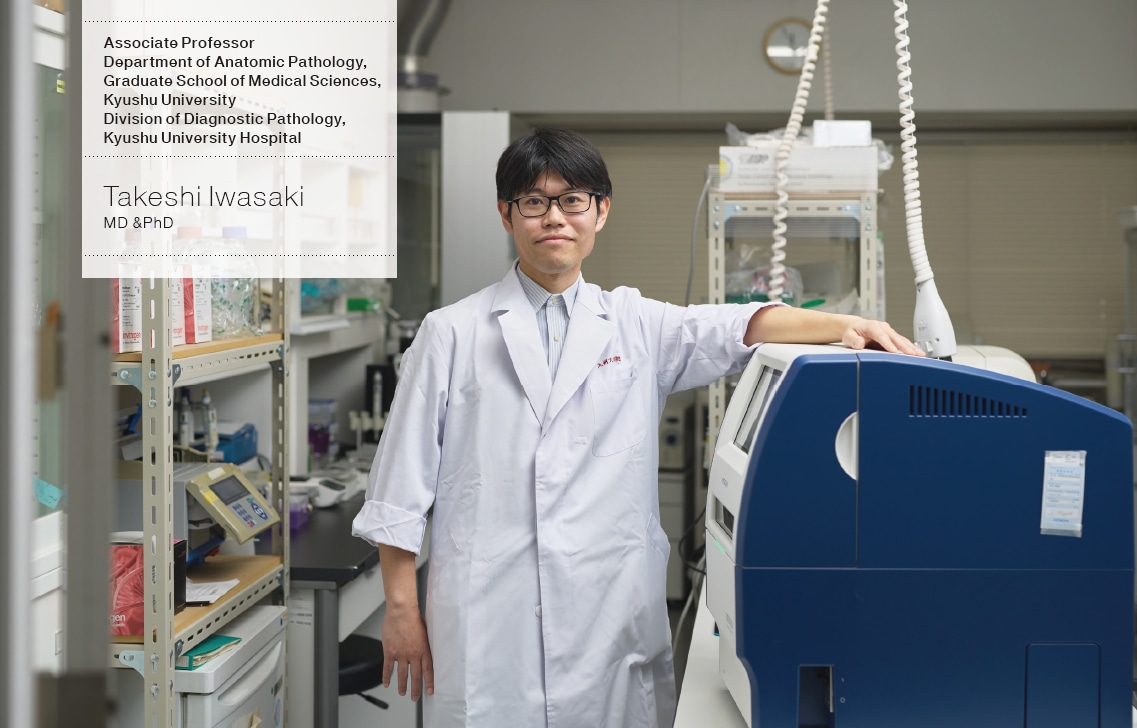
Investigators at the Graduate School of Medical Sciences of Kyushu University are working to characterize diseases and improve diagnostic procedures and treatments with the goal of providing optimal care for patients. As part of this work, the graduate school’s Department of Anatomic Pathology is studying bone and soft-tissue tumors. Malignant bone and soft-tissue tumors are called sarcomas. Due to their rarity and diverse histological features, investigating their genetic alterations is a key element in the development of pathological diagnostic procedures and treatments. We interviewed Associate Professor Takeshi Iwasaki of the Department of Anatomic Pathology, who conducts experiments and extracts data with the goal of developing accurate diagnostic procedures and appropriate treatments.
Associate Professor
Department of Anatomic Pathology,
Graduate School of Medical Sciences,
Kyushu University
Division of Diagnostic Pathology,
Kyushu University Hospital
Takeshi Iwasaki
MD & PhD
Bone and soft-tissue tumors generally refer to tumors of mesenchymal tissues such as bone, muscle, adipose tissue, nerves, and blood vessels. To most people, the terms “cancer” and “tumor” are typically associated with epithelial cancers such as colon and gastric cancer, which differ significantly from bone and soft-tissue tumors in their characteristics.
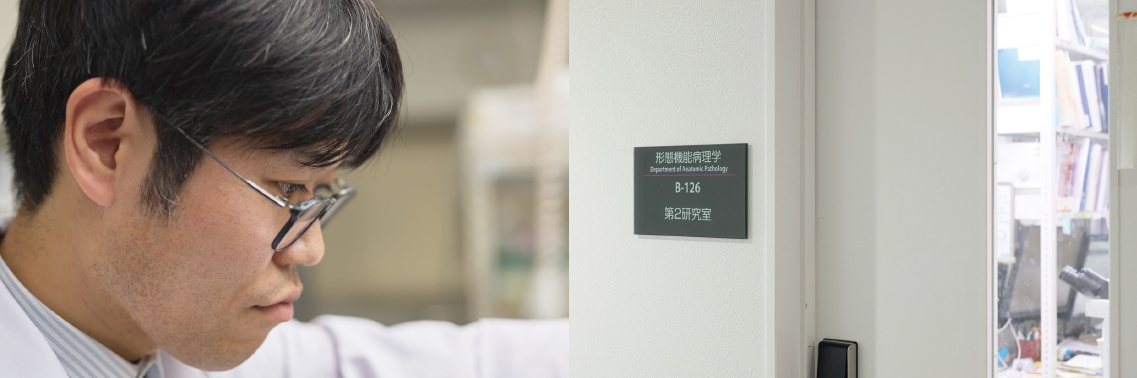
Associate Professor Takeshi Iwasaki, who specializes in bone and soft-tissue tumors in the Department of Anatomic Pathology of Kyushu University’s Graduate School of Medical Sciences, notes, “Colon cancer is often diagnosed based only on microscopy of affected tissue, but bone and soft-tissue tumors are notoriously difficult to diagnose accurately.” Their diverse histological features mean that they can rarely be accurately classified based on morphology alone. Their rarity means that few patients are encountered in typical hospitals and that there are few specialists.
Bone and soft-tissue tumors are also difficult to treat. Gastric cancer and colon cancer are often found at regular physical examinations. In contrast, bone and soft-tissue tumors are typically discovered incidentally when patients seek medical attention for subjective symptoms such as a lump or swelling, often in the foot. Retroperitoneal tumors, which occur deep within the body, often remain undetected until they have grown substantially.
“Given the rare nature of this type of tumor, delayed diagnosis or discovery only after a sarcoma has become quite large may require resection of a larger area and reconstructive surgery(myocutaneous flaps or skin grafts) by a plastic surgeon. Tumors that are already unresectable when they are discovered often carry a poor prognosis.”
Bone and soft-tissue tumors affect everyone from children to elderly people and characteristically occur in many different locations such as the subcutis, muscles, and blood vessels. The recent advent of molecular targeted drugs has brought cancer treatment to a new level. Therapies targeted against specific molecular alterations are now widely used to treat breast cancer and colon cancer, for example.
“But since there is such a wide range of bone and soft-tissue tumors, treatments specific to the many different types have yet to be established.”
Although recent research findings have helped physicians better classify diseases based on genetic alterations, many bone and soft-tissue tumors still remain difficult to classify. A growing number of previously unknown genetic alterations are being discovered in this class of tumors, which still remains incompletely studied. As such, few tumorspecific molecular targeted drugs are available.
Faced with these challenges, Associate Professor Iwasaki is studying molecular alterations in bone and soft-tissue tumors to inform the development of new diagnostic procedures and treatments.
Immunostaining is commonly used in cancer research. The technique is well suited for characterizing protein expression but cannot be used for analysis of genetic alterations. Gene analysis is instead done with techniques such as gene panel testing and whole RNA sequencing with next-generation sequencers (NGSs). Associate Professor Iwasaki, however, says that these techniques do not suit all research needs.
“I try to establish procedures that enable more accurate diagnosis using FISH, RT-PCR, Sanger sequencing, MLPA, NGS, and other methodologies, but each has its pros and cons in terms of cost, speed, and usability. You have to pick a technique that fits what you want to analyze.”
Genetic analyses are typically outsourced to central university laboratories. Associate Professor Iwasaki, however, often needs to quickly analyze only certain genetic alterations at his own pace and therefore finds such arrangements inconvenient.
Another hurdle is sample degradation.
“Kyushu University Hospital is a hub for bone and soft-tissue tumor care and research in the Kyushu area and one of just a few such institutions nationwide. Here in the Department of Anatomic Pathology we have many archived specimens and receive many other specimens from our research partners. But given the rarity of bone and soft-tissue tumors, we are sometimes forced to use specimens that are three decades old. If the nucleic acids are highly fragmented, this can sometimes prevent successful analysis using next-generation sequencing(NGS). As we were seeking to resolve this issue, we were told about the DS3000, a compact capillary sequencer.
Associate Professor Iwasaki tells us that excellent operability and favorable cost performance were behind his team’s decision to purchase the DS3000.
“We were convinced once we saw how easy it was to use and how it facilitated our research. DS3000 consumables, moreover, do not come in sets. They can be replenished individually as needed. Replenishment is simple and waste-free because consumables are provided in individual cartridges. This flexible design makes maintenance easy and reduces costs. Finally, Hitachi’s extensive experience developing capillary sequencers was also reassuring.”
Associate Professor Iwasaki tells us that the laboratory technicians who actually use the instrument report no major inconveniences.
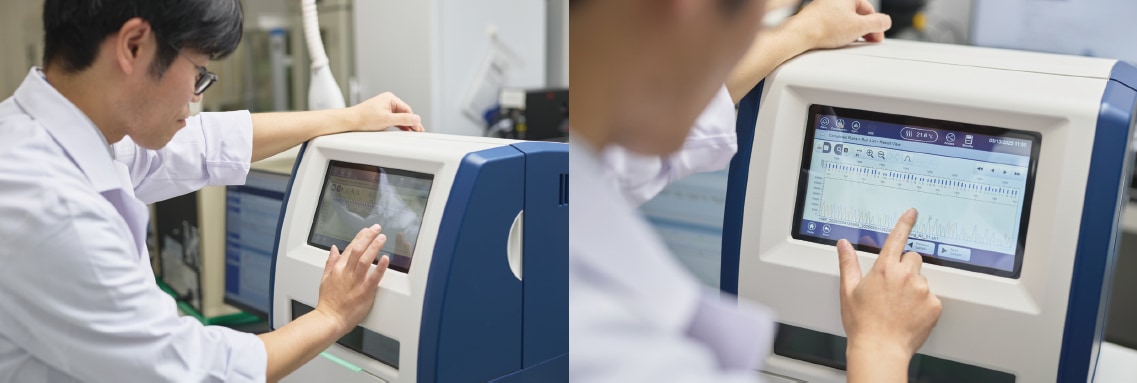
“It initially took effort to get used to operating the instrument, but it’s easy to use now. The instrument displays waveform data that closely resembles raw data, which is different from the instrument we previously used. Initially, interpreting the data took time.”
Associate Professor Iwasaki, however, says his team overcame this issue by using the other instrument to check data.
“We were grateful to have the opportunity to evaluate the operability and performance of the instrument during a demo period before we purchased the DS3000 in December 2024.”
Associate Professor Iwasaki says that the extended demo period they had gave them the opportunity to assess both the advantages and limitations of the instrument that would not have been apparent over a shorter time. This ultimately led to their decision to buy it.
“Scientific instruments are used for a long time and must be chosen carefully. Being able to fully evaluate the instrument during the demo period gave us peace of mind when it came time to buy it.”
Associate Professor Iwasaki finds the compact size of the DS3000 appealing.
“Our laboratory is crowded with equipment. We didn’t have the space for a big instrument. The small DS3000 fit on a lab bench with room to spare. Since we will be getting more equipment, this compactness is a great feature.”
As stated previously, the DNA in formalin-fixed paraffin-embedded specimens used in research is often fragmented and can be difficult to analyze. Associate Professor Iwasaki’s team sometimes analyzed DNA with NGS but was often unsuccessful with library creation.
“In such cases, the DS3000 capillary sequencer was often sufficient to yield usable results. This proved extremely useful.”
The team sometimes verifies NGS data with Sanger sequencing, which is very reliable and well suited for verifying the presence of specific mutations.
“Faced with budget constraints, we appropriately choose between NGS techniques and capillary sequencing to get reliable data while keeping costs down. In terms of the balance between research speed and cost, I’m convinced that capillary sequencers will remain indispensable. Capillary sequencers excel at delivering rapid results.”
“Now that we have the capillary sequencer, we can analyze samples in our laboratory without outsourcing. This arrangement places fewer time constraints on our research and lets us work more freely. When we outsourced to the central university laboratory here we had to work to meet submission deadlines and spend time arranging for shipping. But now, we just load the sample and then check the results on the following day. Since we’re able to reliably analyze short target regions with no increase in workload, we have become more efficient.”
Many unknown targets remain concealed within bone and soft-tissue tumors. At the same time, advances in sequencing technology have made more analytical techniques available, more capable investigators are coming of age, and costs are falling. Offering quick, inexpensive analyses, capillary sequencers will remain an effective tool. They offer broad capabilities beyond mere mutation analysis, such as fusion gene detection, verification of vector construction, MLPA-based methylation analysis, and copy number analysis. The scope of their use will continue to expand.
“Previous research mainly relied on bulk analysis using techniques such as Sanger sequencing or multiplex analysis, but single-cell analytical methods are now evolving rapidly. We are able to obtain data in finer detail now that analysis is possible on the single-cell level. These strides forward in technology are moving bone and soft-tissue tumor research into a new phase. We will continue with our research using a wide array of analytical tools as we seek to discover more effective treatments in this still understudied field.
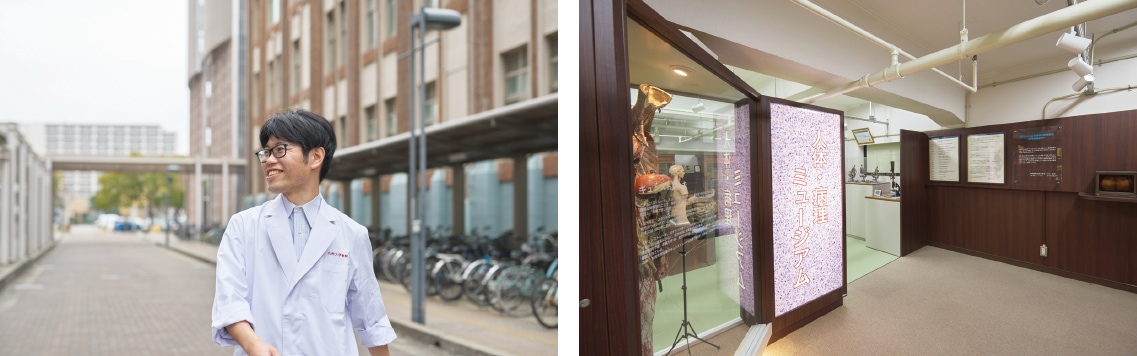
Kyushu University, which has studied anatomical and molecular pathology for over a century, has 160 rare specimens on display at the Kyushu University Museum of Human Anatomy and Pathology on campus. Also on display are historic anatomical models, vintage microscopes, and other medical history artifacts not seen in a typical laboratory setting.
Interview date: March 13, 2025 (interview/article: Toshinari Yamaguchi, photographs: Yuki Akiyama)