Interdisciplinary Research in Ecology and Molecular Biology Aiming for Innovations in Pest Control
As the global population increases at an alarming rate, there are concerns about food shortages in the future. As part of this worrying scenario, farmers across the world are seeing their crops suffer ever greater damage from drought, floods, and pests made worse by climate change. Japan’s agricultural sector is also facing problems such as the declining birth rate and aging population, and the quest for increased sustainability has become a pressing issue. With pest control in particular, the problem of resistance to the pesticides that are the main weapon in the fight against pests is becoming increasingly serious, and there is a need to establish new methods of control. Biological control, which makes use of the natural enemies of pests, looks promising as an effective solution. One of the leading researchers in this field is Professor Norihide Hinomoto of Kyoto University Graduate School of Agriculture. We spoke to him about the advantages of biological control, the focus of his current research, and the use of genome sequencing technology in pest control research.
Professor
Laboratory of Ecological Information
Division of Environmental Science
and Technology
Graduate School of Agriculture
Kyoto University
Norihide Hinomoto
PhD (Agriculture)
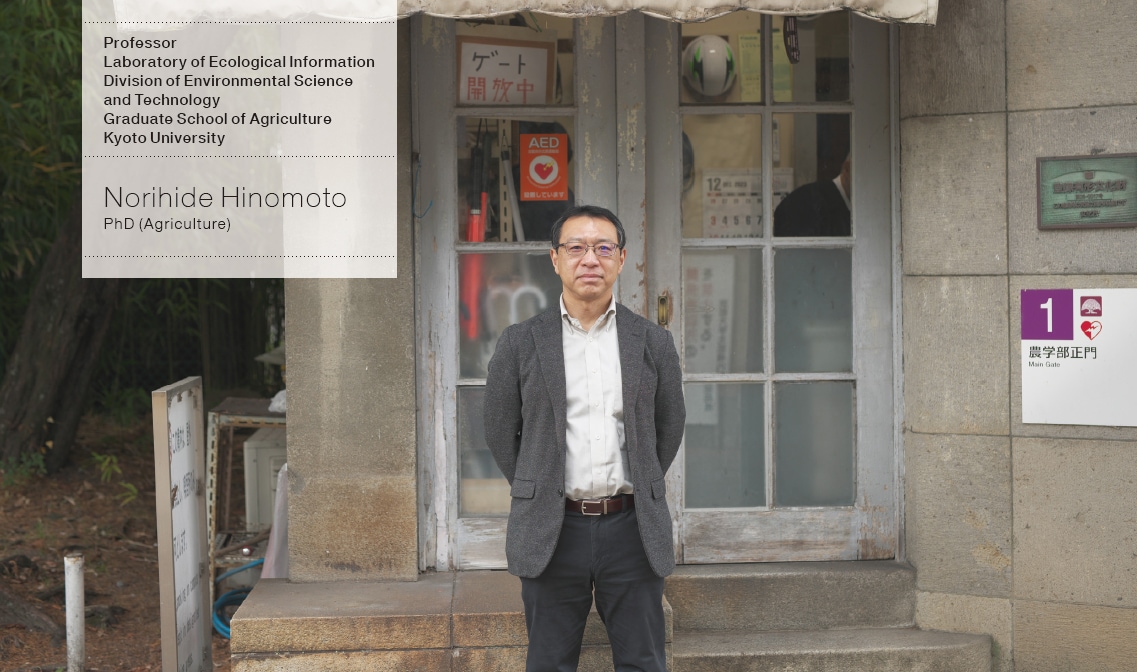
Damage to crops from insect pests has been increasing worldwide in recent years due to the effects of climate change. Professor Norihide Hinomoto of Kyoto University, who specializes in research into pest control technologies, points out that while each individual pest may be diminutive in size, the cumulative effect of pests on agriculture is huge. “It has been calculated that around 40% of the global crop yields that should be possible is lost to pests, which include insects and other animals, diseases, and weeds,” he says. “We are seeing losses on this scale despite measures such as regular spraying with pesticides. To put it differently, if we could prevent this damage, we would be able to increase crop harvests by something like 1.7 times the current yields.”
Spraying pesticides to control insect pests is tough work. In the heat of summer, farmers have to don protective wear such as long sleeves, masks, and goggles, but even after spraying they still suffer huge losses. It seems a thankless task.
“Resistance to pesticides is an enormous problem,” says Hinomoto. “If you keep using the same type of pesticides, the number of pests that can survive gradually increases, and eventually the chemicals don’t work anymore. In Japan, the population is aging as the birthrate decreases, and there is starting to be a shortage of people to take over agriculture from the older generation. For this reason, we need increased labor-saving and efficiency in agriculture. Improving working conditions in agriculture by reducing the burden of pesticide spraying is an important step in encouraging new workers to enter agriculture. Biological control is a promising method for overcoming these problems.”
Chemical pest control prevents pests and pathogens through the use of agro-chemicals with active ingredients that are mostly synthesized by chemical means. Biological control, on the other hand, fights pests by using insects or microorganisms that are the pests’ natural enemies. There are two methods of biological control: one is to purchase natural enemy organisms (biological control agents), which are registered and marketed in the same way as chemical pesticides, and release them on agricultural fields; the other is to attract native natural enemy organisms living in surrounding areas to the agricultural fields. Prof. Hinomoto’s research covers both methods.
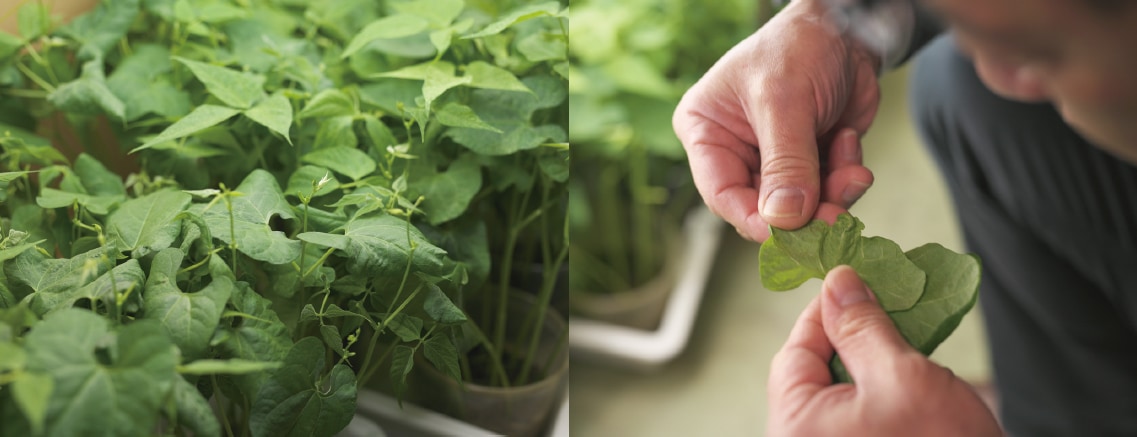
There is a huge variety of pest species that attack crops, but Prof. Hinomoto’s research is focused on the very small types such as spider mites, thrips, whiteflies, and aphids, as well as their natural enemies. “These tiny pests have short lifespans, often around 10 days from egg to adult. This means that over a single year there may be several dozen generations,” he explains. “If you continually dose them with a chemical pesticide, the survivors will steadily be selected and in no time at all the pest will have acquired resistance to that particular pesticide. To add to this, environmental standards have become stricter over recent years, and it takes a considerable amount of time and money to develop a new chemical pesticide. As a result, the types of pesticides available for use are becoming increasingly limited.”
In 2021, the Ministry of Agriculture, Forestry and Fisheries formulated its “Green Food System Strategy.” This strategy aims to bring about the coexistence of increased productivity and sustainability of food, agriculture, forestry, and fisheries, and one of its initiatives is the establishment and spread of comprehensive insect pest management systems that do not rely solely on chemical pesticides, with the aim of a 50% reduction in chemical pesticide use by 2050. The key to achieving this goal is biological control. Prof. Hinomoto is keen to emphasize the significance of this method: “If we can fight pests by making use of the predator-prey relationships and competitive relationships that organisms have built up naturally, it will have a low impact on the ecosystem and will help us to increase the sustainability of agriculture,” he says.
However, while pest control using natural mechanisms offers huge advantages, dealing with living organisms is not without its challenges. Prof. Hinomoto explains that it is difficult to estimate and control the timing and quantity of releases: “If you release the natural enemies when the pests are scarce or aren’t there, the natural enemies will die of starvation or move elsewhere. If there are too many pests, the natural enemies won’t be able to eat them all,” he says. “The main focus of my research is how biological control can be used in a stable fashion. Specifically, my research is advancing along the two main lines of clarifying the ecology of the target pests and their natural enemies, and creating high-performance strains of the natural enemy materials for commercialization.”
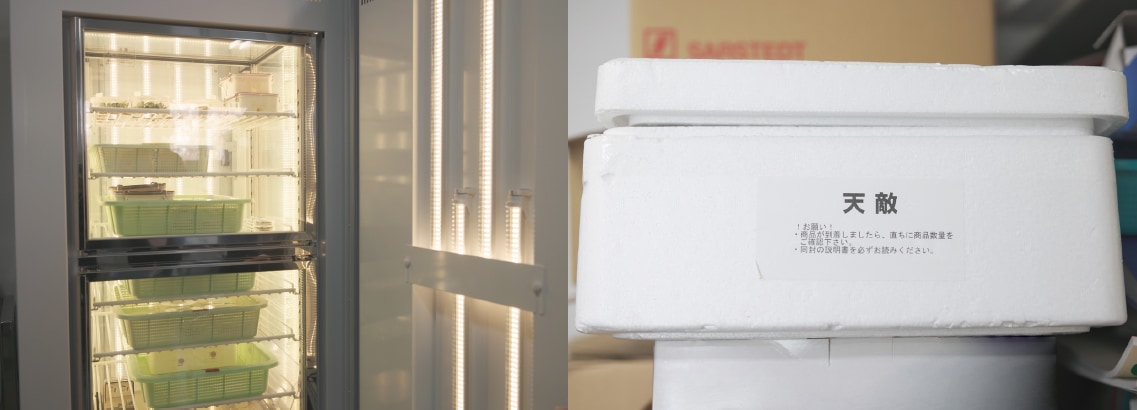
Among the natural enemies that Prof. Hinomoto is currently researching are the various species of phytoseiid mites that prey on spider mites. Spider mites are parasites of plants, living in groups on the undersides of leaves and sucking the sap from the plant to gain nutrients. If a plant is parasitized by large enough numbers, its growth will be stunted, and it may even wither and die. Spider mites are troublesome pests that are widely distributed, and they parasitize many different types of plant. An important species is the two-spotted spider mite, which in particular has become a massive problem around the world as it readily acquires resistance to pesticides.
In the laboratory, Prof. Hinomoto breeds twospotted spider mites and their natural enemies, phytoseiid mites, and examines and analyses them in the laboratory environment. He also carries out joint research with research institutions in different regions, analyzing samples and data collected from actual agricultural land.
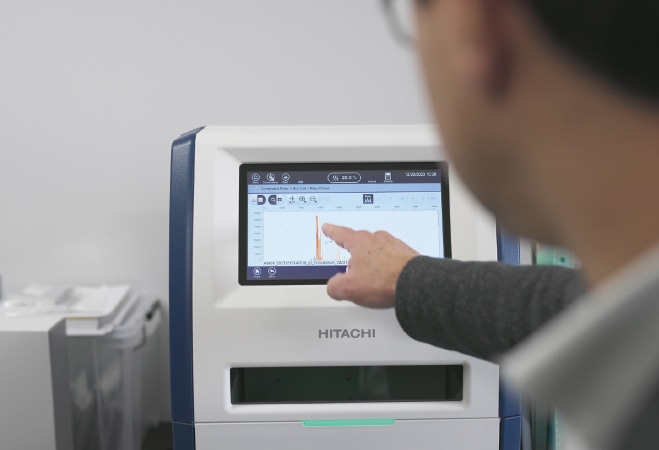
“I am currently taking part in the Cabinet Office’s Moonshot Agriculture, Forestry and Fisheries Research and Development Program, for which I am putting together a research project that aims for the ‘Realization of zero pest damage agriculture by fully utilizing advanced physical methods and unused biological functions,’” he explains. “Specifically, the aim of this project is to develop technology to kill pests with blue laser beams, to develop new control technologies through breeding superior natural enemy strains and controlling their behavior, and to combine these technologies to establish pest control systems that do not rely on chemical pesticides. Genome sequencing is indispensable to breeding and behavior control research, and I used the research budget to purchase a Hitachi High-Tech DS3000 Compact Capillary Electrophoresis Sequencer, which we are making good use of.”
Breeding is mainly carried out by collaborating researchers from NARO (National Agriculture and Food Research Organization), who are working with the cutting-edge breeding method of DNA marker-assisted breeding.*1
“The natural enemies are released outside, which means that genetic modification is regulated, and genome editing may also be subject to regulation in some cases. We are therefore aiming to use techniques such as genome editing and RNAi*2 to efficiently discover genes that are linked to superior performance and to establish natural mating patterns to produce populations that carry these genes,” says Prof. Hinomoto.
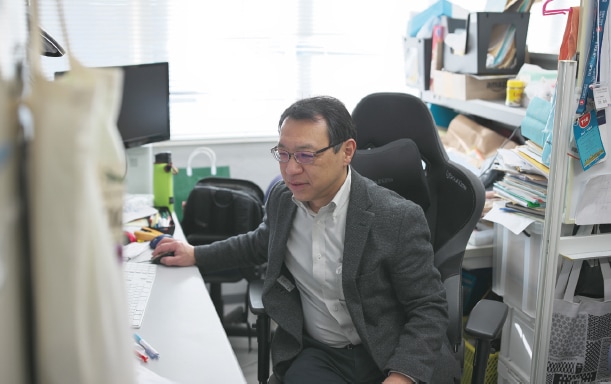
Prof. Hinomoto’s main area of research is behavioral control of natural enemy organisms. He is working to understand the behavioral characteristics of natural enemies in order to establish ways to attract native natural enemies living in the vicinity of agricultural land and to ensure that natural enemy materials that are released on agricultural land stay there.
“When we talk about chemical substances to attract organisms, most people probably think of sex pheromones,” he says. “However, I am focusing on herbivory-induced plant volatiles, or HIPVs. These are volatile substances that are released by plants when they are damaged by plant-feeding pests, and they have the property of attracting the natural enemies of these pests. HIPVs were discovered in the 1980s, but little progress was made in clarifying them as they comprise a range of different substances and their composition varies between the species and variety of plant. It is only in recent years that researchers have begun to understand the genes involved in sensing volatile substances and the relationship between sensing these substances and behavior. I believe that if we could use this information to develop a chemical agent that attracts natural enemies, it would be possible to attract native natural enemies to agricultural land from surrounding areas and induce them to stay.”
For this to work, it is necessary to know where the natural enemies are usually found—the methods used to bring them in will differ greatly depending on whether they live in the weeds surrounding the agricultural land or in remote mountain forests. “If they live nearby, we have to think of how to attract them; if they live far away, we need to think more in terms of how to make them stay if they come. I am working on genomic analyses of natural enemies in agricultural land and the surrounding areas in order to elucidate genetic lineages and gain an understanding of their migration and distribution. For this, I use simple short repeat sequences called microsatellites. Studying these sequences makes it possible to uncover phyletic relationships within species and blood relationships within populations.”
The recent spread of DNA sequencers has led to the use of genome information in a wide range of fields. However, ecology studies, and in particular the field of pest control, have been slow to use this information, largely because of the time and effort required for stable breeding and reproduction of pests and their natural enemies in the laboratory. Prof. Hinomoto is blazing a trail by combining ecology with the latest findings from molecular biology.
“To be able to use genome information, it is essential to have a DNA sequencer available for use in the laboratory whenever it is needed,” Prof. Hinomoto points out. “It is expensive and time-consuming to outsource everything, and in my laboratory in particular we need to analyze a lot of DNA fragments that external providers can’t really handle. This means that the DS3000, which has fragment analysis built in as the default application, is absolutely invaluable. All the consumables are in cartridge form so they can be replaced easily and with no wastage, and maintenance is very straightforward. This makes the device very userfriendly, even for students.”
As well as a means of gaining an understanding of natural enemy distributions, fragment analysis is also used in Prof. Hinomoto’s laboratory to investigate the feeding characteristics of natural enemy organisms. Answering questions such as whether natural enemies are eating the target pest on the agricultural land, or what they eat when the pest is not available, will provide important data for behavioral control.
“If you do a complete genome analysis of phytoseiid mites collected from agricultural land, the DNA from the content of their digestive systems will also be detected. So if you wanted to investigate whether the phytoseiid mites are eating a particular pest, you put a marker on the DNA of the pest and then see whether the same marker turns up in the analysis results for the phytoseiid mites. You could run a PCR with specific primers for the pest DNA, but the detection efficiency will be extremely poor if the pest DNA has been broken down by digestion. Fragment analysis using fluorescent primers is highly sensitive and can find differences of just a single base—this means that if the pest that was eaten was a thrips, it can be identified not just at the level of the order, but right down to the individual species. As the organisms we are looking at are not your normal research animals such as mice, markers have to be developed for fragments, and this involves trial and error. However, if you have a sequencer available, you can carry out various different trials, and we certainly appreciate the freedom this device gives us to run tests at different concentrations.”
There have been cases where highly sensitive fragment analysis has provided scientific evidence for phenomena that had only been inferred empirically. For example, phytoseiid mites were believed to eat pollen when the pests they normally prey on are not available, and this had been confirmed under breeding conditions, but the proof came when plant genes were found in fragment analysis of phytoseiid mites collected from agricultural land.
“They may be using the proteins in pollen to stay alive. This suggests that it is highly likely that provided there are flowers in bloom, the natural enemies will stay on agricultural land even if there are no pests there. Phytoseiid mites are tiny, about 0.5 mm long, so going around counting them with the naked eye is not a realistic proposition. However, it is obvious from a single glance whether flowers are blooming or not, so that would give you a rough guide as to whether or not there are any natural enemies on the agricultural land.”
Prof. Hinomoto believes the concept of integrated pest management (IPM) will be increasingly important in agriculture. This is the approach of combining diverse methods to manage pests and weeds in a rational manner, rather than the conventional, symptomatic method of clearing pests and weeds with chemical pesticides.
“Making use of the fact that natural enemies eat pollen, trials are underway in which flowering plants other than the desired crop are planted. These are called insectary plants. Marigolds, for example, produce a great deal of pollen and they are also home to marigold-loving thrip species. This means that marigolds are effective at attracting native natural enemies that feed on thrips, and also at ensuring that native or commercial natural enemies become established. Some agricultural areas have succeeded in reducing their use of pesticides by planting marigolds around eggplant fields, and research is currently looking into creating environments in which there are always flowers in bloom by combining multiple species of insectary plants that have different flowering periods.”
Modern agriculture has aimed for efficiency through uniform environments in which only the desired crops grow on agricultural land, but the downside is that environments with little diversity are vulnerable to outside threats such as pests. Increasing the diversity of fields themselves, including both plants and animals, is likely to maintain a better balance between organisms so that the entire ecosystem of the agricultural area can become stable.
“Agricultural land in Japan originally had high diversity, and I believe we can regain this diversity through reducing pesticide use. For this, agriculture needs to be considered at the overall regional level, rather than in terms of individual producers. It is important to uncover relationships and interactions between pests and their surrounding environment, which includes their natural enemies and plants, on a regional level.” Prof. Hinomoto has a dream for the future: “Ultimately, I want to bring about pest management where it is enough to plant crops and insectary plants and then introduce biological control agents or take measures to attract native natural enemies, after which it can all just be left alone.” His research started from the desire to do something about the pests that plague the producers of the crops that we need for our survival, and he is determined to develop it further: “I’m aiming for an ideal model of sustainable agriculture that reduces the workload of the producers and enriches the environment.”

(Interview by Akiko Seki, photos by Yuki Akiyama)