The Thrill of Discovering New Principles—That Nobody Had Ever Noticed Before
Our guest today is Professor Kazuo Miyamura, Professor Emeritus at Tokyo University of Science. As an analytical chemist specializing in coordination chemistry, Professor Miyamura's many accomplishments include analyzing the structure of assemblies of metal coordination complexes, studying the growth of lipid/coordination complex hybrid layered crystals, and, more recently, discovering new compounds capable of storing heat upon cold crystallization. He is also well-known for his lifelong love of rail travel; he has ridden trains not only on every line in the Japan Railways network, but also on every private railway in Japan—an accomplishment known as the "full ride"—and, from April 2014 to March 2025, starred in "The Well-Traveled Professor: A Railway Odyssey Across Japan," a program on NHK's Late-Night Radio Dispatches(Radio Shin’ya-bin). On top of Professor Miyamura's work as a researcher and as an educator and his passionate commitment to his hobbies, he somehow finds time to chair the Chemical Heritage Committee of the Chemical Society of Japan. He recently sat down for an in-depth roundtable discussion with three members of the Design and Development Division of Hitachi High-Tech Analysis: Hideyuki Sakamoto, Kazuko Yamamoto, and Masahito Matt Ito.
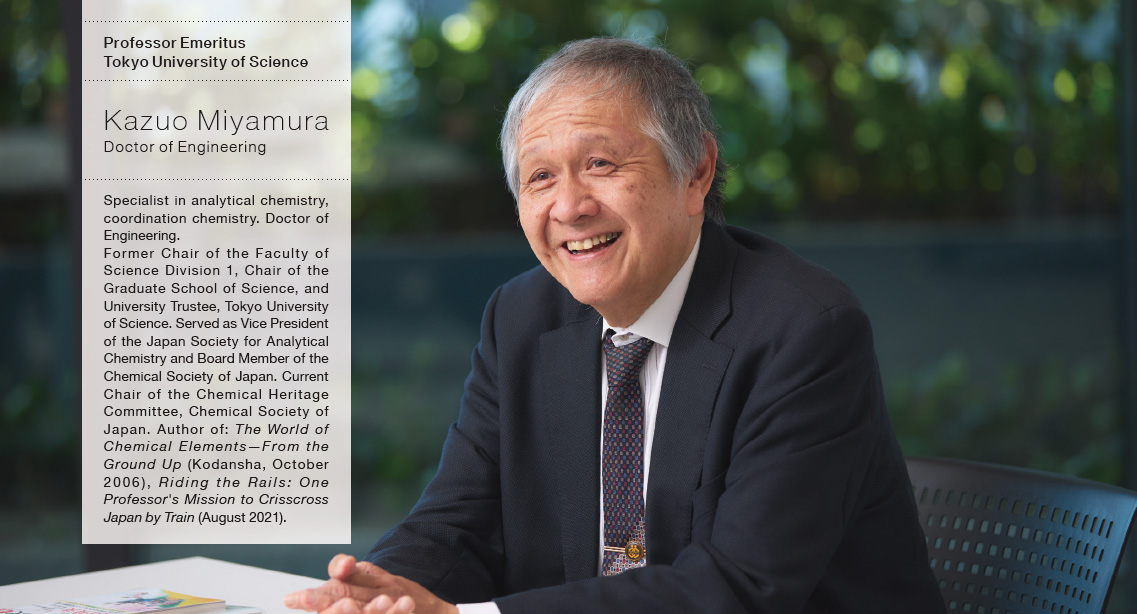
Professor Emeritus
Tokyo University of Science
Kazuo Miyamura
Doctor of Engineering
Specialist in analytical chemistry, coordination chemistry. Doctor of Engineering.
Former Chair of the Faculty of Science Division 1, Chair of the Graduate School of Science, and University Trustee, Tokyo University of Science. Served as Vice President of the Japan Society for Analytical Chemistry and Board Member of the Chemical Society of Japan. Current Chair of the Chemical Heritage Committee, Chemical Society of Japan. Author of: The World of Chemical Elements—From the Ground Up (Kodansha, October 2006) , Riding the Rails: One Professor's Mission to Crisscross Japan by Train (August 2021).
Ito Professor Miyamura, I understand you've been involved in selecting technologies for recognition as elements of Japan's Chemical Heritage. Have you chaired that committee since its inception?
Miyamura No, I'm the second chairman they've had. They decided they wanted a task force in Tokyo, and that was when they reached out to me. My attitude has always been "I'll try anything once," so I was happy to accept.
Sakamoto One of our products, Japan's oldest amino-acid analyzer, was selected for Chemical Heritage recognition in 2024. Do you think it is important for today's scientific instruments to be passed down to future generations as elements of cultural and industrial heritage?
Miyamura Oh, I think it's very important—otherwise these precious tools run the risk of being forgotten. Other nations do a better job of protecting and preserving their scientific legacies; I particularly remember visiting the University of Glasgow, where the study used by Lord Kelvin—a giant of 19th century physics who became a professor there at the age of 22—is preserved exactly as it was in his time. It's crucial for us to remain aware of that sort of history.
Ito Yes, it certainly seems like Japan should have more pride in its history of technological innovation.
Miyamura Absolutely. Japan has been at the forefront of scientific technology within Asia and elsewhere, and I believe our mission is to ensure that all of those groundbreaking instruments and accomplishments are properly preserved as elements of heritage—and to pass on this heritage through communication, directed toward Asia in particular. The difficulty is that scientific instruments tend to be discarded because they take up so much space. So, we're grateful if you recommend candidates for Chemical Heritage recognition.
Sakamoto You once said "Science is all about the thrill of discovery." What sorts of experiences did you have in mind?
Miyamura As an undergraduate, I worked in a laboratory whose main focus was metal coordination complexes. In practice, this primarily meant studying organic synthesis, and my research involved using metal atoms as templates to aggregate and induce reactions among organic molecules, thereby creating new types of ligands. My first project was a synthesis reaction for assembling large ring-shaped molecules from many small components; this turned out to be a fascinating subject with ramifications for the synthesis of chiral molecules with stereocenters, i.e., molecules that come in distinct right-handed and left-handed variants. For a target compound containing three hetero rings, I was able to achieve over 80% yield using a single-stage reaction, so, that was a pretty successful outcome for an undergraduate research project.
I also discovered a phenomenon in which, in the process of forming metal coordination complexes, simply switching the order in which metals bind to ligands has the effect of modifying the structure of the final complex. This makes it possible to assemble complexes containing the same ligands but distinguished by distinct three-dimensional structures, so it's a very interesting reaction.
Ito Were these structures observable by eye?
Miyamura Ultimately the structures were confirmed by X-ray analysis. But, even before we got to that stage, it was clear from spectral measurements that we were producing distinct compounds. You have to remember that performing an X-ray structural analysis in those days required preparing a stack of punched cards, and it took an entire week just to get data on a single structure.
Yamamoto Punched cards! I have vague memories of those.
Miyamura Our generation must have been the last to use them. But determining the structure of molecules is very important—for compounds like metal coordination complexes in particular, it's the structure that determines the functional properties. I was working with nickel complexes, and to some extent we could predict the structure based on the FMR (functional metal ligand), but at the end of the day it's the X-ray analysis that's decisive in determining the structure.
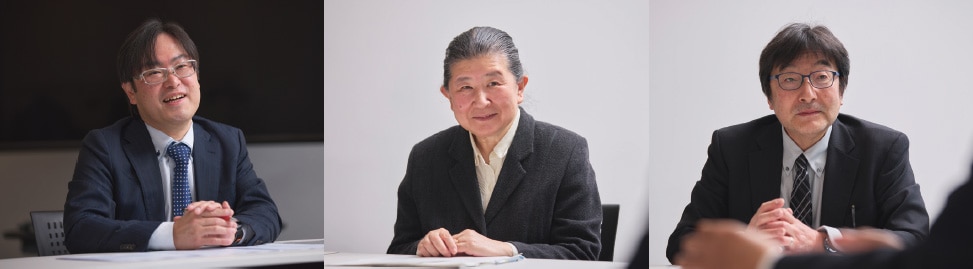
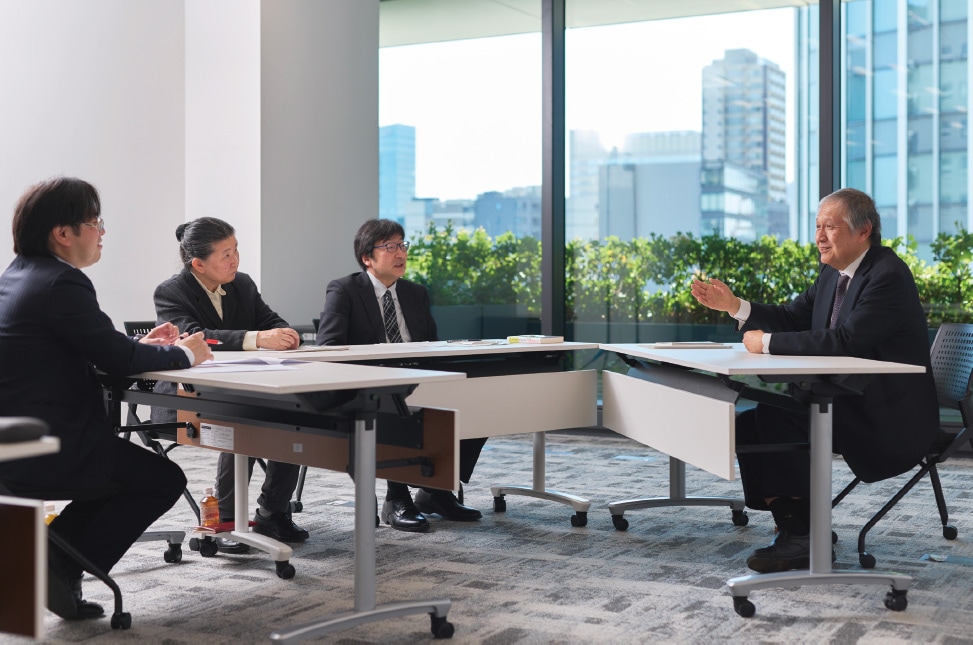
Participants in the roundtable discussion (from left): Hideyuki Sakamoto (Application Development Center), Kazuko Yamamoto, Masahito Matt Ito(Analytical Instruments System Design Department 2)
Miyamura Before entering university I knew I wanted to study chemistry, but I had trouble deciding which department to join. I'm not sure if you're aware of this, but industrial chemistry, taught within engineering schools, was extremely unpopular at that time. At one point the Department of Industrial and Synthetic Chemistry held a department seminar, and the speaker chosen by the department was Professor Sadao Yoshikawa; I heard that Professor Yoshikawa was coming to campus and would be visiting our laboratory in Hongo on the Saturday of that week, but when I showed up for his visit, I was the only student in attendance! So I got to talk to him directly in the professor's office. And then Assistant Professor Masahiko Saburi came by, and by chance I had attended Professor Saburi's seminars at Komaba, so that was how I wound up choosing to join the Department of Industrial and Synthetic Chemistry.
Sakamoto And that was how you wound up working on associations of molecules?
Miyamura Yes. One of my senior colleagues had said to me, "You know, complicated compounds are too expensive—they aren't useful for anything besides pharmaceuticals." And that got me wondering if it might not be possible to proceed in the opposite direction: to explore not just individual compounds, but interactions among multiple molecules—or molecular associations—to create substances with new properties. In other words, the idea was to modify physical properties not by "synthesizing" substances, but by "assembling" them.
Sakamoto And that led to your research on surfactants and molecular associations?
Miyamura Exactly. I left the doctoral course before completing the degree and became an assistant researcher, and the first thing I tried to do was to synthesize metal complexes with alkyl groups. The surfactant behavior becomes prominent when the number of carbon atoms is greater than 10, so I was trying to synthesize things like C8, C10, C12. Metal complexes tend to be colored, so these substances appeared dense in appearance, but nonetheless their concentration was too low to be functional as organic molecules, so at first we had trouble making measurements. However, eventually we succeeded in increasing the concentration and making NMR measurements, which revealed dramatic changes in the observed spectra—thus confirming that molecular association was taking place.
Ito You had studied engineering, but the work you're describing is closer to science than to engineering.
Miyamura That's true, but it was a combination of personal connections and serendipity that sent me in that direction. In my case, opportunities always seemed to arise out of turning points, and it was often these encounters that determined the large-scale trajectory of my career.
Sakamoto The story of how you became a research assistant is a bit unusual as well.
Miyamura Definitely. In the first year of the doctoral course, I happened to attend a reunion of graduates who had studied chemistry and related fields in the engineering school; I only showed up because I had heard there would be an all-you-can-eat buffet, but once I got there a professor of analytical chemistry kindly took me aside and said, "Hey, I know a professor who wants to hire you as a research assistant." At that point in my life I was already devoting a lot of time to my hobby of taking train trips, and I was a little worried that such a job wouldn't leave much time for that—but I wound up accepting the position anyway.
Sakamoto The laboratory you joined as an assistant, led by Professor Yohichi Gohshi, specialized in X-ray analysis. However, I understand you were advised not to focus on X-ray research.
Miyamura I think that probably had something to do with Todai's (the University of Tokyo's) approach to educating students. When I joined Professor Gohshi's laboratory, he told me I could study whatever I liked, but that I was strictly forbidden from doing X-rays. I think he just wanted to make sure I wouldn't follow him around and do everything he said; he wanted me to start up my own original research program and carry it so far that it even surpassed his own achievements.
Sakamoto Have there been any new discoveries to emerge from your recently research?
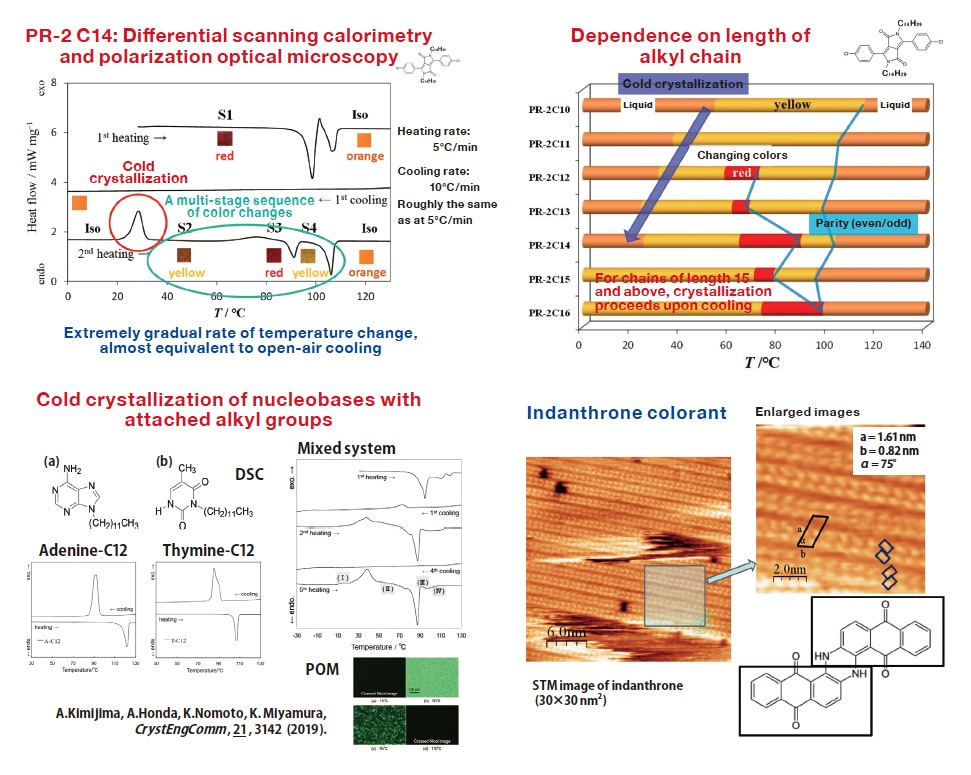
Miyamura Yes, one of the most interesting is the phenomenon known as "cold crystallization." This refers to substances that refuse to crystallize as the temperature is lowered, but then—counterintuitively—crystallize spontaneously when the temperature is raised. The reason is that crystal nucleation sites do not form at the freezing point, while crystal growth does not proceed at temperatures where nucleation sites do form. However, as the temperature rises, crystal growth begins once the temperature exceeds a certain threshold; we figured out that crystals just begin to grow all of a sudden beyond that temperature.
Yamamoto Roughly how high is the crystallization temperature?
Miyamura Just under 100°C. So these are "heat-storage materials" capable of storing and releasing heat. Of course, it would be even more interesting if this heat could be converted to electrical power. I believe some of my younger colleagues are working on energy-conversion research with this goal in mind.
Yamamoto That sounds like something that could have a lot of practical applications.
Miyamura No question—we've already had inquiries from a manufacturer of automotive components regarding heat-recovery applications. But controlling crystallization processes like this is extremely intricate—it demands a lot of knowledge and experience regarding purities and synthesis methods. I think our mastery of these techniques is one of the key strengths of our laboratory.
Ito You're also well-known as a railroad enthusiast. Is it true that you have ridden trains on every line in the Japan Railways network and on every private railway in Japan?
Miyamura That is true! This hobby of mine began during my student years—I took advantage of every extended vacation to make train trips here and there. Also, whenever I would travel for academic conferences I would take the opportunity to sample the local railways. Conferences are held in locations all over Japan, so by traveling to those, and making various detours along the way, I eventually managed to cross every rail line in Japan off my list.
Ito What about the municipal railways in various Japanese cities? Have you ridden on all of those as well?
Miyamura Municipal railways tend to offer full-day passes, so they aren't very expensive to explore. The issue is time—for branch lines, in particular, you can't stay very long at the terminus stations before you wind up having to ride the train right back. But I often encounter fellow train enthusiasts—often times at terminus stations I'll just get that sense about one or another passenger, like, "Hmm, that guy looks like he might be one of us." There are also a fair number of middle-school and high-school students.
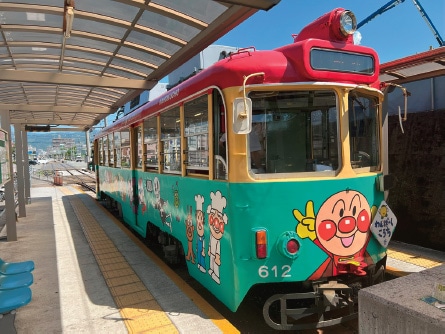
A local train in the Japanese city of Kochi decorated with images of the “Anpanman” cartoon character.
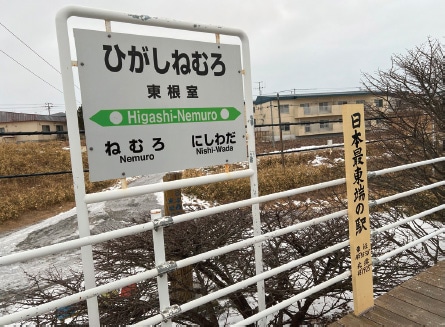
Higashi-Nemuro Station was the easternmost rail station in Japan before being decommissioned on March 15 of 2025 as part of a route restructuring.
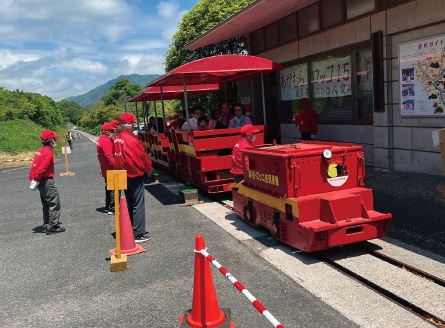
Akamura Trocco: A volunteer-operated tourist destination in Kyushu, open seasonally.
Yamamoto Your achievement of having ridden trains on every line in Japan—is that a boast that many of your fellow train aficionados can make?
Miyamura You'd be surprised how many there are! So much so that when NHK asked me to do their "Late-Night Radio Dispatches" program, I found myself wondering "what's so special about me?"
Ito Having retired, I might have expected you to become something of a full-time train traveler, but in fact it seems you're still quite busy.
Miyamura My plan had been to pack up my things and depart from the university immediately, but I kept getting asked to teach courses—there are more course offerings now than before I retired. As for rail travel, I've been giving talks at Asahi Culture Centers, and a serial magazine feature has started up—plus, more recently, I've been contributing to an online magazine produced by Japan's Cabinet Office.
Sakamoto Do you think your approach to scientific research is something you can pass on to your students?
Miyamura In my research group, I never required my students to tackle specific research projects, because I believe that students won't follow through on projects unless they really want to pursue them for their own purposes. I think it's important for students to learn how to propose their own research initiatives, so in my group I have undergraduates (4th year students) work with graduate students to think through projects and make their own proposals.
Sakamoto I see—so you're really trying to emphasize independence and individual initiative.
Miyamura I also avoided imposing requirements on when students needed to be in the lab, because I felt it was important that students be prodded to learn how to manage their own time. For example, when you're studying crystallization, it's really best to just leave your experiments alone without touching them for a while—probably the most effective thing for a student to do during that time is to get out of the lab and take a trip or something, and whatever time they spend goofing off they can always make up later. So you might say my approach was more results-driven.
Yamamoto Your own life offers a good example of how to balance research work with hobby pursuits.
Miyamura As a student I took a lot of train trips, but I always managed to submit abstracts for conference talks before the deadline. I think my advisor was always a little surprised and impressed by that. The key is to find your own ways of doing things, and take responsibility for the way things come out. I guess you could also say that's the Todai way. The only instruction I received was "You can't do X-rays, but you can do anything else you like." Beyond that, I was left on my own to figure out what to do, and I think that wound up kick-starting my career.
Sakamoto Do you have any thoughts on future directions for your field of research?
Miyamura I think we're past the era in which you could develop a single new compound and declare victory. Going forward, I think the key challenge will be figuring out how to combine multiple component molecules to yield substances with novel functional properties. Of course, there are infinitely many ways to implement such combinations and infinitely many choices of component fractions, so researchers will need to develop clever ways of searching through a limitless landscape of possibilities.
Yamamoto That sounds like the very definition of the scientific enterprise.
Miyamura In cold crystallization, for example, we started with the nucleobases adenine and thymine and added alkyl groups to each; each one on its own refused to crystallize, but when we combined them we succeeded in achieving cold crystallization. This was just not some random stroke of good luck—it resulted from observational insight and our hypothesis that under these specific conditions we can expect something interesting to happen.
Ito Is that sort of strategic mindset something that can be passed on to your students?
Miyamura The key is to devise one's own strategies, formulate hypotheses, and test them experimentally. I'm a big fan of the term "blunt honesty"—it's through repeating this process over and over again that students develop intuition. That's precisely why it's so important to discover one's own research—one's own internal sense of curiosity is the most powerful motivator in the world.
Sakamoto Inspiring words—and reason to expect great things from future generations of students who learned from your example. Professor Miyamura, thank you very much for your time today.
Editor's Postscript
One hot day in the summer of 2023, Professor Kazuo Miyamura arrived at Hitachi High-Tech's Naka Area(the site of Hitachi's former Naka factory) to inspect an element of Japan's Chemical Heritage: Hitachi's KLA-2 amino acid analyzer, first released in 1962, which I had the privilege of introducing to the Professor. I also took the opportunity to show Professor Miyamura another instrument on display in the same building: the 835 highspeed amino acid analyzer. Thanks to strong support from Professor Miyamura in his capacity as chairman, the Chemical Heritage Committee selected the 835, released in 1977, for official recognition; apparently decisive in this decision the fact that one of the instruments had been preserved and remained intact to this day. We were also grateful that the KLA-2 was recognized as the first amino-acid analyzer in Asia.
The following year, upon receiving official documentation from the Chemical Society of Japan confirming the bestowal of Chemical Heritage status, we invited Professor Miyamura to participate in an interview to be published in SI NEWS. He graciously accepted our request almost immediately, and I was struck by the depth of his experience and his endless trove of interesting stories. Sometime thereafter I had an opportunity to discuss the idea of Chemical Heritage in a lecture series open to the general public. As I was reviewing this interview in preparation for my lectures, I was reminded of just how soft-spoken the Professor was in person.
As mentioned in our interview, Professor Miyamura is also something of a railroad fanatic, and has even written a book about his hobby: Riding the Rails: One Professor's Mission to Crisscross Japan by Train. The book recounts many of the stories Professor Miyamura told on NHK's Late-Night Radio Dispatches. The relaxed pace of his storytelling is perfect for midnight radio broadcasts, and I remember thinking that NHK couldn't possibly have found a better professor.
Everyone who casts eyes on Professor Miyamura must report the first impression: He looks like a warm, friendly, and very tall gentleman. I can confirm personally that the Professor is every bit as generous and thoughtful as he appears, and I hope these qualities are conveyed by our interview and the accompanying photographs. Perhaps some readers will have their own opportunity to engage Professor Miyamura in discussion someday—and will be quickly won over by the irresistible force of his personality. He is the very personification of a scientist, but he is more than just a scientist: he is an educator, and one whose lofty, high-minded perspectives rub off on each and every student. Here's hoping that Professor Miyamura continues sharing his passion and insight—on coordination complexes, for chemistry students, and on the thrill of railroads, for the general public—for years to come.
(Masahito Matt Ito)
(Written and reported by Toshinari Yamaguchi. Reported on April 9, 2025.)