Kuniaki Mita*1, Wataru Kotake*2
In recent years, a growing need for rapid, high-precision characterization of fine-grained sample structure in fields such as materials development, quality control, and defect analysis has spurred demand for scanning-electron microscopes (SEMs) offering advanced capabilities such as high-resolution observation, efficient observational workflows, and stable, consistent data acquisition. Meanwhile, the increasing diversity and high functionality of manufactured products has increased the importance of flexible analytical approaches capable of non-destructive, in-situ observation of large, complex samples.
To meet these needs, Hitachi High-Tech has developed the new SU3800SE/SU3900SE SEM systems (Figure 1). These versatile instruments retain key strengths of the general-purpose SU3800/SU3900 SEMs—including support for large samples(*1) and outstanding ease-of-use—while adding a new Schottky electron gun to enable high-resolution observation with a stable beam current over long periods of time. The advanced features of the SU3800SE/SU3900SE—which include automated optical-calibration capabilities, the EM Flow Creator (EMFC) system for automating routine workflows, and user-privilege settings to facilitate instrument operation by users with varying levels of expertise—not only streamline observational workflows and enable consistent data acquisition, but also offer extensive support functionality to allow early-stage prevention of system malfunctions.
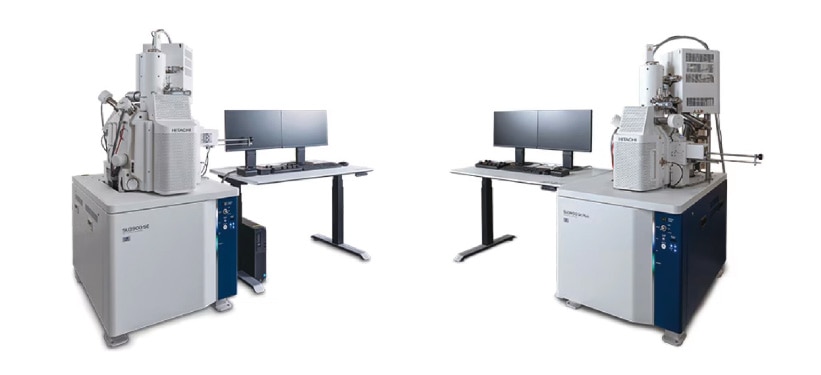
Fig. 1 The SU3900SE (left) and SU3800SE (right) SEM systems from Hitachi High-Tech.
The SU3800SE and SU3900SE are equipped with a new Schottky column to support high-resolution observations and high-beam-current analyses. The instruments feature secondary-electron and backscattered-electron detectors and may additionally be equipped with an optional low-vacuum secondary-electron detector and an optional in-column secondary-electron detector, enabling acquisition of a diverse variety of signals emitted from samples. These instruments also offer optional retarding functionality,(*2) in which a reverse-bias voltage applied to the sample stage decelerates the primary electron beam just before it impinges on the sample, reducing aberration to enable high-resolution observations at low accelerating voltages. Figure 2 presents examples of SEM micrographs acquired using the SU3800SE/SU3900SE. Figure 2(a) shows a fuel-cell catalyst observed at an accelerating voltage of 30 kV and a magnification of 500k×; Pt catalyst particles with sizes on the order of 1 nm are clearly discernible in the image. Figures 2(b,c) show a lithium-ion battery anode material observed at an irradiating voltage of 0.3 kV with retarding; the secondary-electron image in Figure 2(b), captured using the in-column secondary-electron detector, shows graphite/binder potential-contrast features (red arrow) while the backscattered-electron image in Figure 2(c) yields morphology and composition information.
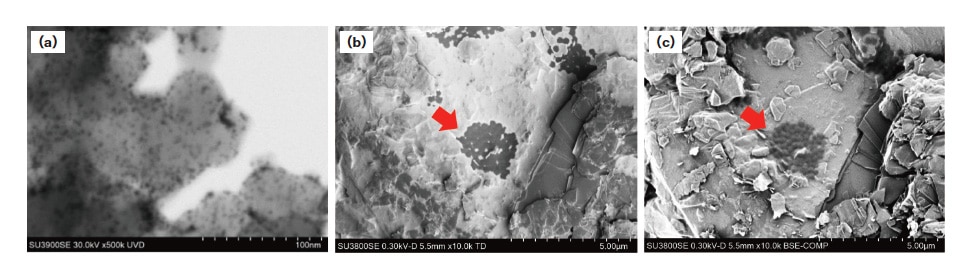
Fig. 2 Examples of SU3800SE/SU3900SE SEM micrographs. (a) STEM bright-field image of fuel-cell catalyst. (b,c) Lithium-ion battery anode material: secondary-electron image captured using in-column secondary-electron detector (b) and backscattered-electron image (c).
To improve ease-of-use for instrument operators and facilitate system maintenance, the SU3800SE and SU3900SE offer two advanced features: auto-alignment sequences and user-privilege settings. When conducting SEM observations and analyses, the electron-optics system must be re-calibrated whenever observation conditions are modified. In this case, this requirement is greatly alleviated by auto-alignment sequences (Figure 3), which enable calibration procedures—such as autofocusing and tuning of the electron-optics system—to be executed automatically in a prespecified sequence. This allows stable acquisition of high-quality data with no dependence on the level of expertise of the instrument operator.
User-privilege settings offer a mechanism to facilitate instrument operation by users with varying levels of expertise, and with these feature, users with higher privilege levels custom-select the range of instrument functionality available to users with lower privilege levels. This not only helps to prevent instrument malfunction due to user error, but allows advanced functions to be removed from the operational menus displayed to novice users and users who primarily invoke routine workflows, simplifying display screens for these users.
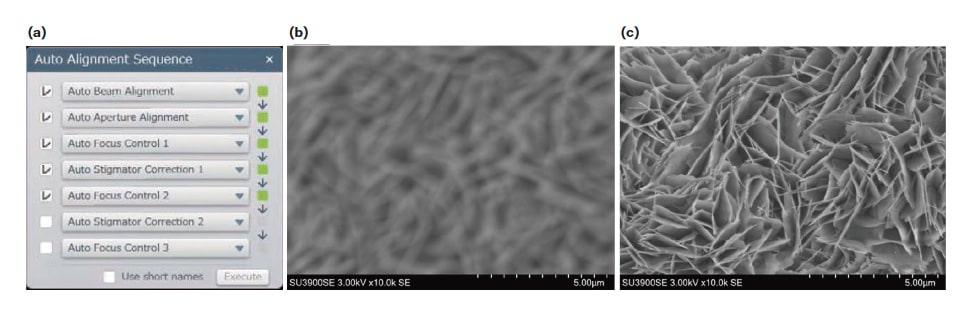
Fig. 3 Auto-alignment sequence (a) and SEM micrographs captured before (b) and after (c) automated calibration. (Sample: brass rust.)
EM Flow Creator (EMFC(*3)) is a software tool for preparing and executing SEM observation recipes to automate SEM workflows. The tool offers a visual-programming interface allowing users to create recipes —with no knowledge of computer programming languages—to enable SEM automation. Figure 4 shows an example in which SEM images of 14 wire-bonding sites were acquired automatically using EMFC. The structure of the observation sample is depicted schematically in Figure 4(a). For each bonding site, images of a given field of view were captured at four magnification levels (1k×, 2.5k×, 5k×, and 10k×). The field of view for each site was determined via template matching, in which a template image—prepared in advance—is superimposed on the observation image and the stage is translated until an alignment score is maximized. In this way, a total of 56 SEM images were captured in a fully automated process requiring approximately 25 minutes. Note that EMFC is optional software for the SU3800SE/SU3900SE.
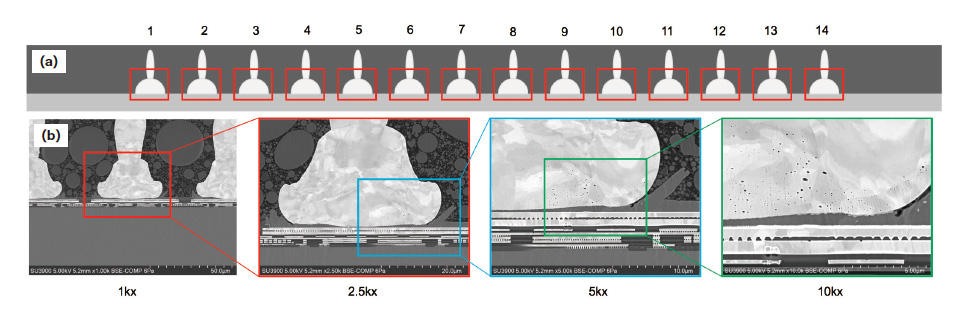
Fig. 4 Examples of automated observation using EMFC. Structure of observation sample including wire-bonding sites (a) and images of wire-bonding sites acquired automatically using EMFC (b).
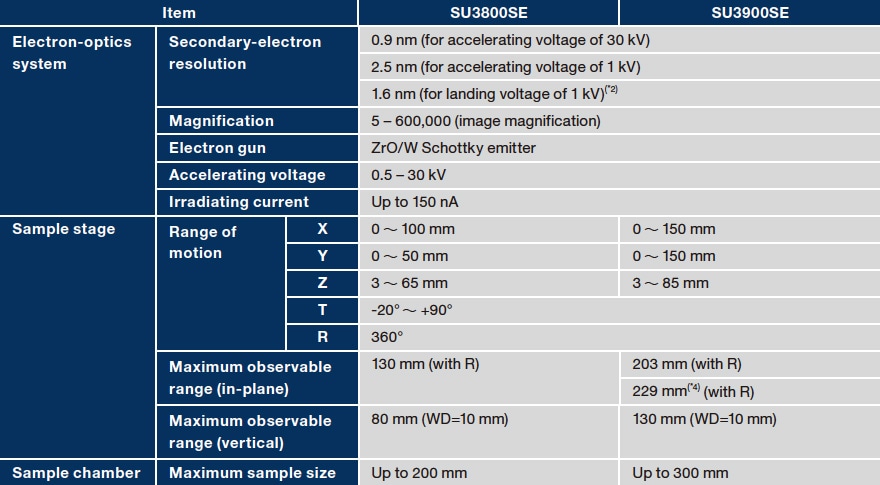
Table 1 lists key specifications of the SU3800SE/SU3900SE.
Table 1 Key specifications of SU3800SE/SU3900SE.
In this article, we surveyed the key features of Hitachi High-Tech's new SU3800SE/SU3900SE Schottky SEM systems and presented illustrative observation examples showcasing their capabilities. In addition to their new Schottky electron-optics system, these instruments offer improved user-support features and the EM Flow Creator software tool to support automated observations, facilitating observation and analysis operations for a broad spectrum of users with varying levels of expertise.
About the authors
*1 Kuniaki Mita
Solution Development Dept.
Beam Technology & Analytical Systems Product Division
Core Technology & Solutions Business Group
Hitachi High-Tech Corporation
*2 Wataru Kotake
Electron Microscope System Design Dept.
Beam Technology & Analytical Systems Product Division
Core Technology & Solutions Business Group
Hitachi High-Tech Corporation
See more