


More accurate, safer, and simpler. Towards stress-free radiation therapy, together
Healthcare Solutions ×
Kyoto University
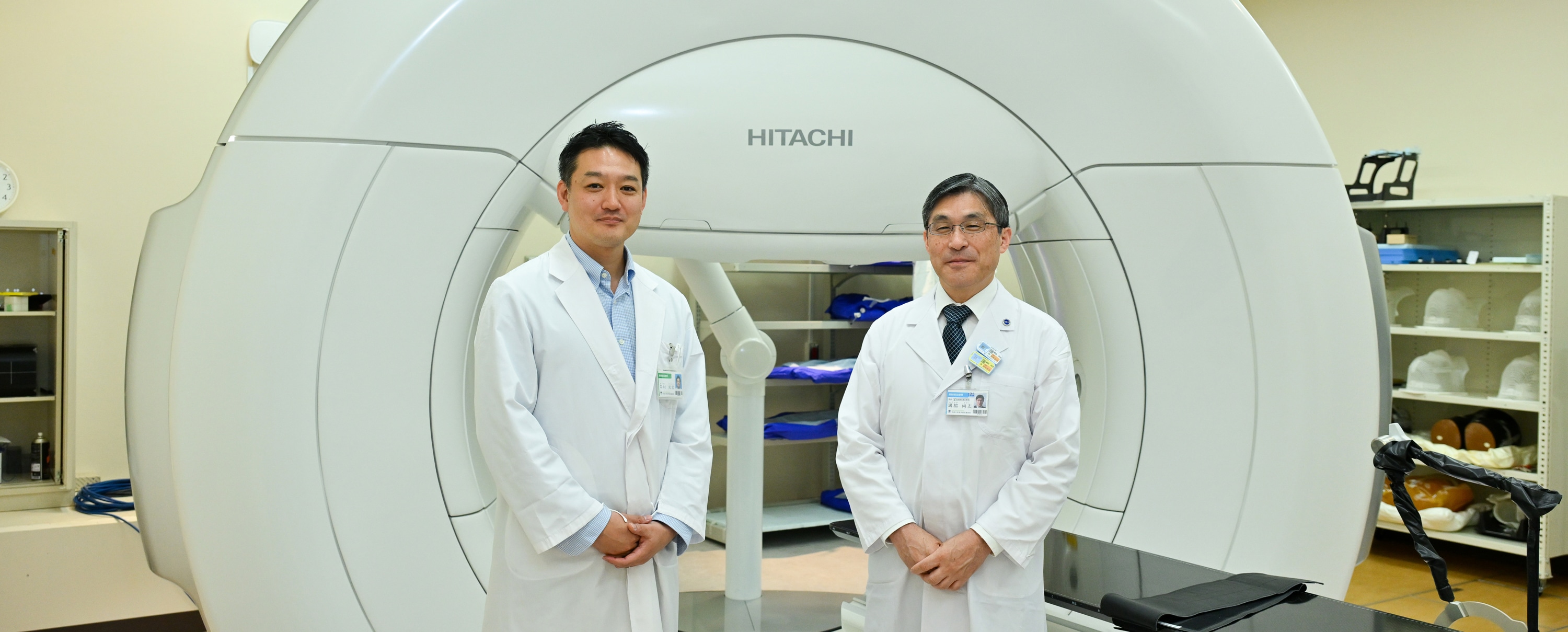
Right: Takashi Mizowaki Professor and Chairman Department of Radiation Oncology & Image-Applied Therapy Graduate School of Medicine, Kyoto University
Development driven by the determination to retain domestically prodcued devices
Nakamura We are currently conducting clinical trials using the X-ray therapy system OXRAY, which was co-developed with Hitachi HighTech. You were involved from the development stage of the preceding X-ray therapy system, weren't you Dr. Mizowaki?
Mizowaki I started developing the relevant X-ray therapy system under my predecessor Professor Hiraoka in 2002. At that time, in the field of radiation therapy, while intensity-modulated radiation therapy (IMRT)*1 had already appeared, technologies for accurate localization to tumors, such as image-guided radiation therapy (IGRT)*2, were just emerging, and only overseas manufacturers were capable of releasing such products. Therefore, when formulating specifications for the joint development, we anticipated that IGRT would likely be standardized ten years later when practical use was expected, and strongly advocated for including that functionality. As a result, IGRT became widespread, and we were able to jointly develop a device that met clinical needs.
Nakamura Yet subsequently in 2016, the company developing the X-ray therapy system at that time changed its management policy, and development was almost halted, right?
Mizowaki I heard that new development of the X-ray therapy system was discontinued to focus management resources on other fields, but by that time, a prototype of the next generation was already underway. Above all, losing an X-ray therapy system capable of Motion Tracking Irradiation*3 and dual-axis simultaneous rotational irradiation*4 would have been an enormous loss.
Once domestically developed technology is lost, restarting development becomes extremely difficult from both knowhow and resource standpoints, and this is not just limited to X-ray therapy systems. This could lead to a decline in national strength in the future, which would be a significant loss. That is exactly why I felt a strong sense of mission that we absolutely must preserve domestic technology.
Nakamura I feel the same way. As for X-ray therapy systems, even if the majority are made overseas, continuing domestic development leaves possibilities for the next generation. Were there any moments when you felt that domestically produced equipment provided truly unique strengths?
Mizowaki The speed of development, for sure. Because there were no language or cultural barriers, it was possible to smoothly resolve problems and improve software. That’s why, at the beginning of the joint development of OXRAY, there was talk of using an overseas-made positioning device, but I strongly insisted, “Please, at the very least, let Hitachi be in charge of development of that.”
*1A method that varies the intensity of radiation within the irradiation field during exposure and performs irradiation according to the tumor’s shape.
*2A technique to compare treatment planning images and images taken right before treatment, correcting the positional error of the tumor with millimeter precision and irradiating with greater accuracy.
*3A method that tracks the location of cancer moving due to breathing in real time and moves the irradiation field accordingly.
*4A method that enables highly accurate and efficient treatment of complex-shaped tumors by using two independent rotational axes to irradiate from different planes.
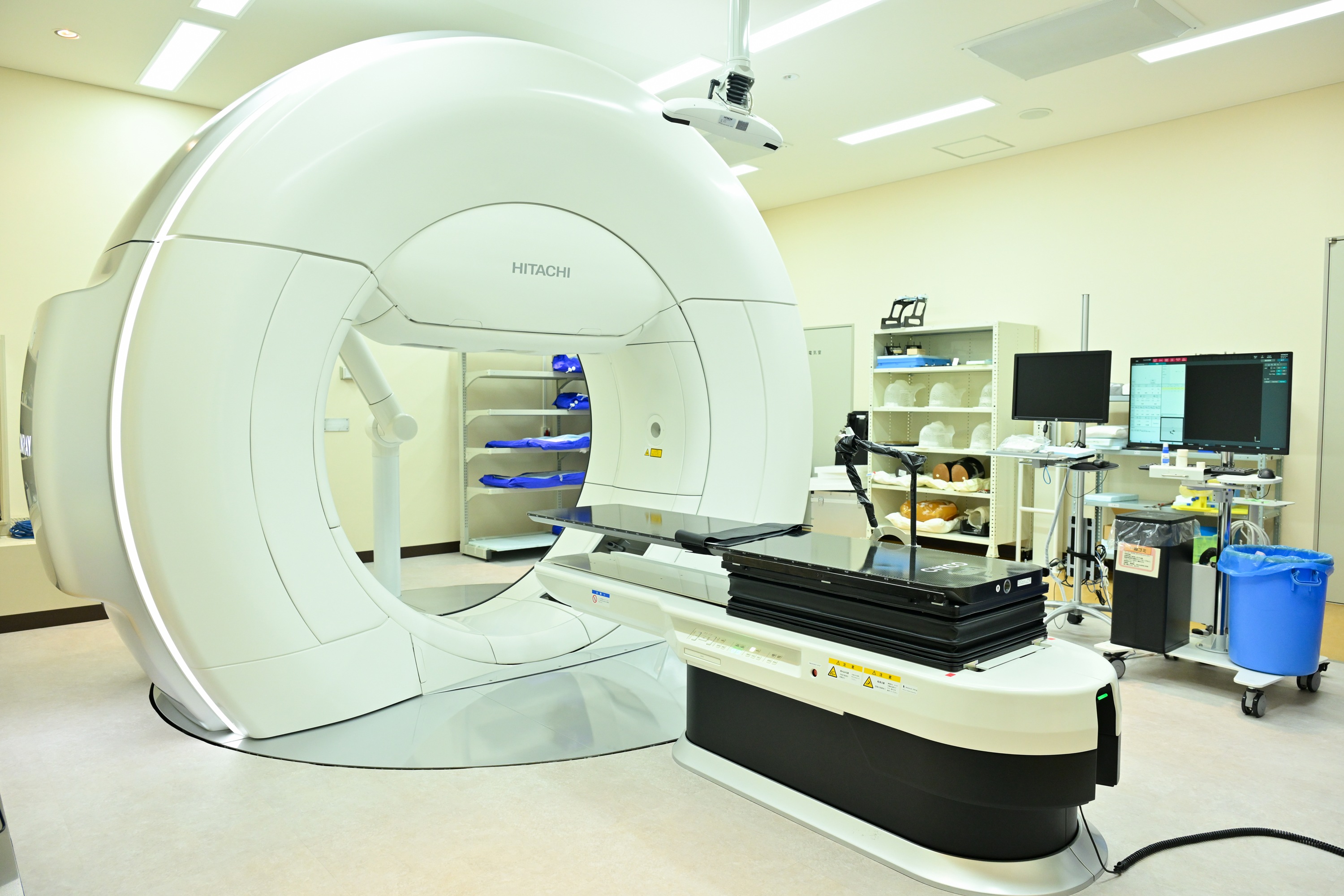
Linear Accelerator System OXRAY
An image-guided X-ray therapy system that integrates irradiation technology and imaging technology cultivated by Hitachi Group, which was launched in July 2023. The O-ring-type gantry structure with enhanced rotational freedom allows for continuous irradiation from multiple directions (different planes) without moving the patient bed, bringing expected improvements in dose distribution. Equipped with two pairs of kV imaging devices and alignment systems capable of capturing X-ray images and cone-beam CT images, it contributes to faster position matching. The ultra-compact accelerator tube and the multileaf collimator that shapes the irradiation field are mounted on a gimbal mechanism, enabling tracking irradiation for moving targets by changing the direction of therapeutic X-ray irradiation.

Helping to lower the impact on patients, with shorter treatment times
Nakamura OXRAY was introduced in 2023, and compared to its predecessor X-ray therapy device, its performance has improved dramatically.
Mizowaki The previous X-ray therapy device was also a groundbreaking system, but it had several issues, the biggest one of which was the irradiation field size was narrow and could not accommodate extensive targets. Because of this, it only covered about 40% of the diseases that should originally be treated with external irradiation. However, by expanding the irradiation range and increasing the rotational angle of the gimbal with OXRAY, more than 90% of conditions eligible for radiation therapy can now be covered. Being able to provide treatment for a wider range of conditions than ever before is a significant advancement.
Nakamura What particularly stood out to me was that the irradiation time for Motion Tracking Irradiation has been dramatically reduced. Motion Tracking Irradiation was possible with the previous X-ray therapy device, but it required irradiation from various directions, resulting in a considerably long irradiation time of over 30 minutes. During treatment, there were times when patients had to maintain uncomfortable positions, such as raising an arm they did not want exposed to radiation, and the longer the irradiation time, the greater the physical impact. With OXRAY, by integrating Motion Tracking Irradiation and Volumetric Modulated Arc Therapy (VMAT)*5, the entire process from positioning to completion of irradiation can now be finished in less than ten minutes.
There is also data showing that, with longer irradiation times, the position of tumors inside the body can shift, so being able to complete treatment more quickly not only reduces the impact on patients, but is also a significant advantage in delivering more precise pinpoint irradiation.
*5An application of IMRT, this method delivers radiation while rotating without stopping the device.
To achieve more accurate treatment tailored conditions of the day
Mizowaki In the future, to further reduce the impact on patients, achieving marker-less motion tracking irradiation is indispensable. Currently, in Motion Tracking Irradiation, a gold marker must be placed inside the body to accurately locate the tumor, which is a significant impact on the patient. To promote wider adoption of Motion Tracking Irradiation, it is necessary to develop the capability to track tumors without using gold markers. Currently, research is underway to achieve marker-less motion tracking irradiation.
Another essential point is preparing for Adaptive Radiation Therapy (ART), which is expected to become mainstream in radiation therapy going forward .
Nakamura That’s right. Motion Tracking Irradiation is a technique that synchronizes irradiation with periodic movements such as breathing, but even as we’re speaking right now, there are many non-periodic internal changes, like the bladder filling with urine or the stomach filling with gas. Therefore, the shape and position of the lesion or organs can change from day to day. Ideally, treatment plans should be redone according conditions of the lesion or organs on a given day, and making that possible is what Adaptive Radiation Therapy (ART) is all about. In addition to the feature of pinpoint irradiation from non-coplanar angles, we believe the ability to realize ART is one of OXRAY’s strengths.
Since OXRAY can capture images from two directions, it is possible to more accurately reflect the internal condition of the body for that day and makes it easier to plan ART. Drawing on these characteristics, our lab is developing new treatment methods and plans to reflect the results in “OXRAY" in the future.
Mizowaki Looking at cancer treatment from a broader perspective, anti-tumor immunity—that is, the immune system’s ability to recognize and eliminate cancer cells— means that if immunity functions 100% properly, cancer would never develop. In other words, if we can prevent impairment or damage to the immune function, we may not need anticancer drugs or radiation therapy at all.
Of course, achieving such a treatment is currently extremely challenging, but there are reports that radiation therapy not only directly attacks cancer cells but also triggers the body’s immune system and promotes an immune response to cancer. Going forward, I believe there will be a trend toward exploring new directions that combine pinpoint irradiation, as you mentioned, with immunotherapy to prevent recurrence.
Nakamura In order to achieve new kinds of cancer treatment, collaboration between clinical settings and device development is necessary. As a medical physicist who understands both clinical and engineering perspectives, I hope to serve as a bridge to maximize the collaborative effect and contribute to cancer treatment.