

Sustainability
Hitachi High-Tech provides a wide range of measurement and analytical instruments to customers across a diverse cross-section of industry, including those dealing in semiconductors, healthcare, environment and energy, materials, and social and industrial infrastructure. As social issues such as decarbonization and the circular economy grow increasingly complex and severe, the instruments that help address these challenges must deliver ever-higher performance.
The skilled technicians supporting the development and manufacturing of these instruments draw on their skills as master craftsmen to tackle high-precision tasks, such as machining, welding, and assembly and adjustment, in order to enhance instrument quality. Furthermore, these same master craftsmen also play a vital role in ensuring that their manufacturing skills are passed down to future generations through education.
Hitachi High-Tech boasts a large number of outstanding technicians in their respective manufacturing sectors. In this article, four individuals designated as Japan’s Contemporary Master Craftsmen discuss their career paths, the skills and mindset they strive for in their daily work and how they hope to utilize their skills for society and pass them on to future generations.
The Ministry of Health, Labour and Welfare of Japan officially recognizes technicians who have demonstrated outstanding skills in their field, contributed to the development of industry and who serve as role models for others. Established in 1967, more than 7000 individuals have been recognized as Contemporary Master Craftsmen.
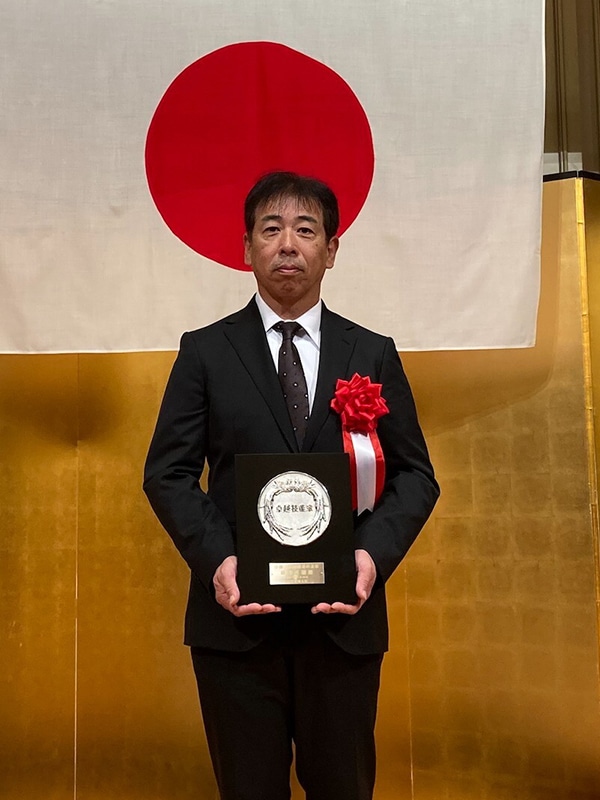
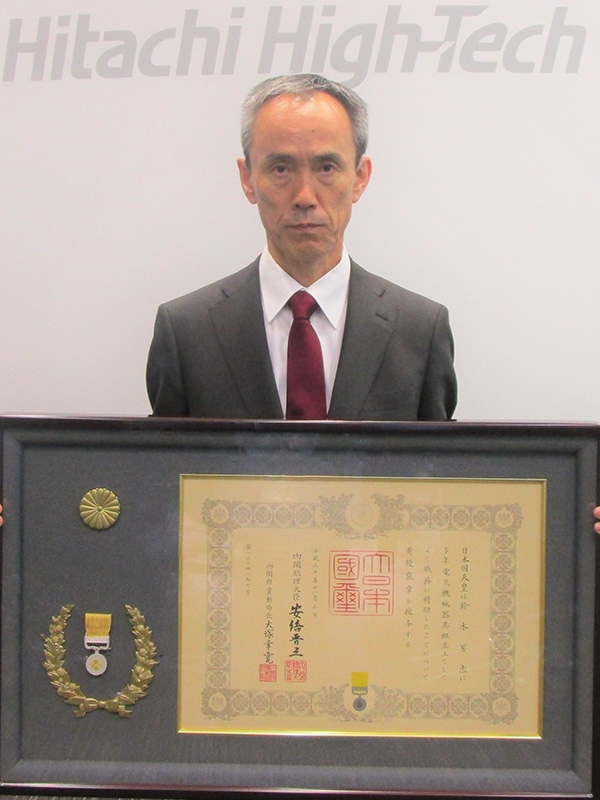
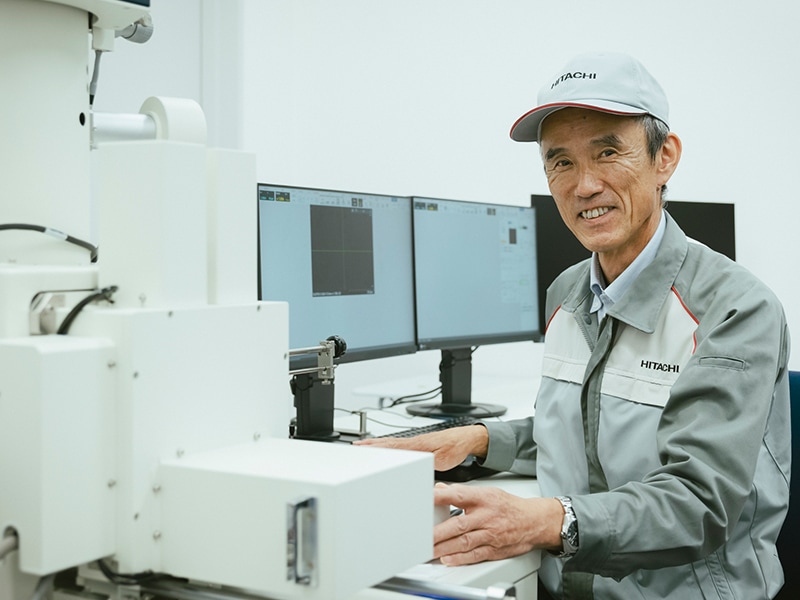
Masanori Watahiki has been involved in the precision assembly of electron microscopes ever since he joined the company 37 years ago. Electron microscopes consist of tens of thousands of individual components, with the smallest components measuring around one millimeter. Assembly of these instruments is carried out by human hands.
Watahiki explains that in recent years, the level of precision demanded in this assembly work has increased in line with increases in the resolution* of electron microscopes.
"In particular, since we began installing spherical aberration correctors—devices that correct aberrations in electron beams, thereby enabling observations at the atomic level—assembly has come to require micron-level* precision."
When working with this level of precision, it would be reasonable to think that automation with robots would be suitable.
However, Watahiki maintains that this is not the case.
"We use measuring instruments to verify the finished state, but the assembly process is carried out by hand, using the index finger to make micron-level adjustments. In a world where even the slightest touch of the fingertip can result in discrepancies of a few microns, the delicate touch and sensitivity of a human is essential, rather than automation."
However, Watahiki also believes that these skills should not be left to individual experience and intuition. He is therefore working on dedicated tools that enable less experienced workers to perform assemblies on par with veterans, as well as systems that visualize and automate the experience and intuition of skilled workers in the form of data.
"In the future, we hope to implement an automated system that assembles loaded components and uses AI to evaluate the finished product. That seems feasible to me."
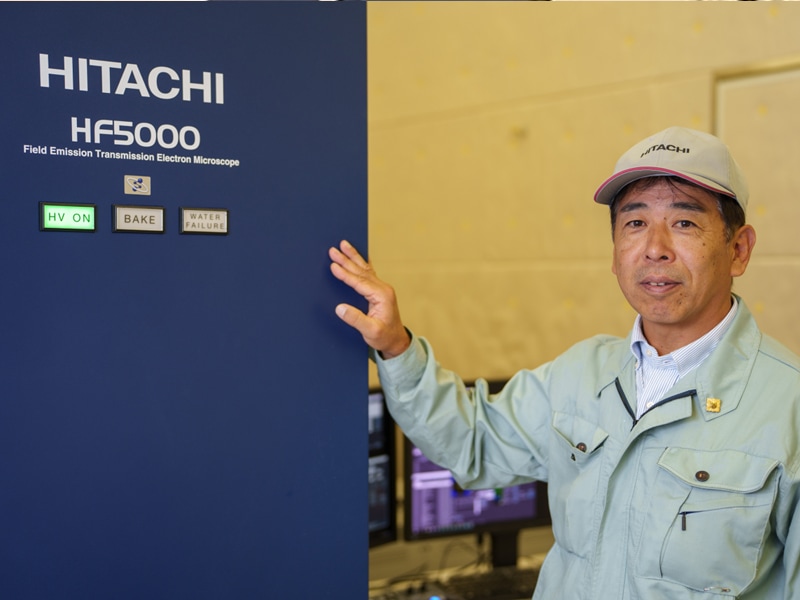
Fusashi Suzuki assembles and adjusts electromagnetic lenses. Of all the components that go into electron microscopes, these require a particularly high level of performance. He previously worked on the production of electric motors and hard disks for rolling stock. After 46 years with the company, Suzuki says that the experience he has built up across his different roles in the company has become a valuable asset.
"My first encounter with an electron microscope was back in 1988. I remember I was struck by the words of my mentor—the designer Mitsugu Sato—who said ‘cutting-edge science is found in work sites.’ One of my seniors suggested ‘let's do some physics at the work site,’ which sparked a sense of curiosity and excitement in me, and went on to become the source of my drive to improve my own skills."
Suzuki explains that each electron microscope has a tendency to show its "individuality" (variability in performance), despite being manufactured using the same components and standardized processes as other units of the same model. To eliminate these discrepancies and ensure that each microscope is able to reproduce the exact same results during measurements, intuitive adjustments performed by experienced and skilled technicians are required.
"In order to improve the quality of manufacturing, one must heighten the senses, such as hearing and touch. The image quality of electron microscopes can change with only slight differences in the adjustments. In order to understand why and how these changes occur, it is important to look at the physics, just like my senior said."
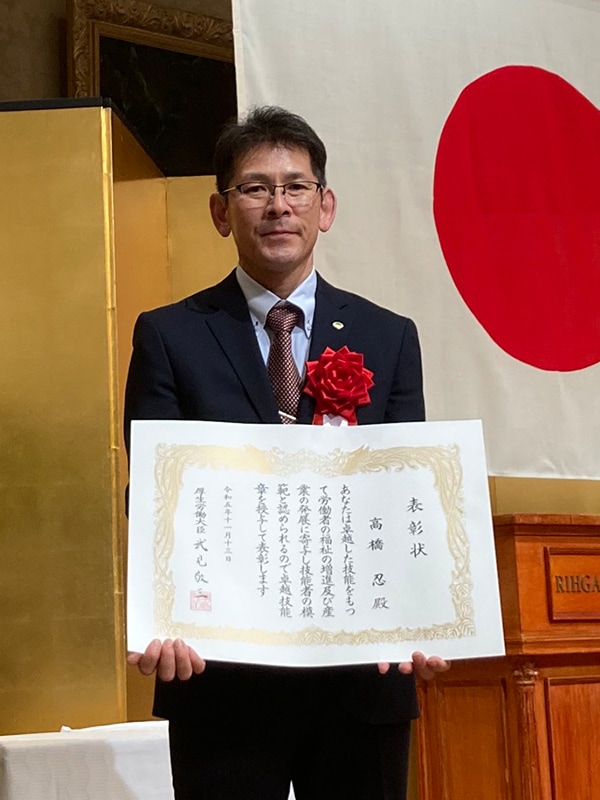
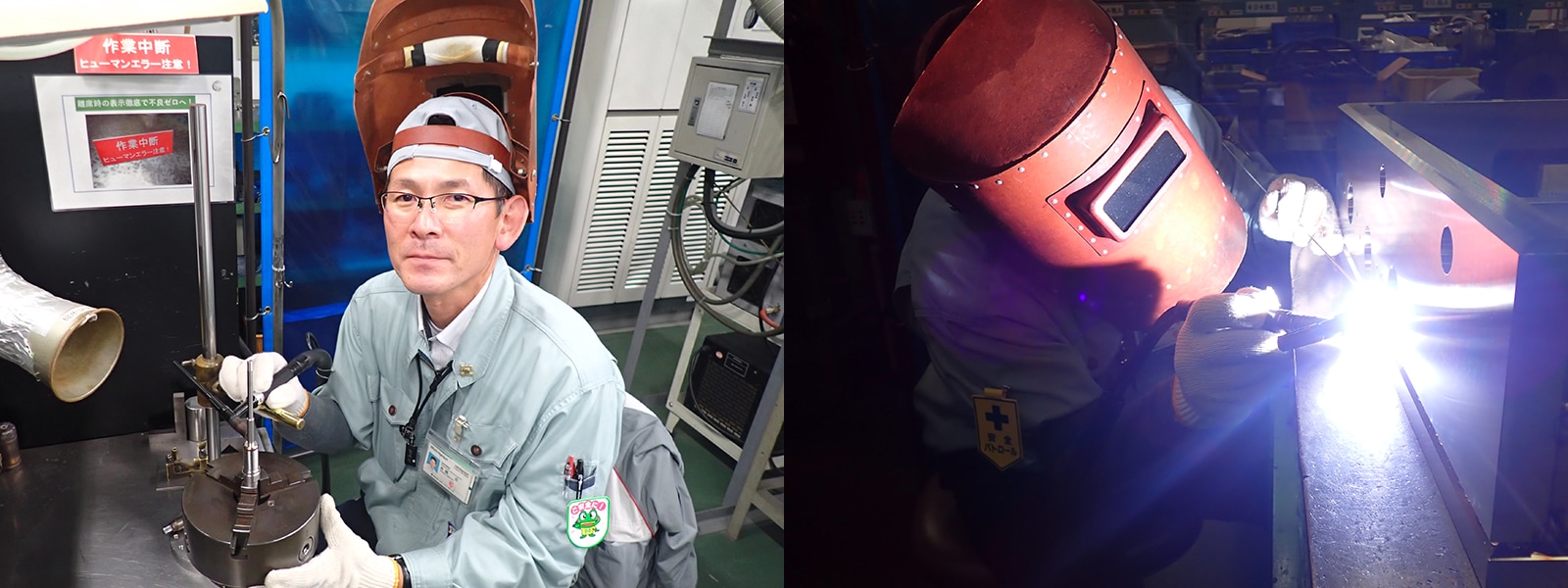
In his 39 years since joining the company, Shinobu Takahashi has dedicated himself to mastering metal welding. His first contact with welding came at the Hitachi Industrial Skills Academy, which he entered after graduating from junior high school.
"Welding as a process is highly reliant on the human worker. While it might be possible to automate the welding process for mass-produced products manufactured to identical specifications in the hundreds or thousands, Hitachi High-Tech products are based on an ethos of high-mix, small lot manufacturing. Creating an automation program for each product is time-consuming, so we weld by hand."
The gun chamber—an important part of the electron microscope assembly— is one example of an instrument requiring advanced-level welding. The chamber is a tubular component that must be welded to maintain an internal high-vacuum state, ensuring a stable electron beam and enabling high-definition observation.
Takahashi mainly performs arc welding, a process in which an electric discharge (arc) generates plasma, using its high heat to melt and join metal. In order to ensure that he is able to take full advantage of the high levels of sensitivity in his fingertips, Takahashi wears thin cotton gloves when performing welding work.
He recalls learning the finer points of welding that cannot be captured by numbers alone from a senior colleague he came to regard as a mentor after joining the company.
"The finished quality of the weld is a direct reflection of the skill of the welder. The quality is determined by the consistency of the weld in terms of width and height, the wave pattern and the color. The ideal color is a reddish gold. If you cannot reproduce the same finish each and every time, then you cannot be considered a first-rate welder. I spent many years following in my mentor’s footsteps, trying to hone my skills. I was so happy when he told me I'd done a good job."
Takahashi goes on to talk about his commitment to going the extra mile.
"Although it doesn't directly impact the performance of the final product, I like to pay close attention to ensuring beautiful esthetics, including clean and crisp weld lines. Even with the components that the customer will never see, I always aim to deliver work that anybody who understands welding will look at and think it was a job well done. It's important to me that I do not compromise on quality, even on the parts that are not visible."
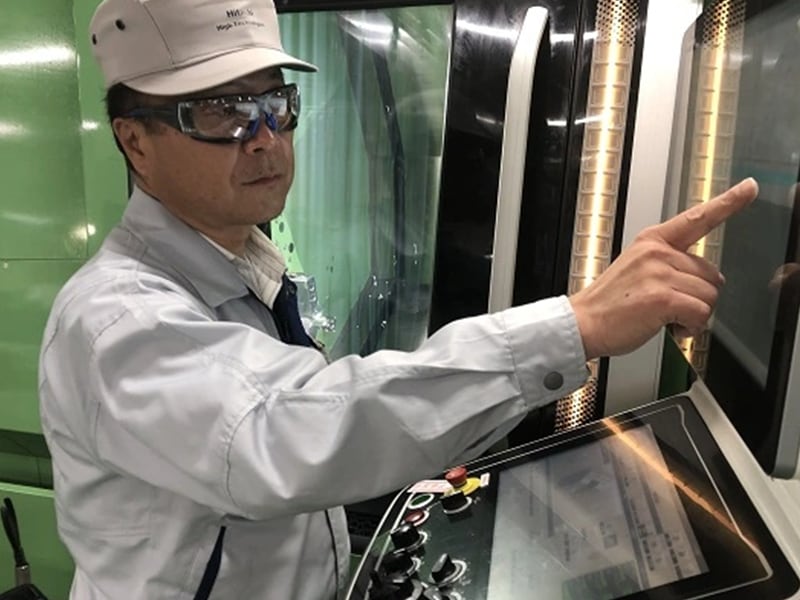
Machinist Mamoru Mashiko uses machine tools such as lathes and milling machines to finish metal components to the dimensions, shape and precision (tolerances) specified in drawings.
He helps create components for a wide variety of instruments, including various analytical instruments, medical devices, electron microscopes and semiconductor defect inspection tools. By improving the precision to which these components are finished, he helps minimize variability in the performance of instruments, thereby making the instruments more reliable.
When Mashiko first joined the company, he was surrounded by senior colleagues who were able to work at speed and make decisions quickly, which, as he reflects, served as motivation to improve his own skills so that he could emulate his colleagues’ capabilities.
"The turning point for me was when I entered an internal skills competition. I competed twice in an event that requires the use of both a lathe and a milling machine, and won first place in my second attempt. The feeling that I came away with was that there is no such thing as an 'upper limit' when it comes to manufacturing. In a typical examination, 100 points is the maximum score, and if you get 80 points, you pass. But in terms of manufacturing skills, there is a world beyond these 100 points."
Mashiko continues,
"By realizing a level of accuracy in excess of that set out in the design and development phase, it is possible to increase the level of completeness of the finished device or instrument. That's the fun part of this work. At no point have I ever thought that a requirement was impossible to achieve, no matter how high. Even though it can sometimes feel challenging with the equipment and environment one currently has at one’s disposal, we can always find a way by applying some creative thinking."
Mashiko explains that the introduction of particular measuring instruments has enabled him and his colleagues to quantify processes that were previously reliant on experience and intuition, thereby allowing them to perform work that was once considered impossible.
As AI and digital technologies evolve, they are forecast to continue to drive the increased visibility of areas of work that previously relied on the skills of human workers. However, Mashiko stresses that this does not mean that humans will no longer play an important role in the manufacturing process.
"What challenges will it solve? And how will it solve them? What processes need to be made more visible, and what equipment and programs need to be made available to realize those solutions? The role of humans is to consider these questions. That is why I think that people's knowledge and experience are going to become increasingly important."
Each of these four workers has different jobs. However, what they all share is the human will to further improve the quality of the instruments.
These four workers have not honed their skills by themselves. One of Watahiki's seniors said that "You cannot become a first-rate professional just by following the design drawings. You need to think about what lies beyond the drawings." Watahiki goes on to explain his interpretation of this advice:
"I think he was conveying to me that learning these skills is not just a case of memorizing the procedures, but also thinking about why a particular action or task is required and why particular processes are performed in the first place."
What really solidified this thinking was his experience being seconded to the service department two years after joining the company. By visiting customer workplaces to perform maintenance and repairs on instruments and communicating with customers, he was able to better understand how the instruments were being used and what issues the customers were facing.
"In one trip to a university, I received praise because of how I was able to ensure that the electron beam descended accurately even with the alignment function for fine-tuning the optical axis of the electron beam on the electron microscope switched off. How do customers assess the performance of the instruments that we assemble? It is these types of insights that I learned in my early years at the company that have shaped the way I approach my work."
It is those insights gained through interactions with a variety of people that have driven the growth of these master craftsmen. Cross-departmental interaction is part of the everyday work at Hitachi High-Tech. Mashiko provides us with an example of this.
"In addition to the manufacturing department where my colleagues and I work, the Naka Manufacturing Division also has many other departments, including design, production engineering and technical training, through which we have lots of opportunities to directly hear the passionate ideas of the design teams. I think that an environment where people can build relationships in such close proximity serves as fertile ground for cultivating proactive and decisive talent."
Takahashi adds the following:
"Even when the design requirements prove challenging, there is a culture of sharing our respective insights with one another to try and find some kind of a solution. My senior colleagues taught me that by improving my own skills, I would be better able to meet design requirements. This directly contributes to the customers who actually use our products, and I believe that the role of manufacturing is to ‘do something’ that has purpose."
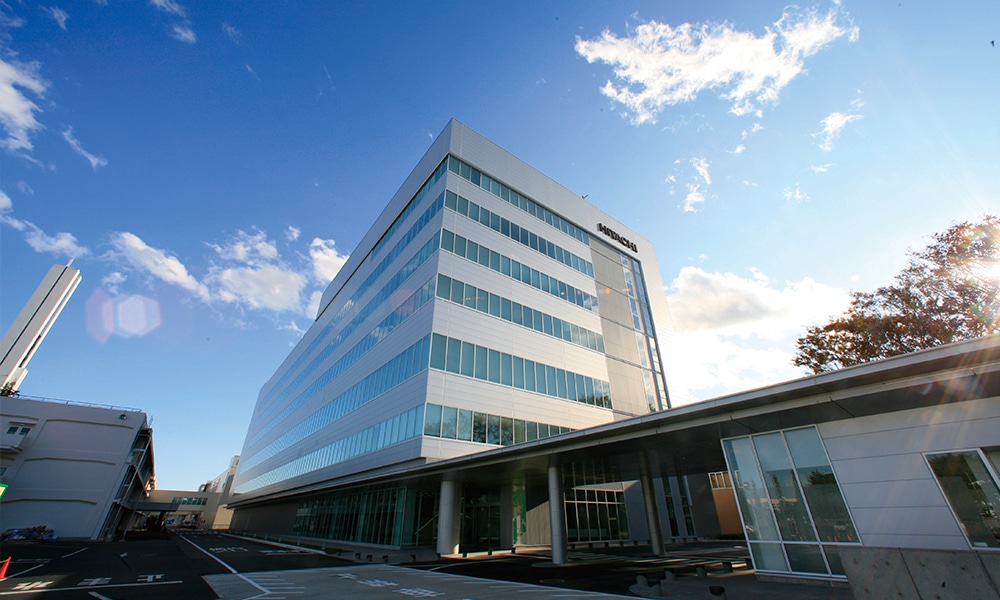
Suzuki expressed his thoughts as follows:
"In 2018, Hitachi High-Tech was one of the first companies to establish a system for highly skilled professionals.* We have also participated in JAVDA's Skills Competition, where young people come together to compete in manufacturing skills, for more than 50 years."
These skills competitions are akin to the Olympic games for technicians. There are two competitions: a national one held in Japan and an international one in which technicians from all over the world compete. Across both of these events, Hitachi High-Tech entrants have won over 100 gold, silver and bronze medals.
Suzuki continues,
"The participants and their instructors in the Skills Competitions train together with the aim of winning. Technicians working on the frontlines every day are similarly pouring their hearts into achieving their respective goals. This creates a virtuous cycle where colleagues across different work sites engage in friendly competition to refine both their skills and mindsets."
When we asked our four interviewees what qualities are necessary for a master craftsman, besides technical skill, each had something slightly different to say.
Watahiki pointed to a sense of responsibility. "Having a sense of responsibility fosters an uncompromising attitude right to the end. No matter how high your skill level, it is meaningless if you forget your responsibility to the customers and society who depend on the quality of your work."
In one instance, when a malfunction occurred at the customer end, Hitachi High Tech technicians were able to identify the cause of the issue and work throughout the week until the malfunctioning instrument was restored. Behind this tenacious response was a sense of responsibility to represent Hitachi High-Tech's Manufacturing Department.
Suzuki mentions a determination to never give up. "One of my favorite authors has a book called Living by Pushing Yourself, Just a Little (tentative translation).* It basically expresses the importance of determination when seeking personal growth."
Suzuki aspires to develop new manufacturing processes for key parts used in equipment employing electron beams. Instead of being satisfied with current working methods, Suzuki believes that seeking out better methods of working will generate new value and be to the greater benefit of society.
Takahashi, meanwhile, values the drive toward self-improvement. "Welding is highly dependent on individual skill, and the quality of the finished product is a reflection of the characteristics and experience of the individual welder. That's why I've dedicated myself to self-improvement with the hope of one day being recognized as a leader in my field."
"There are many different types of welding. My knowledge and experience lie in TIG welding—a type of arc welding—and gas welding using flammable gas, but I want to expand my skills to other welding methods so that I can contribute to the evolution of manufacturing," says Takahashi, with a view to the future.
Mashiko talks about developing a strong interest in the subject. "Instead of waiting for a problem to occur before investigating things, maintain a curious mindset and analyze things as a matter of routine. From this, you can always find things that can be improved further, particularly with smaller points that others might overlook."
Mashiko is currently working on the deformation that affects materials and tools used at processing sites. The challenge lies in how to minimize the minute deformations that occur when the workpiece moves away from the cutting tool or, conversely, when the tool bites too deeply into the material. In his daily work, Mashiko is never short of new challenges to set his mind to.
The Contemporary Master Craftsman program has produced medalists in many fields, not just the industrial sector. These other fields include traditional crafts, cuisine, beauty and gardening. The four master craftsmen talk about their feelings from interacting with other winners.
"Regardless of the field, we all share a common mindset of never being satisfied with the status quo and consistently wanting to push ourselves to learn more." (Watahiki)
“I was strongly drawn to the philosophy held by the masters of the traditional crafts, which is that your skills will only survive if you have the support of your customers." (Suzuki)
“We are all producing high value-added deliverables that combine elegance and functionality, born out of a skill set fostered over many years." (Takahashi)
"Each individual is a perennial student at heart and is deeply interested in what they are doing." (Mashiko)
Suzuki says that the Italian phrase "Ancora imparo" (I am still learning), which he heard back in 2017 when he won the award, is etched into his memory. The secret to becoming a master craftsman may be the mindset of always aiming for better rather than settling for the status quo, regardless of their age or where they are in their career.
Our four master craftsmen all have their own messages for the next generation of young technicians.
"Don't allow the fear of failure to prevent you from challenging yourself. All of your experiences, including those that ended in failure, will be valuable to your growth," says Watahiki, who is also putting his efforts into teaching at industrial high schools as a master craftsman in Ibaraki Prefecture. The hope is that by allowing the younger generations to experience the joys of manufacturing, they will develop a greater interest in contributing to Japanese industry in the future.
"If you are satisfied with the skill levels that you already have, you should remember that your growth will come to a complete stop," says Suzuki. "You should always be thinking about which of your skills need to be updated and which do not. Puzzle solving is also key as it gives you more opportunities to challenge yourself in the fields you want to pursue. This is what I would advise if you want to go on to become master craftsmen,” he offers by way of encouragement.
"Refine the skills that you learned from your predecessors and aim for world-class levels of manufacturing,” says Takahashi who is aiming to broaden the manufacturing base by conveying some of the appeal and depth of welding as a skill to students at industrial high schools and other educational institutions.
"You should also maintain an interest in things that seem to have little connection to your work. In the long run, these interests will circle back around into your work," says Mashiko, adding that "manufacturing starts with developing people."
Based on the Hitachi Group sustainability strategy PLEDGES,* the Hitachi High-Tech Group is committed to realizing its corporate vision by maximizing financial and non-financial value through the development of its business in accordance with the five focus areas of sustainability.

Our measurement and analytical instruments help customers find solutions to problems by ensuring stable quality, improving the efficiency of work processes and accelerating research and development efforts. The values generated by these instruments support technological innovation in the semiconductor, healthcare, and environment and energy sectors while also contributing to social/environmental value by linking in with Hitachi High-Tech's sustainability focus areas of a "sustainable global environment," "healthy, safe and secure lives,” and the "development of science and industry."
Driven by a passion to create something better, Hitachi High-Tech's Contemporary Master Craftsmen, working at sites supporting the development and manufacturing of such instruments, are engaged in efforts to make day-to-day improvements to their work processes, to pass on their skills and to explore the possibilities of manufacturing in the future.