


FOR IMMEDIATE RELEASE
Hitachi High-Tech supports the optimization of coating processes for cathode active materials used in all-solid-state batteries with HMAX Industry utilizing physical AI
Contributing to advancements and efficiency in the battery industry, combining data measurement from digitalized assets and advanced AI analysis such as informatics
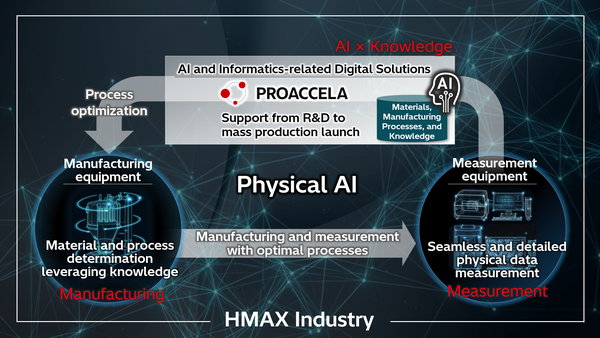
Tokyo, August 20, 2026 – Hitachi High-Tech Corporation ("Hitachi High-Tech") has completed a demonstration ("the Demonstration") to investigate optimal coating conditions for the surfaces of cathode active materials*1—a process in the manufacturing of all-solid-state batteries, aiming to prevent output degradation and battery deterioration—with Powrex Corporation ("Powrex"). Hitachi High-Tech and Powrex will accelerate collaborative efforts toward its commercialization.
Coating is an important factor that directly affects the performance of all-solid-state batteries, and is an advanced technology that requires specialized knowledge and experience. The Demonstration, which leveraged Powrex's technical capabilities in coating, its domain knowledge, and its extensive equipment operation data and Hitachi High-Tech's physical AI that combines analytical technology with AI and informatics technologies*2, validated an efficient approach to identifying optimal coating conditions.
We will build a system that enables efficient and data-driven process development that previously relied on the accumulated highly specialized knowledge and vast experience of engineers to repeatedly conduct experiments and prototyping. By offering this as part of HMAX Industry lineup, we aim to contribute to the development of all-solid-state batteries with Lab to Fab*3, to shortening the time required for beginning mass production, and to the stable supply of high-quality all-solid-state batteries.
*1 Cathode active materials: Materials that take in electrons during a battery reaction. Metal oxides containing lithium ions are primarily used.
*2 Developed and provided in collaboration with Hitachi, Ltd.
*3 Lab to Fab: A business model that provides integrated support from R&D to mass production, creating value such as reducing time from development to market launch (Time to Market).
Background and Challenges
Secondary batteries*4 used in PCs, smartphones, and EVs (electric vehicles) are widely used as one of the sources of energy that contribute to the realization of a sustainable society. In recent years, instead of lithium-ion batteries, all-solid-state batteries —which use safer, non-combustible solid electrolyte materials—have been attracting attention. In addition to having improved safety, all-solid-state batteries are expected to offer improved energy density and a longer service life thanks to their higher voltages and ability to be used with metal lithium anodes. As a result, we can expect them to deliver many benefits— including increased EV ranges; fewer recharge cycles; smaller, lighter battery packs; and more—and contribute to a decarbonized society.
On the other hand, one of the challenges in the adoption of all-solid-state batteries is developing a manufacturing process that can prevent reactions that would lead to a battery output degradation and battery deterioration. Secondary batteries consist of electrodes (positive and negative) and electrolytes, with the ions contained within the electrode's active material generating energy by traveling through the electrolytes. Of these, all-solid-state batteries are attracting attention due to their use of electrolytes that have high ion conductivity and are non-combustible solids, enabling them to be safer and have better battery performance. However, within the course of the all-solid-state battery’s repeated discharge and charge cycles, a resistive element forms at the interface between the cathode's active material and the solid electrolyte, causing energy output degradation. To address this, a method has been strongly adopted whereby the cathode's active material is coated with a lithium-conductive oxide film to prevent the formation of this resistive element. Designing an optimal coating process that achieves uniformity, coverage, and film thickness control for particulate cathode active materials required multiple factors to be considered, such as material composition, compatibility with solid electrolytes, and equipment conditions. As such, investigating these conditions and scaling up required a significant amount of time and workload. In addition, highly specialized knowledge and skills in coating and batteries were required, and in many cases relied on the experience and knowledge of expert workers. This presented a challenge due to the limited number of researchers capable of designing high-quality coating processes.
*4 Secondary batteries: Examples of these include lithium-ion batteries and lead-acid batteries, which contribute to reducing resource consumption and waste as they are rechargeable and can be used repeatedly. In addition, all-solid-state batteries and sodium-ion batteries are expected to be adopted and more widely used as next-generation batteries.
Overview
Powrex is a manufacturer providing equipment and process solutions centered around powder processing technology*5 to a wide range of fields such as pharmaceuticals, food, chemicals, and battery materials. Its strengths lie in its equipment technology and process design capabilities in powder processes such as mixing, granulation, and coating. In addition to having coating technology for a wide variety of highly complex particle shapes, the company has a proven track record of leveraging its long-standing technological capabilities and knowledge cultivated over many years to create high-quality coating processes based on optimal conditions tailored to particle size distribution and material properties. Hitachi High-Tech provides analytical instruments and electron microscopes to a wide range of fields, including materials, biology, biotechnology, and pharmaceuticals, supporting the analysis and evaluation of various materials and products. In the batteries field, Hitachi High-Tech has also supported the battery material development and mass production investigations with our analytical and analysis technology by providing X-ray fluorescence analyzers (XRF) and scanning electron microscopes (SEM). With One Hitachi, we are also contributing to promoting DX for our manufacturing customers, from R&D to mass production, through the use of Physical AI that combines PROACCELA*6—a digital solution that leverage the Hitachi Group's AI and informatics technologies—and measurement data.
*5 Powder processing technology: Technology for processing raw materials into powder and granules.
Both companies are merging the cumulative technological capabilities, expertise, and knowledge they have cultivated over the years with digital technology to streamline these investigations into the optimal processes for achieving high-quality coatings, particularly with regard to configuring and evaluating coating conditions on cathode active material surfaces, for which past investigations would have had to go through repeated trial and error while relying on highly specialized knowledge and experience.
Specific demonstration details
(1) Developing a quantitative method for physical properties evaluations for cathode active material coatings
Measuring the coatings of cathode active materials is incredibly difficult as it requires complicated pre-treatment and the use of equipment that demands a high level of specialized knowledge, hence why there was a need to develop a simpler measurement method. In the demonstration, we used Hitachi High-Tech's XRF and SEM, which require no complicated pre-treatment and are easy to operate, to analyze samples with fluidized bed*7 coatings under various manufacturing conditions in Powrex. This enabled us to streamline the evaluation process, and by shortening evaluation time and reducing measurement result variability, we also developed a method for quantitatively evaluating coating conditions such as coating thickness, coating uniformity, and interfacial characteristics. In addition, we were also able to clarify the causal relationships between processing conditions, material properties, and battery performance based on the data obtained.
*7 Fluidized bed: A layer of mixed solids and gas whereby the inflow of air from below the powders and particles ("particulate") has caused this particulate to become suspended and mixed with the air. This results in a state in which the particulate and air flow together like boiling water.
(2) Optimizing coating conditions through the utilization of process informatics
We integrated operational data obtained from Powrex's coating equipment, past coating performance data, and evaluation results from the method developed in (1) into a single data table, and then applied Hitachi High-Tech's PROACCELA process informatics (PI)*8 technology. In the past, engineers would have had to go through trial and error while relying on their highly specialized knowledge and experience for investigations. This time, using PROACCELA yielded optimal solutions for high-quality, highly reproducible coating conditions.
As a result of the Demonstration, we were able to determine the optimal coating conditions and confirm that this method would reduce development time and the time required for beginning mass production for particle coating, which is highly technically challenging.
*8 Process Informatics: A technology that integrates and analyzes data on conditions and measurements from manufacturing and experimental processes, and uses data‑driven approaches to predict performance and identify optimal manufacturing process conditions.
Future Outlook
Based on the results of the demonstration, Hitachi High-Tech and Powrex will work toward commercializing an optimal coating process proposal, as part of HMAX Industry lineup, in anticipation of the full-scale emergence of the all-solid-state battery market which is expected to emerge around 2030. In addition, for battery materials, we will expand the scope of this application to various coatings and types of materials. Going forward, we will explore expanding into a wide range of fields, including not only the battery industry, but also fields such as high-performance materials, pharmaceutical products, and chemicals.
Hitachi High-Tech belongs to the Industrial Solutions Business Unit in Hitachi's Connected Industries (CI) sector, and is focusing on HMAX Industry, a next-generation solutions group that combines domain knowledge and advanced AI with data from a rich installed base of products (digitalized assets). Hitachi High-Tech aims to become a leading company in physical AI, and through its core focus of providing industrial solutions centered on these technologies, aims to maximize lifetime value for its customers and transform industries globally to achieve a prosperous society.
Related Links
Trademark Notice
All trademarks and product names are the property of their respective owners.
About Hitachi High-Tech
Hitachi High-Tech provides cutting-edge technologies, products and services to society and customers with its corporate vision of "Changing the World and Future with the Power of Knowledge" to contribute to a sustainable global environment, healthy, safe and secure lives, and the sustained development of science and industry. We manufacture and sell clinical analyzers, biotechnology products and radiation therapy systems in the healthcare field, semiconductor manufacturing and inspection equipment in the semiconductor field, as well as analytical systems and electron microscopes used in environmental fields and materials research. We are also engaged in a wide range of business areas globally, providing high added-value solutions in battery, communication infrastructure, railway inspection, digital and other industrial and social infrastructure fields. We provide solutions through a deeper understanding of the issues facing society and our customers to contribute to realizing a sustainable society. The company's consolidated revenues for FY2025 were approx. JPY 821.7 billion.
For further information, visit https://www.hitachi-hightech.com/global/en/
Business Contact
Beam Technology & Analytical Systems Business Div.,
Core Technology & Solutions Business Group,
Hitachi High-Tech Corporation