
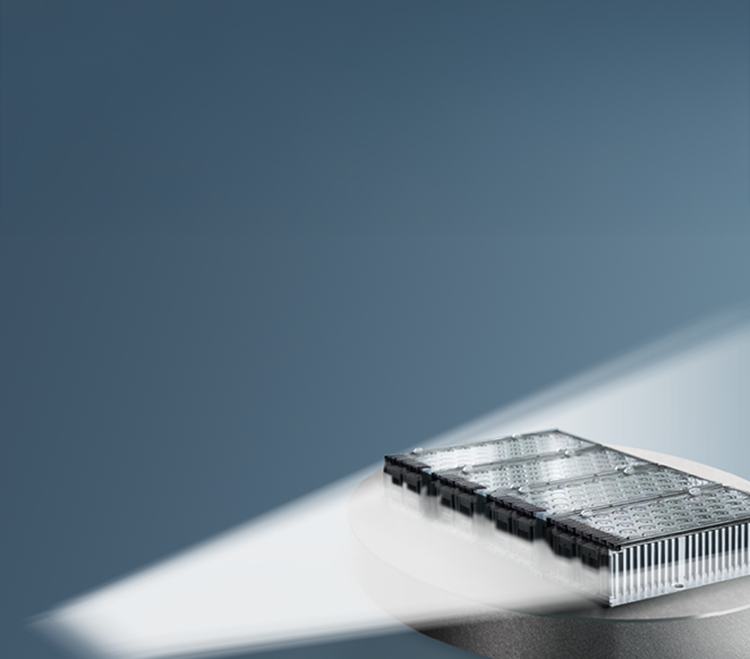


From liquid lithium-ion batteries (LIB) to fully solid-state batteries and fuel cells,
we visualize the inner structure of on-board battery packs and modules
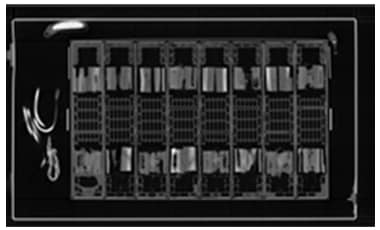
To observe the state of a battery before and after impact and crush testing compliant with the United Nations UN-R100 standard for electric vehicle batteries, other relevant standards and customer specifications, it can be difficult to disassemble the test sample, making non-destructive analysis through high energy X-ray CT system an effective option.
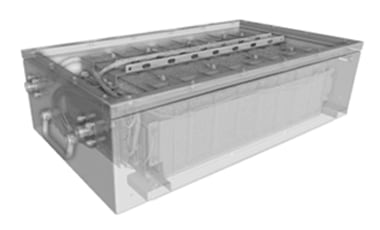
By using high energy X-ray CT system for benchmarking during the development stage, it is possible to create 3D data of both the exterior and interior of a piece without disassembling the main body to evaluate its dimensions.
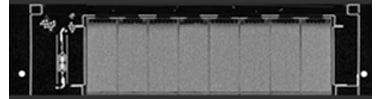
In some cases, defect or degradation analysis of a battery pack is only possible with disassembly, and since it is necessary to observe the entire battery pack, high energy X-ray CT-based non-destructive analysis is an effective approach.
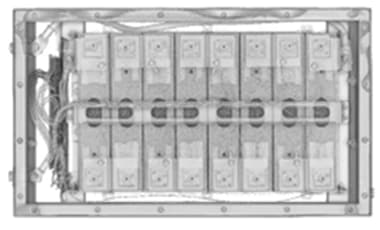
When considering the design of structural reinforcement during the battery development phase, checking the bonding state of bus bars or verifying battery pack or module assembly precision, the inner structure needs to be confirmed non-destructively. An integrated approach employing high energy X-ray CT-based non-destructive analysis, the generation of 3D images, dimensional evaluation and CAE analysis, etc. is an effective way to do this.
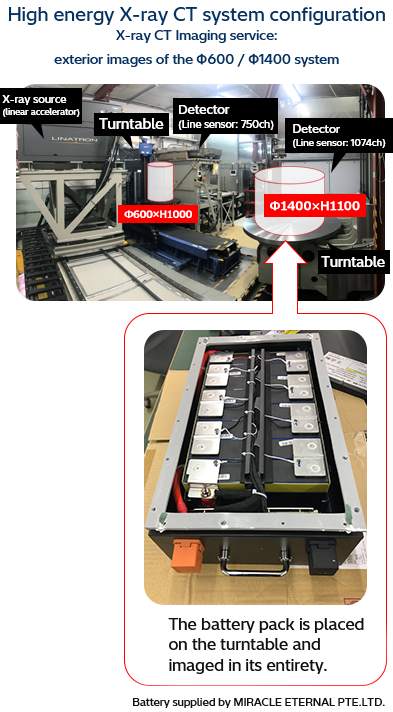
Battery supplied by MIRACLE ETERNAL PTE.LTD.
High energy X-ray CT system is an indispensable tool in lithium-ion battery quality control and development, and helps streamline development and enhance quality control for various types of batteries.
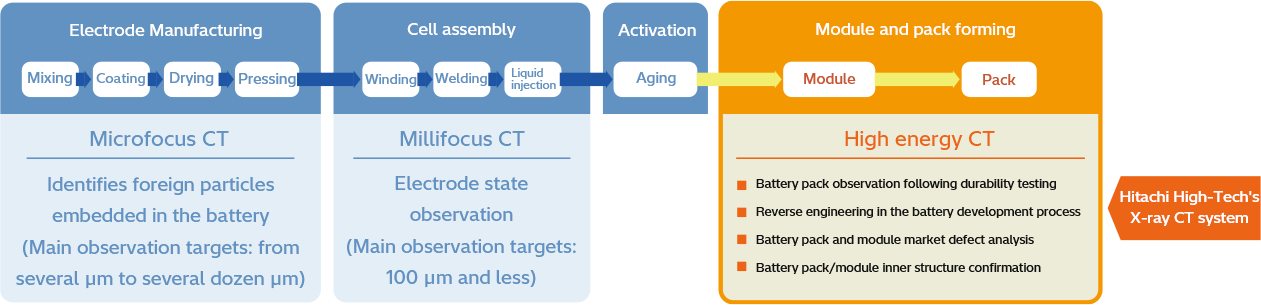
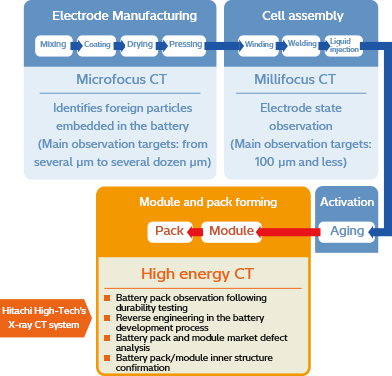
In lithium-ion battery manufacturing, there are appropriate X-ray CT testing ranges for each process. Microfocus CT is suitable for electrode manufacturing, while the cell assembly process requires millifocus CT, and battery module/pack forming falls under high energy CT.
Hitachi High-Tech's industrial X-ray CT systems boast high energy 9MV output, among the world's strongest. This enables entire battery packs and modules to be imaged, which cannot be observed with other X-ray CT systems.
The ability to observe the internal structure enables the confirmation of assembly precision, reverse engineering and market defect analysis. In addition, it helps return insight to highly reliable designs through the 3D reconstruction of the captured images and the generation of meshes for CAE analysis.
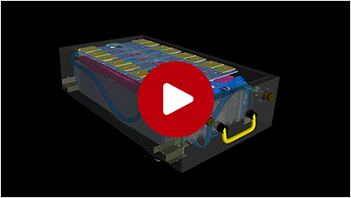
3D video generated by the high energy X-ray CT system
Generated 3D image of an e-axle and lithium-ion battery pack
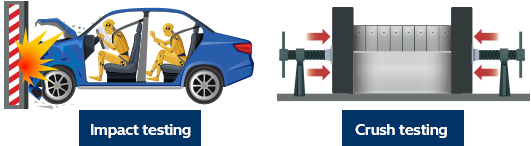
Observing the inner state of the battery before and after testing is crucial when developing batteries compliant with the impact and crush testing required by the United Nations UN-R100 standard for EV batteries. It can be difficult to observe the state of a battery before and after impact and crush testing through disassembly, making non-destructive testing through X-ray CT scanning an effective option.
Hitachi High-Tech's industrial X-ray CT system boasts high energy 9MV output, among the world's strongest. This enables entire EV battery packs and modules to be scanned, to efficiently observe battery state before and after testing.
During the vehicle and battery design phases, it is necessary to obtain 3D data and generate meshes to perform the simulation analysis (CAE) needed to ensure EV battery safety. Hitachi High-Tech supports the generation of meshes from imaging data, which helps customers reduce person-hours.

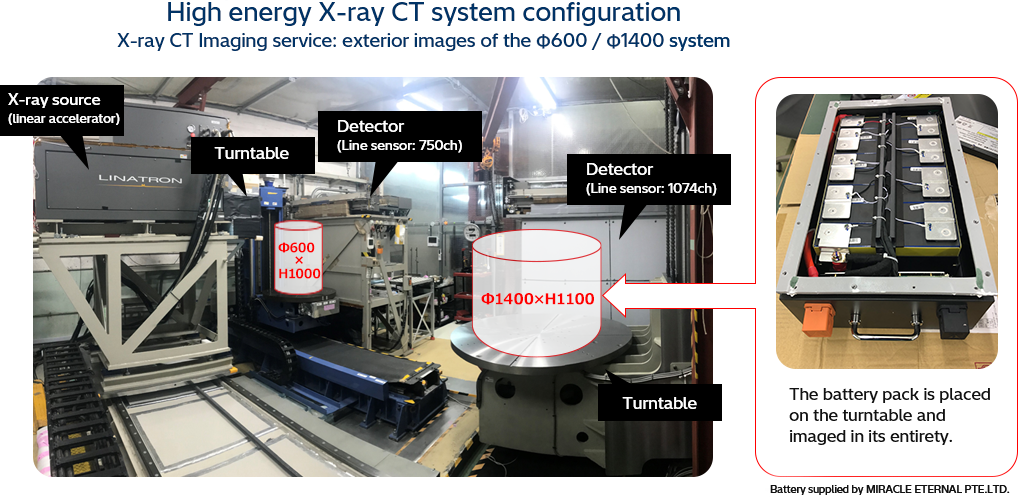
Hitachi High-Tech's high energy X-ray CT systems are able to image large and heavy objects thanks to the high penetration capabilities of high energy X-rays boasting 9MV output, among the strongest in the world. This makes it possible to observe the interior of on-board battery modules and packs non-destructively, a task that has traditionally been difficult.
High energy X-ray CT imaging is useful when considering the design of structural reinforcement during the battery development phase, and when verifying on-board battery pack or module assembly precision. In addition, with conventional disassembly techniques, it can be difficult to observe the state of a battery before and after impact and crush testing compliant with the United Nations UN-R100 standard for electric vehicle batteries, other relevant standards or customer specifications. With high energy X-ray CT imaging, this can be done non-destructively.
In some cases, defect analysis of a battery pack is only possible with disassembly, and since it is necessary to observe the entire battery pack, high energy X-ray CT-based non-destructive analysis is an effective approach.
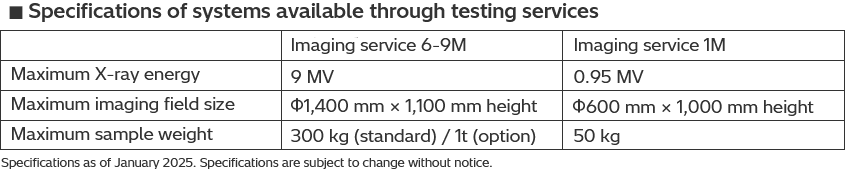
The size of the sample that can be observed varies by system model. Hitachi High-Tech offers two types of systems, each tailored to different imaging environments.
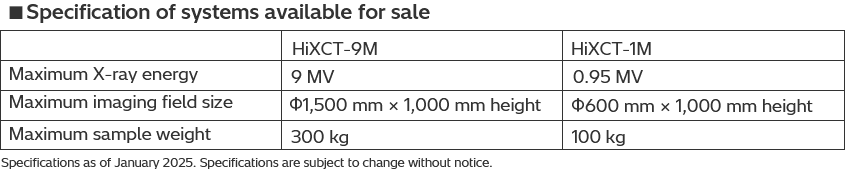
Maximum imaging field size and maximum sample weight can be customized.
EV battery (on-board battery) packs are sets of batteries equipped in vehicles, supplying power for the entire vehicle. These packs include multiple battery cells, with lithium-ion batteries commonly used. By contrast, EV battery (on-board battery) modules are assemblies of multiple battery cells that are combined and adjusted so that the appropriate capacity and voltage levels are reached. They are also referred to as "assembled batteries." When multiple modules are connected with one another, and housed in a case that incorporates various functions such as protective circuits, a battery management system (BMS), charge-discharge circuits and cooling mechanism, it functions as a single "packaged" system and is therefore referred to as a "battery pack." To put it simply, EV battery modules are the parts that make up EV battery packs. High energy X-ray CT scanning is an effective way to non-destructively analyze the inner structures of EV battery packs and EV battery modules.

This section introduces the features of Hitachi High-Tech's high energy X-ray CT systems.
This is a generated 3D image of an e-axle and lithium-ion battery pack.
Sign up to view the two materials described above.