


Hitachi's high-energy X-ray CT systems use an electron beam-type accelerator as the source of X-rays. The following table shows the differences in penetrability achieved for different sample materials and X-ray energy levels. The higher the X-ray energy, the better it can penetrate a material.
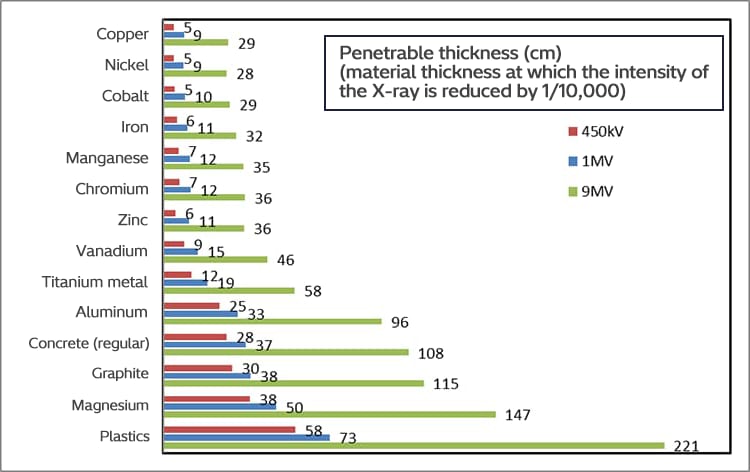
How differences in sample material and X-ray energy affect penetrability
Hitachi's high-energy X-ray CT systems offer selectable X-ray sources with outputs of 1 MV, 3 MV, 6 MV and 9 MV. The following table summarizes the differences in penetrability based on X-ray energy for each of these output options. In addition, MV-class X-rays not only feature high penetrability, but also enable density analysis by correlating X-ray attenuation with the density of the material being imaged.
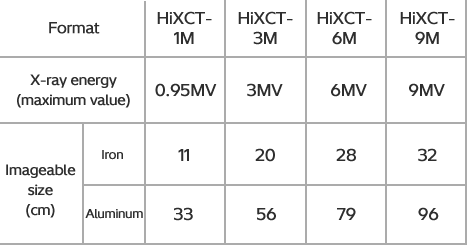
Specifications of Hitachi's high-energy X-ray CT systems
Many industrial products are made up of a combination of various components, from low-density materials such as resin and rubber, to high-density materials such as steel and copper. To CT image these composite materials, a wide detection dynamic range is essential.
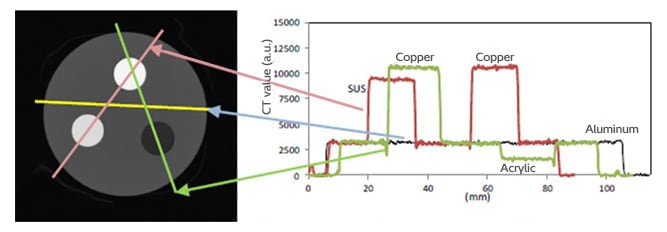
Figure 1 Example of Composite Material Density Identification (1)
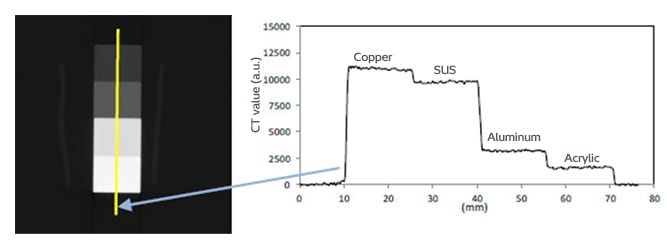
Figures 2 Example of Composite Material Density Identification (2)
Figures 1 and 2 show the results of CT imaging performed on a sample material made up of copper, steel (SUS), aluminum and acrylic, using Hitachi's high-energy X-ray CT system. CT values that correspond to the density of each material are recreated, showing that accurate density measurements for composite materials can be made.
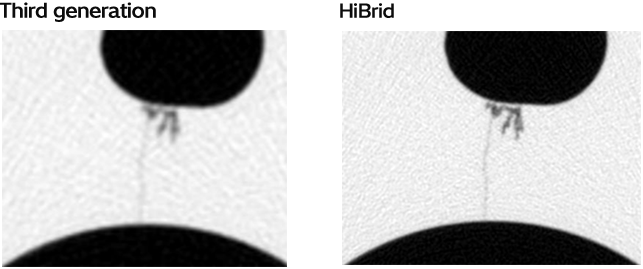
This figure compares images of an area where a defect has occurred inside cast iron.
The HiBrid method allows the state of defects to be confirmed in greater detail.
Hitachi developed the HiBrid imaging method to take better advantage of the performance of high-output, high-resolution equipment.
The rotate-rotate geometry method (third generation) is currently the most common imaging method used in industrial X-ray CT systems.
In addition to this imaging method, Hitachi has developed the HiBrid method (double-rotate method). This HiBrid method conducts CT imaging over two rotations, enabling resolution to be improved by approximately 1.5 times (according to a 0.5 MTF value compared with other Hitachi products) while using the same detection array.
Spatial resolution is the ability to determine to what degree of detail you can distinguish between small parts of an image when it is scanned.
In X-ray CT systems, as the X-ray energy increases, penetrability increases, making it possible to image large samples. However, as the focal point becomes larger, the resolution decreases. With the HiBrid method developed in-house by Hitachi to solve this, high penetrability has been successfully balanced with high resolution.
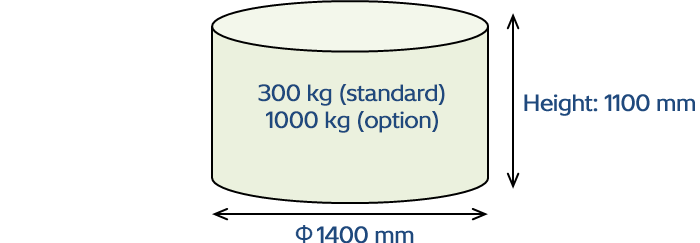
In addition to using a 9 MV high-energy X-ray, among the most powerful in the world, Hitachi has developed an offset scanning method enabling the imaging of large samples. The size of samples that can be imaged (table diameter and height) can be customized to meet customer requirements. Hitachi's contract imaging services support turntable diameters of Φ1,400 mm and maximum loads of 1 ton, among the highest in Japan. This allows customers to perform CT scanning of a wide range of materials including engines, automotive batteries, large cast products, large tires and cultural artifacts without having to divide large samples into smaller parts.
Imaging service* equipment (φ600 mm type) *Available only in Japan

Imaging service* equipment (φ1400 mm type)
Among the largest in Japan
*Available only in Japan
Hitachi's X-ray CT systems are equipped with high-sensitivity, high-performance detectors known as HiR, which were developed in-house. Hitachi has also developed a dedicated detector circuit that leverages the characteristics of HiR detectors. High-energy X-rays with strong penetrability also pass through the detectors. Hitachi has been developing detectors capable of detecting these high-energy X-rays with a high degree of sensibility since the 1980s, and those efforts are ongoing.
This section introduces the features of Hitachi High-Tech's high energy X-ray CT systems.
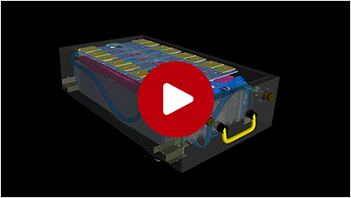
This is a generated 3D image of an e-axle and lithium-ion battery pack.
Sign up to view the two materials described above.