Made Possible by Materials Informatics and Analytical Instruments
In recent years, the ongoing transition to electric vehicles and other developments in the automotive world have imposed increasingly stringent demands on the performance of tires. The task of developing powerful new materials to meet these needs requires that conventional strategies—based on the experience and skills of individual designers—be augmented by material informatics (MI) techniques capable of rapidly developing new materials using high-quality data. One firm on the vanguard of this new paradigm is Asahi Kasei Corporation, which recognized the possibilities of MI from the earliest stages and has moved aggressively to deploy it for product commercialization, notching one prominent success with the development of new synthetic rubbers. To learn more, we visited Asahi Kasei's Synthetic Rubber Development Department and spoke with Chief Engineer Yoshihisa Inoue about the trajectory of this project and the role played by analytical instruments.
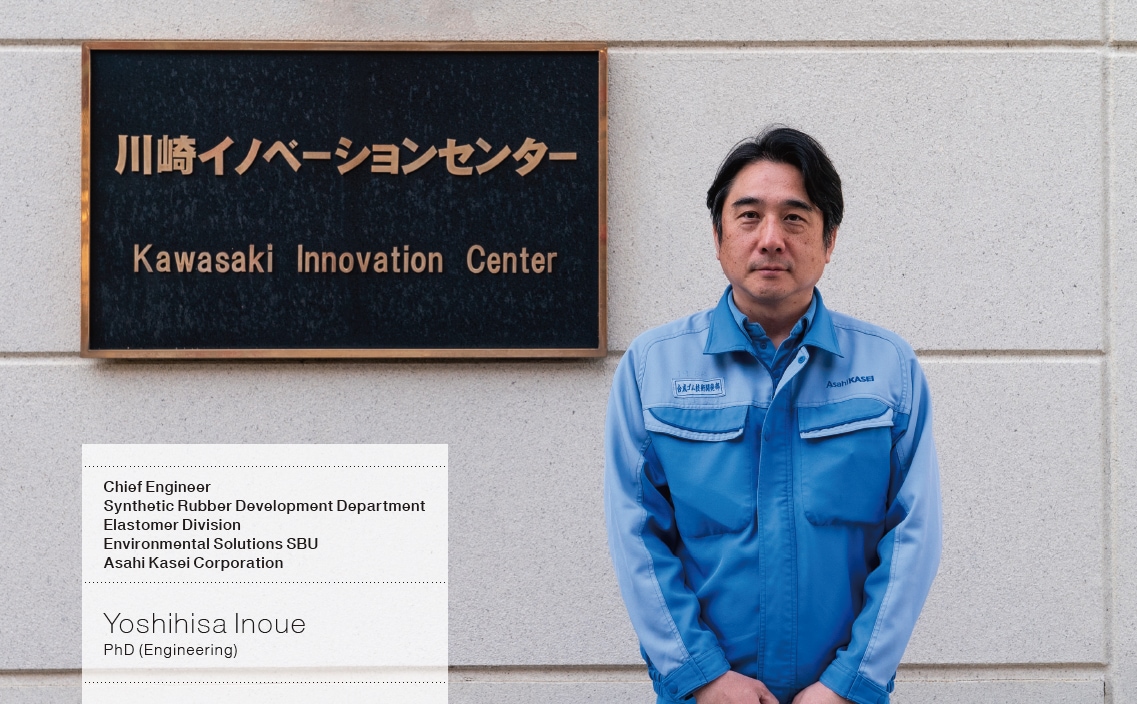
Chief Engineer
Synthetic Rubber Development Department Elastomer Division Environmental Solutions SBU Asahi Kasei Corporation
Yoshihisa Inoue
PhD (Engineering)
The functionality and performance of products depends crucially on the properties of their constituent materials. In the past, the standard approach to designing materials with desired properties was simply to guess promising combinations of ingredients of various types and structures—relying heavily on the knowledge, experience, and intuition of individual researchers—and then test these combinations experimentally. The problem, of course, is that the number of possible combinations is essentially infinite, so finding the optimal solution via this process requires many, many iterations of the research and testing cycle—which is why there always seemed to be unavoidably long delays before new materials could debut as commercial products.
The story is one with which Inoue is all too familiar.
“Right now I'm part of a Synthetic Rubber Development Department—we're an R&D team working on synthetic rubber materials for tires, and I'm in charge of characterization and analysis for these new materials, as well as technical services. Until fairly recently, the development of synthetic rubbers for automotive tires followed the same trial-and-error procedure I mentioned before. We would fabricate a candidate material and test its performance, and if things looked good we'd pass it along to some tire manufacturers for their assessment, then make improvements based on their feedback and iterate the process. The key to eking out a competitive position was the speed of this iteration—having received test results and customer feedback, how quickly could we rally back with improved candidates for the next round?”
Inoue's experience testifies to the inestimable value of speedy development cycles. The question of how quickly a company can leverage its accumulated base of in-house assets—experience, know-how, research data, and other resources—to develop new materials with competitive advantages remains perpetually mission-critical. But in today's world, with so many promising new materials having already been developed and commercialized, the challenge of producing higher-performance synthetic rubbers with all requisite properties is daunting—and threatens to cost more, and take longer, than ever before.
Over the past few years, this reality has motivated a new strategy for instantly turbocharging the pace of material development: augmenting the conventional toolbox of computational simulations and laboratory experiments with novel AI techniques such as machine learning and data mining. This new paradigm of materials informatics has already begun transforming the material-development process in dramatic fashion.
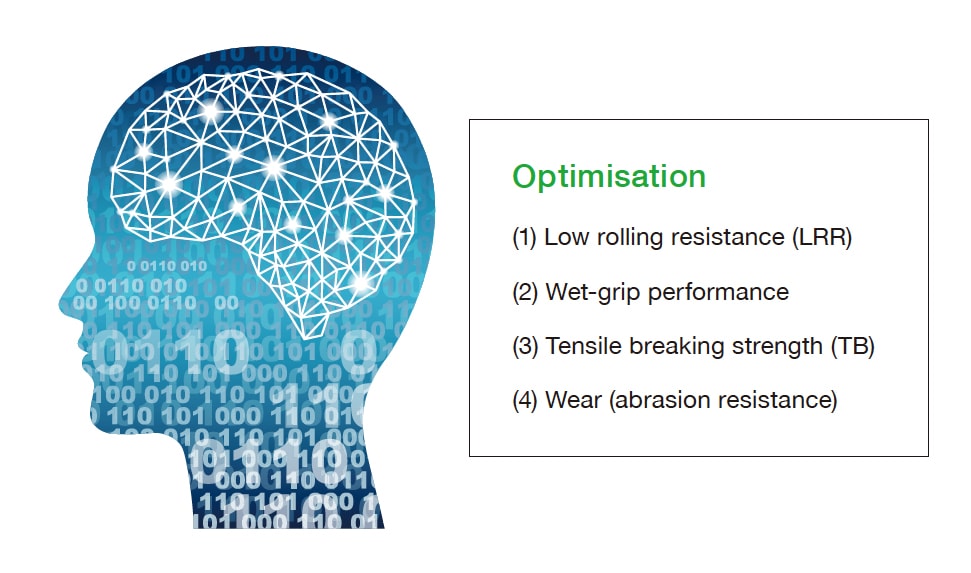
Figure: Materials informatics (MI) is now commonly used to optimize tire performance.
As noted above, next-generation tires are subject to increasingly stringent performance requirements. What ramifications does this have for the performance and functionality of the synthetic rubber materials they're made from?
“In the past we had already seen pretty tight specifications for fuel efficiency and wet-grip performance,” Inoue explains, “but right now the main requirements are for fuel efficiency and abrasion resistance—actually, the term 'electrical efficiency' is starting to come up more and more. If you think about electric vehicles (EVs), fuel-cell vehicles (FCVs), and other so-called 'vehicles of the future,' reducing the rolling resistance of tires is obviously just as important as it ever was, but abrasion resistance is suddenly much more crucial than before.”
The batteries in EVs and FCVs are said to make these vehicles around 20% heavier than comparable gasoline cars. This increased weight exacerbates tire abrasion, an effect that must be compensated for by mixing and other high-level processing steps, as well as by optimizing the molecular-level design of the polymers from which synthetic rubbers are made.
But abrasion resistance is also essential for a different reason: It facilitates compliance with environmental regulations as nations and regions around the world strive to build more sustainable societies.
Consider the example of Europe. To reduce air pollution, the EU regulates exhaust-gas emissions from automobiles; the current standard is named Euro 6, but this will soon be replaced by a more stringent standard named Euro 7. The provisions of this standard are incredibly strict compared to previous regulations—so much so that it has prompted considerable grumbling even within the EU; in addition to regulating exhaust gases, Euro 7 imposes limits on emissions of particulate matter from brakes and microplastics from tires. These regulations apply to EVs as well, and are accompanied by additional EV-related benchmarks such as reductions in the frequency of EV battery replacements. The upshot is that environmental considerations furnish an additional reason for why tires need to be energy efficient.
“But, to me it seems quite clear that corporate priorities aren't the only driver of this evolution—the very framework of society itself is shifting beneath us as we speak,” Inoue notes. “As a producer of materials, we need to be thinking constantly about what we can do to make the world more sustainable.”
The task of developing novel materials has traditionally consumed enormous amounts of time and money, but MI is starting to bring about dramatic accelerations and cost reductions.
“Our project to start deploying MI tools began sometime around 2019, and took off pretty much immediately after that. We started by constructing a database to allow us to optimize structures and physical properties, and then we increased the accuracy, and the process started producing results incredibly quickly. MI is a set of tools for optimization, which is distinct from simulation; as we're working toward some desired target material, we'll decide we want to maximize this capability and that attribute—so how should we structure the polymers to achieve that? And the MI tools will generate a list of candidate solutions, which speeds up this step of the process enormously.”
The team has already used MI to develop a new synthetic-rubber material, which a tire manufacturer has adopted as a new product grade; Inoue says the development cycle for this product completed in a fraction of the time it would previously have needed—but that its performance nonetheless satisfied the manufacturer's requirements. The groundbreaking new material boasts excellent fuel efficiency and abrasion resistance without compromising grip strength for driving on rain soaked roads.
What role do analytical instruments play in developing synthetic rubbers for high-performance tires?
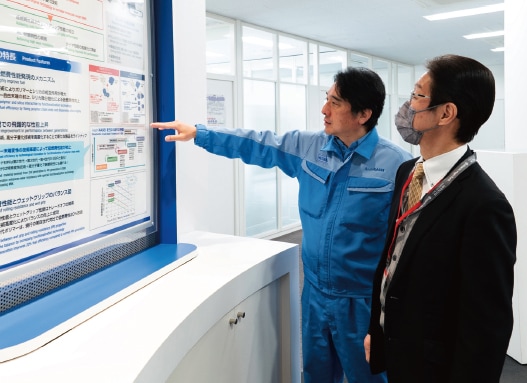
“One of the key techniques enabling progress in fuel-efficient tires is using silica as filler, which makes it possible to reduce fuel consumption while simultaneously improving wet-grip performance,” Inoue explains. “However, for this purpose it turns out to be crucial that the silica is properly dispersed throughout the rubber—and the silica dispersion is important for abrasion resistance as well.”
Even after using MI to optimize the silica dispersion, Inoue says that using laboratory instruments to verify the dispersion in actual samples is an essential step in the commercialization process.
“MI will give us a suggestion for how to improve both fuel efficiency and wet-grip strength while enhancing abrasion resistance, but it's all just hypothetical until we test it out. So it's more important than ever to observe and verify the actual material configuration using electron microscopes and other analytical instruments.”
To illustrate, Inoue shows a microscopic image of silica particles in rubber; the distribution of silica is uniform over nanometer length scales. Tricks for increasing silica affinity help achieve uniform dispersion, allowing the competing goals of fuel efficiency and wet-grip performance to be achieved simultaneously while also enhancing abrasion resistance.
“Although we think about these materials on microscopic levels, getting them into tens of thousands, or tens of millions, of vehicles could have environmental benefits on a global scale. There's nothing microscopic about that!”
Customer demands are getting more and more sophisticated and complex, including regarding the environmental performance of products. But eras of major change also offer opportunities for novel solutions to open up new markets. For material producers, using MI to streamline and accelerate R&D cycles can be a meaningful way to retain competitive superiority.
At the same time, personnel development generally remains an important issue for MI-assisted development and commercialization.
MI projects need engineers who combine a deep understanding of materials with a data science mindset. In Asahi Kasei's Synthetic Rubber Development Department, expert researchers in chemistry and material science study information science techniques and run their own MI-assisted material-develop projects; this is one key to the company's successful MI track record.
“Not surprisingly, it turns out that human knowledge and experience is important for configuring MI parameters,” Inoue explains. “Encouraging researchers themselves to become proficient with MI tools is something that's easy to overlook, but I think it's really important.”
MI is a tool for extending human capabilities; the ability of engineers with material-development skills to use this tool conveniently is one reason it continues to produce unexpectedly impressive results.
When asked if the combination of analytical data with MI tools might open new frontiers going forward, Inoue pauses to think before responding.
“Even assuming that EVs and FCVs will be the key players in mobility going forward, the longstanding needs for fuel efficiency and abrasion resistance will remain, and we'll need to keep moving in that direction. But, if we think about development projects a couple of generations in the future, I think we're going to need huge leaps in performance beyond what's achievable just by extending our trajectory thus far. That's what we need to be building. And I think that accumulating larger datasets for this purpose, and fusing MI with polymer design and analysis, will make it possible to create those innovations.”
Improvements in material performance are widely believed to be essential for achieving the United Nations Sustainable Development Goals. Japan's particular talent for R&D in the materials sector has long been a source of industrial strength, and, going forward, anyone interested in innovative new materials to solve societal problems would be wise to keep an eye on what Asahi Kasei is creating.

Postscript
When asked if innovations can reshape conventional wisdom, Inoue answers immediately: “Oh yes. They can.” He offers the history of silica in tires as an example: “The use of silica as a material for tire tread surfaces (the parts of the tire that make contact with the road) started around 30 years ago. Before that, people had mainly used carbon black, but it was hard to get both rolling resistance and wet-grip strength that way. But then Michelin came out with a silica-based tire that instantly transformed the conventional wisdom regarding tires.” It's fascinating to wonder what history-making innovations will emerge next—and exciting to know that front-line pioneers rely on analytical instruments from Hitachi High Tech.
(Reported and written by Toshinari Yamaguchi)