An Expert in Measurement and Analysis—with a Multi-decade Track Record Supporting TOTO Product Development
The TOTO Corporation's(hereinafter referred to as TOTO) Comprehensive Research Institute has been conducting extensive research to make water-related spaces in daily life cleaner and more comfortable. Additionally, they have achieved significant results in a wide range of fields, such as providing development support for applying ceramic technology to semiconductor production equipment. On this occasion, we visited the Analytical Technology Center of the institute and spoke with Senior Researcher Toshihiro Aoshima, who has been involved in analysis work for many years. We discussed the achievements of TOTO's analysis work and the introduction of ExTOPE, which contributes to data sharing and operational efficiency.
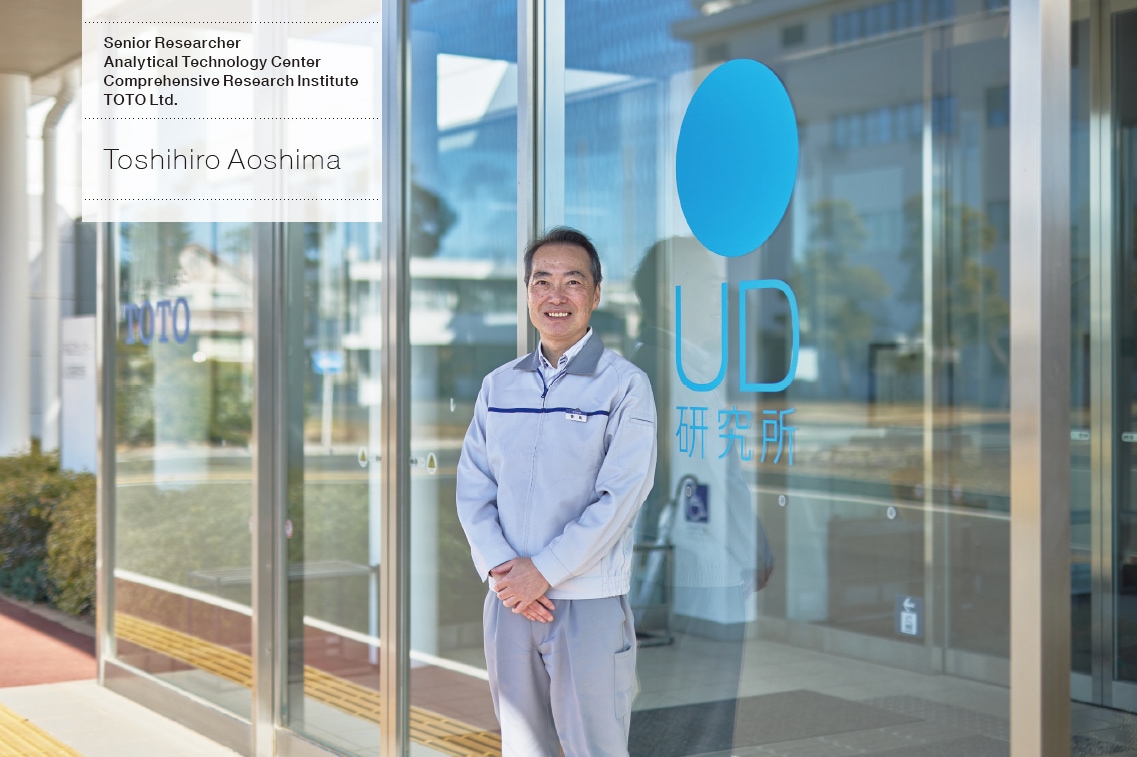
Senior Researcher
Analytical Technology Center
Comprehensive Research Institute
TOTO Ltd.
Toshihiro Aoshima
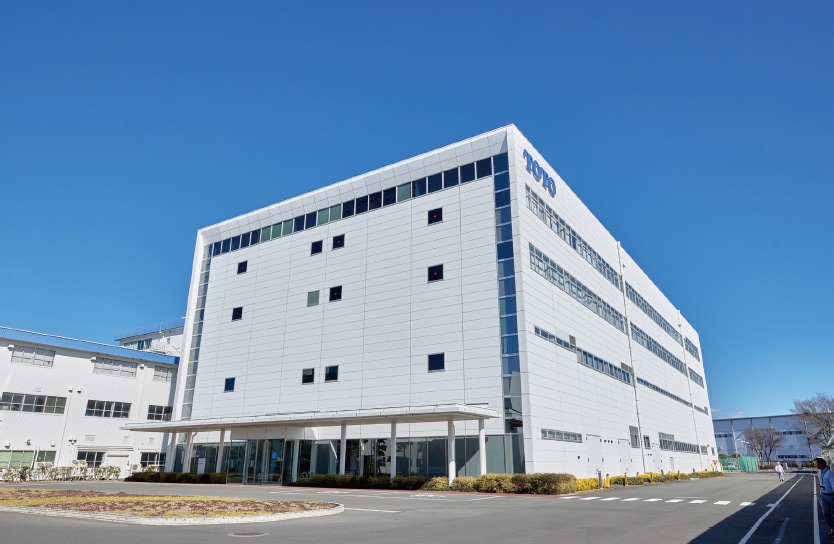
The name TOTO is likely something everyone has seen at least once in their daily life. Playing a crucial role in the technological development of indispensable products for everyday living is the Comprehensive Research Institute located in Chigasaki City, Kanagawa Prefecture. The mission of this institute, as a research center for a leading company in water-related spaces, is to explore new proposals and technologies that transform everyday issues in toilets, bathrooms, washbasins, and kitchens into positive experiences.
Since its founding in 1917, TOTO has conducted fundamental research on materials and products within its respective business divisions. Later, the company established a research institute, which evolved into the Comprehensive Research Institute in 2002. Today, the institute conducts comprehensive product research for all of TOTO, expanding its scope to include fields such as ergonomics, sensory engineering, lifestyle, and living patterns, creating core technologies for products. One key aspect of core technology development is analytical technology. Currently, the development of materials at the nano level is a critical issue across all industrial fields. For TOTO, analytical technologies that clarify invisible elements like water quality, materials, odors, and microorganisms are directly linked to the development and offering of attractive products.
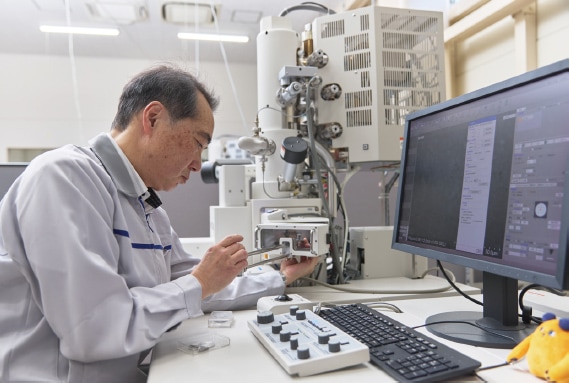
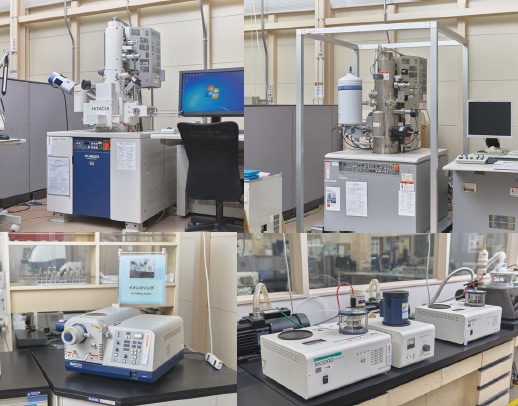
Toshihiro Aoshima joined the company in 1978 and began his career in the analysis group of the laboratory, which was the precursor to the research institute launched in 1979. Since then, Aoshima has consistently tackled important issues in TOTO’s research and development and within its various business divisions. He reflects on his experience: “The history of the research institute began in a small building at the western edge of this Chigasaki factory. It was in the basement there that I encountered the Hitachi X-560, which I now think of as a fateful meeting. The X-560 was a localized analysis device equipped with SEM and WDX(wavelength-dispersive X-ray spectrometer), combining observation and elemental analysis. Unlike the automated devices of today, it was the ultimate manual device that helped hone observation techniques and the sensitivity for localized analysis.
In 1980, the company experienced a significant leap forward, marked by the launch of the Washlet, which became synonymous with bidet toilet seats. Furthermore, in 1984, the Ceramic Division was established, and since then, the institute has deepened its understanding of phenomena through various analytical technologies, working closely with the division.
Over time, the analysis group expanded its staff and continuously introduced cutting-edge analytical devices. "Introducing new equipment provided opportunities to interact with development engineers from analytical device manufacturers and researchers from academia, fostering growth as an analytical technologist. A major turning point was the introduction of the Hitachi S-800," Aoshima recalls. The S-800 was a high-resolution scanning electron microscope(SEM) that achieved the world's best resolution of 2 nm at an accelerating voltage of 30 kV at the time. Its improved operability significantly enhanced the user experience, leading to the rapid spread of FE-SEM technology.
"The first image displayed was of nm-sized tungsten particles deposited on an alumina substrate. As the CRT's raster(a single scan line moving from top to bottom across the screen) slowly moved in the darkness, the beautiful particles shone brightly and vividly. I vividly remember the excitement of seeing such a striking image for the first time, as if it happened yesterday."
Acquiring the S-800 substantially improved TOTO's research and development capabilities, according to Aoshima.
The work of the Analytical Technology Center contributes significantly to the development of various TOTO products. One example is "CeFiONtect," which remains an important selling point for TOTO toilets. Faced with the challenge of significantly enhancing the toilet's stain resistance, Aoshima, as a member of the development team, observed the surface of aged sanitary ceramics. The observations revealed that dirt accumulates in the zircon roughness exposed by the melting of the glaze. The development team addressed this issue by creating a glass layer without zircon. The resulting CeFiONtect glass layer possesses nano-level smoothness, preventing dirt adhesion and making it easy to clean, with durability confirmed through microscope images for over 10 years of use.
For "Cleanse Water," which is produced by electrolyzing chloride ions in tap water, capturing the process of bacterial death and contributing to the development of durable electrode surface materials were key achievements. In developing water-saving toilets that flush waste with minimal water, X-ray CT was used to create a 3D model of the entire toilet, allowing fluid simulation to visualize water flow, ultimately shortening the development period.
Through these series of clean technology developments, TOTO's sanitary ceramics have achieved water savings to less than one-third of what was used 30 years ago. This not only reduces the use of detergent and water for users but also addresses societal issues by effectively utilizing precious water resources.
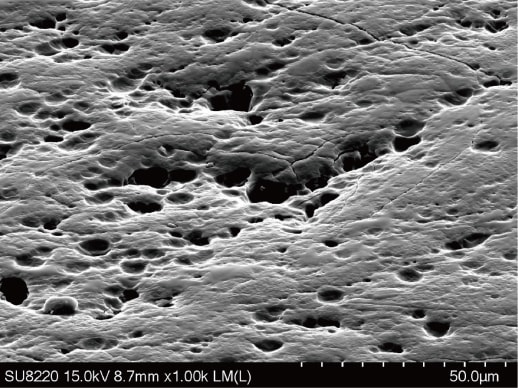
SEM image of surface of anodized aluminum observed at 60° tilt angle.
The Analytical Technology Center engages in analytical technology across various phases such as manufacturing, quality assurance, and research, dealing with a wide range of materials. Building on these achievements, Aoshima's activities have broadened to include presentations at academic conferences and collaborative research with academia.
"In joint research with Professor Keisuke Ohta from Kurume University School of Medicine, we worked on elucidating anti-algal mechanisms, clarifying the microstructures of algae, mold, bacteria, and biofilms."
This research expanded into "Hydrotect," leveraging photocatalytic action, and is used in materials for environmental purification, such as building materials and exterior walls.
Additionally, at Kyushu University’s Graduate School, Aoshima has been giving lectures for 18 consecutive years on research and development utilizing analytical technology in the Ceramic Engineering Course, hosted by the Manufacturing Engineering Education and Research Center. This aims to nurture young talent in regional companies, and the course consistently receives high evaluations from participants.
The remote operation of analytical devices with ExTOPE quickly became a collaborative research example. The project, which allows remote operation of a high-resolution electron microscope located in Chigasaki from divisions in Kitakyushu(headquarters), Nakatsu, and Gifu, began with the understanding of the utility of analytical devices at the Comprehensive Research Institute, Aoshima explains. Initially, there were issues with communication response, but now each TOTO division uses it to solve their challenges and develop new technologies. Operating an electron microscope requires expertise; it’s not simply pressing a button to see what you want. Aoshima notes that when division representatives operate the microscope, a brief advice from him can lead to dramatically improved images. Furthermore, on-site guidance during discussions on image interpretation and problem-solving is crucial. ExTOPE seems poised to play a vital role in passing down skilled techniques and nurturing successors.
One notable achievement includes the electrostatic chuck, a key component in semiconductor manufacturing equipment. In the development process, the conductive mechanism was elucidated, leading to a product with excellent plasma resistance, which has become a flagship product of the Ceramic Division.
"The electrostatic chuck is expected to be a new revenue source within the ceramics business, contributing to productivity improvement and cost reduction in the semiconductor manufacturing field. This achievement was recognized with the Technical Award from the Ceramic Society of Japan in 2009, shared by members from the Ceramic Division and the Research Institute. Above all, continuous research is essential to meet the cutting-edge needs of semiconductor manufacturers and to propose future-oriented solutions. Analytical technology that elucidates micro and nano domains holds the key to this pursuit."
In the fall of 2004, when TOTO's Specialist system began, Aoshima was appointed as the first TOTO Specialist, becoming Chief Researcher. By 2010, he became Senior Researcher, focusing on advising and guiding "analytical technology," "analytical equipment," and developing "analytical talent" to enhance the analytical capabilities of the business divisions.
Aoshima's extensive involvement with analytical device manufacturers, academic activities, and collaborative research with academia undoubtedly stems from his experience as a TOTO Specialist. He has made numerous contributions both internally and externally and asserts that the role of analysis is "to reveal the truth."
"The truth is intricately linked to visible phenomena and properties. What is expected of us in the analysis department is to unravel and clarify this intricate world. Since we are dealing with a truly sophisticated opponent, this technology is naturally profound. Advancing it requires a wealth of experience, know-how, and above all, intuition."
He also describes a specialist as someone who knows their limits. "You understand how a material should appear and have the capability to reach that point. Obtaining beautiful data that can speak volumes with a single photo attached to a report is very important."
Reflecting on the past, when the S-800 was first introduced, images were captured on film. Technicians at the time processed them in darkrooms, painstakingly developing and attaching the printed photographs to reports with adhesive. These manual tasks served as an excellent classroom for learning principles and are anecdotes that convey how much more fortunate the digital era's analytical environment is, he explains.
"The evolution of analytical devices is not limited to SEM; new methods are continuously being developed, allowing us to vividly see and measure worlds previously unseen or unmeasurable with high sensitivity. I was a demanding user who often told Hitachi, 'I'd like to see this,' 'It would be great to have this feature,' and some of these wishes led to patents. With each evolution of equipment, our analytical technology improved, for which I am grateful."
Aoshima believes that, although the speed of work, the amount of information, and the way we work have changed significantly from his time, the fundamental spirit of a technician should remain the same across eras.
"I hope the younger generation will skillfully utilize the overwhelmingly convenient aspects compared to the past and make full use of their TOTO business cards to grow as corporate technologists. I wish Hitachi would continue supporting the advancement of TOTO's analytical technology," he said with a smile.
In addition to supporting TOTO's development as an analysis specialist, Aoshima has another role as the head coach of the TOTO women's basketball team. The team is a member of the Japan Business Basketball Federation and competes in the regional corporate league. They achieved a long-desired first victory in the 2024 Women's East Japan Regional League under the slogan "You be bright this time! ~Shine now ~." Alongside aiming for victory, Aoshima actively engages with children through mini-basket clinics and experience classes, contributing to the community. This aspect is introduced as part of his character, reflecting his extensive involvement with many people and tackling numerous challenges both inside and outside the company.
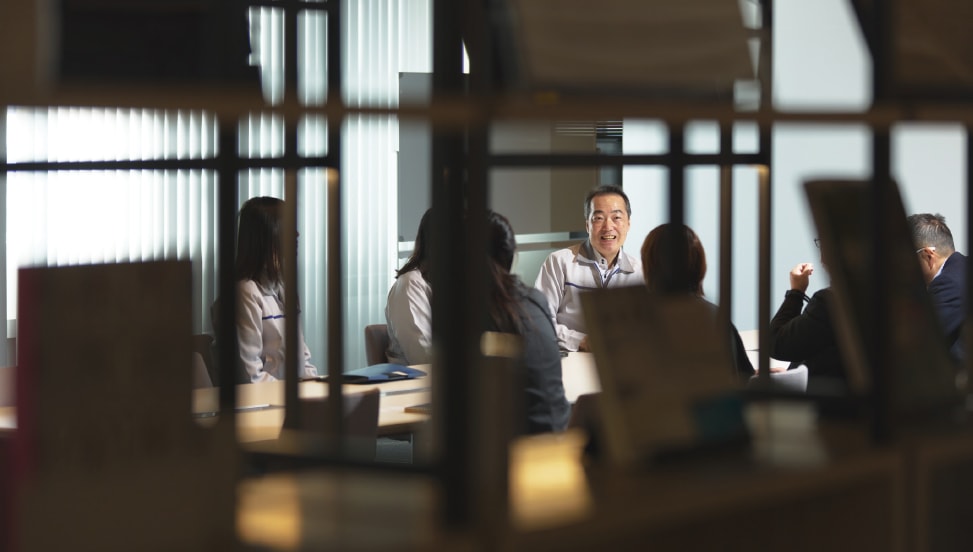
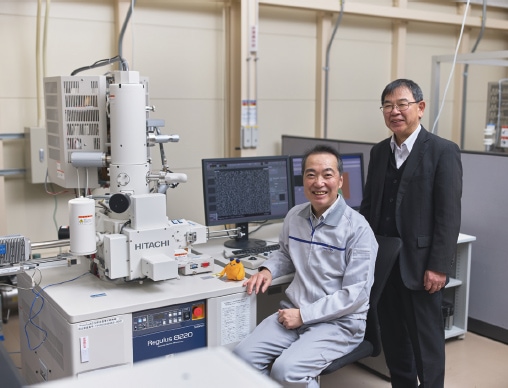
Editorial Note
I have had the pleasure of knowing Mr. Aoshima for approximately 30 years through demos, conferences, and seminars. His passion for SEM analysis is remarkable, and I fondly recall the nights spent at a family restaurant in Shonan, deeply engaged in discussions about image interpretation and equipment improvements, as if it were just yesterday. I also remember watching the practice match between the basketball teams of TOTO and Hitachi High-Tech, noticing that his demeanor as a coach was akin to his fervor for SEM. During the recent interview, I learned about his numerous achievements, from the establishment of the Research Institute to various research and development episodes, reaffirming that his recognition as a specialist is well-deserved. My association with Mr. Aoshima, who has adopted many Hitachi SEMs, starting with the X-560, is a valuable asset to me, and I would be honored to continue this relationship in the future. Next time, I hope we can reminisce about the past and discuss the future over drinks at a place with a view of the Shonan sea.
(Ryuichiro Tamochi)