Masahito Matt Ito*1, Norimasa Minamoto*1, Yoko Inoue*2
In March 2024, the Chemical Society of Japan officially inducted Hitachi’s Model 835 high-speed amino acid analyzer as a new entry (entry no. 066) in its "Chemical Heritage" catalog of historically significant milestones in the development of instruments for chemical analysis; the Society described the Model 835, Japan's oldest existing amino-acid analyzer model, as an invaluable instrument offering a detailed illustration of a long trajectory of technological progress, from the earliest amino-acid analyzers to modern HPLC systems1). But this was not the first public recognition of the historical significance of this seminal instrument; in 2020, the Division of Liquid Chromatography of the Japan Society for Analytical Chemistry designated the Model 835 as the third entry in its own pantheon of epochal breakthroughs in the history of science—an event commemorated by a contemporaneous report in SI NEWS2). The goal of this historical survey is to pull back the camera on the evolution of Hitachi's amino-acid analyzers, retracing the early genealogy of these systems from the first prototypes through the transformative release of the Model 835.
1958 witnessed the launch of a research collaboration between the Kyoto University Graduate School of Science and Hitachi's Taga Works in Hitachi City, Japan; in 1960, Hitachi provided the university with a KLF-1—Japan's first liquid chromatograph—and it was around that time that the development of amino acid analyzers began in earnest. Shortly thereafter, work on this project shifted from Taga to Hitachi's newly-constructed Naka Works (located in what was then Katsuta City, now Hitachinaka City), where the first amino acid analyzer, the KLA-1, was completed in 1961. Despite the KLA-1 being only a prototype, a rare photograph of this instrument has survived (Figure 1).
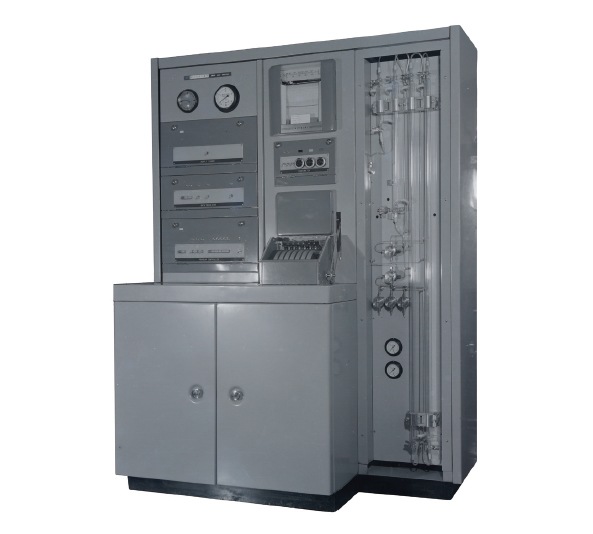
Fig. 1 The KLA-1 prototype system.
The instrument is nearly indistinguishable from the commercial product into which it evolved, Hitachi's KLA-2 amino acid analyzer.
The KLA-1 prototype was quickly refined into a commercial product, the KLA-2, released in 1962 and recognized by the Chemical Society of Japan as Asia's first amino acid analyzer; comparing the external appearance of the KLA-1 (Figure 1) to that of the KLA-2 (Figure 4 in Ref. 2), one sees that that two instruments are nearly indistinguishable like spot the difference pictures. The development of the KLA-2 was based on the famous paper3) by Moore et al.4-7); perhaps because this was around the start of Japan's era of rapid economic growth, the development process appears to have begun with efforts to faithfully reproduce existing results.
Thus, the KLA-2 featured two glass columns with lengths the same as those reported in the paper by Moore et al.; the choice of glass for both columns ensured that the column interior was visible from the outside. The longer column, with a length of 1.5 m, was used to separate acids and neutral amino acids; to allow gas bubbles to escape, the column was oriented vertically, thereby ensuring an overall system footprint that consumed considerable vertical space—and could only be installed in high-ceilinged laboratories.
The use of two columns was an innovation designed to accelerate operations. After first using the short 15-cm column to separate basic amino acids, the short column was manually disconnected and replaced with the long column, with the eluent replaced as well; this allowed the same flow channels to be used for the reaction and detector systems. Thanks to this and other speedups, experiments that had previously required a full week to complete could be performed on the KLA-2 in under 24 hours (Figure 2)—a transformative advance that left contemporaneous observers unable to believe their own eyes4). That Hitachi began exporting the KLA-2 overseas almost immediately—just one year after its domestic release in Japan—testifies further to the enormous impact delivered by the new instrument.(Meanwhile, the identity of the first foreign nation to receive these exports—the former Soviet Union—gives a flavor of the distinct international relationship against which these events played out.)
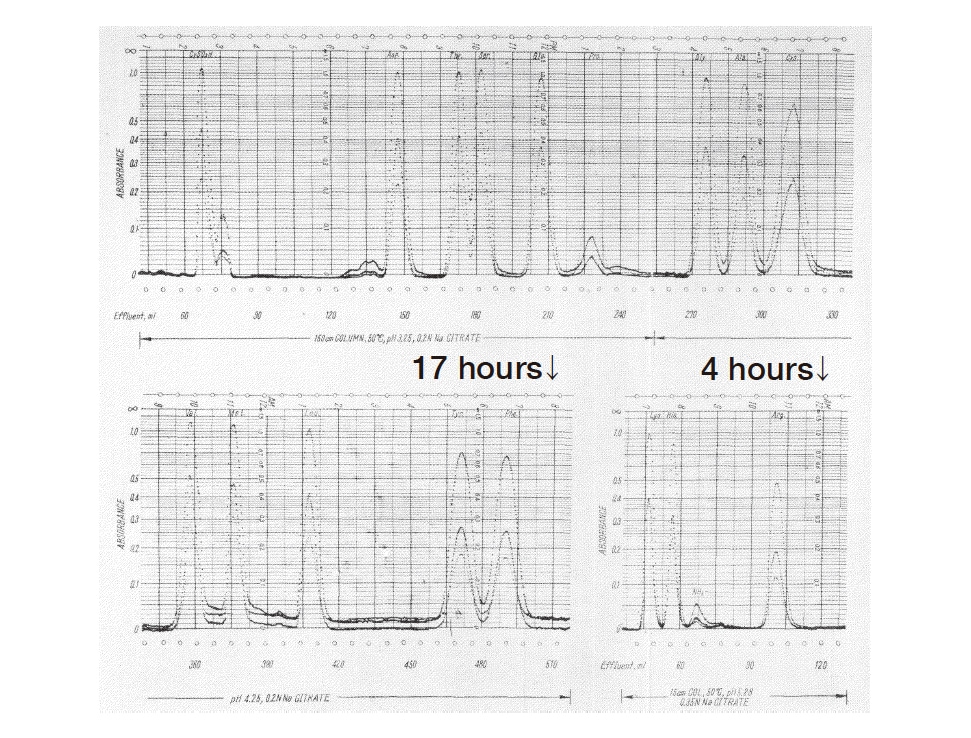
Fig. 2 A KLA-2 chromatogram.
The x-axis indicates the retention volume in milliliters, which may be converted to retention time using the flow rate of 30 ml/hour.
Source: Reproduced from S. I. NEWS, Vol. 5, No. 1 (1962).
This was an era in which data-processing tools were in their infancy; to estimate the area under a chromatograph peak, researchers would approximate the peak as a triangle, hand-measure the peak width and peak value to determine base and height, then multiply and divide by 2. To verify the reproducibility of peak-area measurements, relative standard deviations (%) were computed by hand. This was a time before pocket calculators: evaluating sums of squares was feasible, if tedious, but computing square roots must surely have been a major chore. Measuring a single test specimen required a full day of laboratory time; including the time required to verify peak-area repeatability, the installation process could easily consume a week or more. The standard sample-injection procedure at the time was to remove the upper column lid and add droplets of the sample solution using a pipette, thus requiring the installation technician to remain glued to the machine; among the accessories shipped with the instrument was a footstool for instrument operators to use when injecting sample solutions or replacing columns. Customers were also given instructions on how to pack columns during the installation process. Although these early models were not equipped with autosamplers, the peak-area repeatability value of 1% reported for glutamic acid (Glu)5) suggests that, when used skillfully, the KLA-2 was already capable of achieving performance levels comparable to those of today's instruments.
The mid-1960s witnessed a sequence of model upgrades at one-year intervals: the KLA-3 in 1964, the KLA-3A8) in 1965, and the KLA-3B9) in 1966 (Figure 3). Column lengths and other design features were optimized to accelerate measurements, improve separation performance, and enable a more diverse range of analytical methods. It was during these years that the instruments were first exported to the U.S.; overall, it was an era characterized by explosive progress in amino acid analyzer technology. Also, although the technique of preparing and purifying amino acids via chromatography is no longer of practical relevance today, throughout those early years Hitachi was actively engaged in developing the LP-2 series of amino-acid preparative instruments10).
The KLA-5, announced in 1971, represented the final stage of the instrument's evolution as a tall floor-mounted apparatus (Figure 4). Using standard columns with an inner diameter of 6 mm and a length of 50 cm, this system reduced the analysis time to just 4 hours.
Whereas the KLA-2 used columns with an inner diameter of 9 mm—the same size reported in the paper by Moore et al.6),—the motivations for using narrower columns in the KLA-5 were to increase sensitivity and reduce reagent consumption11).
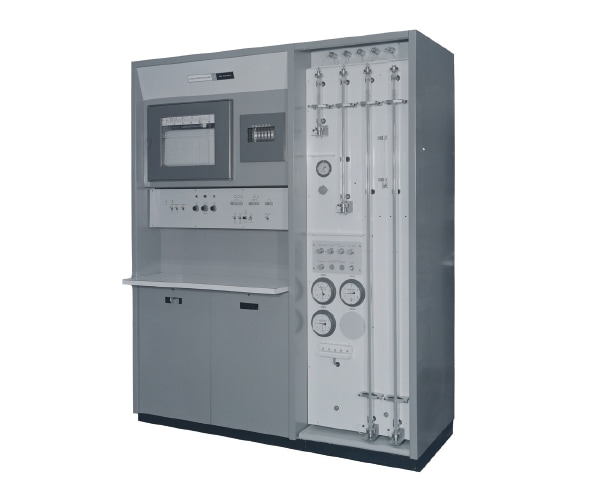
Fig. 3 Hitachi's KLA-3 amino acid analyzer, which was exported to countries including the Soviet Union, the U.S., and China.
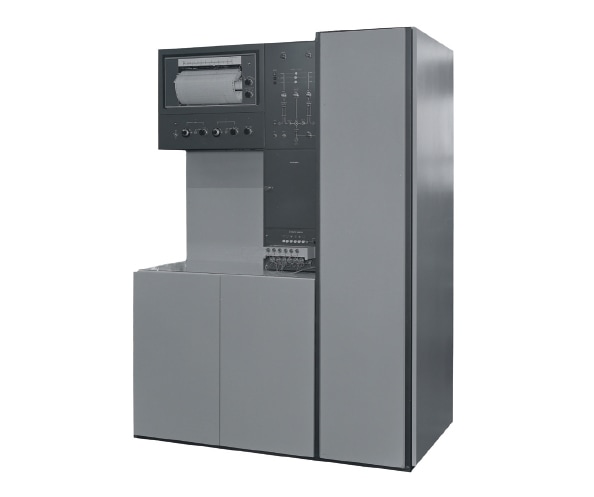
Fig. 4 Hitachi's KLA-5 amino acid analyzer. This was the final model to adopt the footprint of a floor-mounted apparatus like tall lockers.
The central concept driving the development of the KLA-5 was fully-automated operation11,12). A first step was the addition of an autosampler enabling multiple analyses to be performed sequentially—and freeing instrument operators from the need to remain constantly at the machine. The first autosampler implementations used a punched-card system, in which users specified desired operational sequences by punching specific patterns of holes in paper cards, then feeding these cards into the instrument. These cards were read at fixed intervals by a sensor unit comprising metal drums and brushes that determined the positions and spacings of the punched holes by sensing the flow or obstruction of electric current, then used that information to drive an array of relays—a mechanism reminiscent of mechanical music boxes. This approach allowed a number of procedures previously carried out manually by instrument operators— including switching eluents, switching columns, and initiating sampling—to be performed automatically in response to commands encoded on punched cards.
To prepare for an autosampler-driven measurement, the instrument operator would pre-fill a maximum of 24 sample tubes with measurement samples, then load these tubes into the autosampler; subsequent operations were automated by a turntable that rotated automatically following the punched-card program. To measure a given sample, the corresponding sample tube would first be connected to an intake tube, with the sample liquid temporarily transferred to this tube. Then the pump responsible for driving the flow of eluent would insert the intake tube into the flow channel feeding the column, thus sending sample solution to the column. Using the intake tube to separate the sample tube from the flow path in this way eliminated the need to maintain the sample tube at high pressures. The design of the instrument also enabled flexible approaches to sample injection: users were not restricted to using the sample tube as a fixed-capacity 500 μL coil, but could alternatively use a microsyringe to pre-inject arbitrary sample volumes in the range 10-250 μL.
The KLA-5 also featured a J221 integrator unit13). As this was still long before the widespread availability of computer systems, this integrator did not work by converting analog signals to digital sequences and processing the results numerically, as would be common practice today; instead, it employed electrical circuitry for direct processing of analog signals from the detector. Specifically, this circuitry featured a voltage-to-frequency converter (VFC), which converted the detector-signal voltage to a repeating pulse train with a particular frequency. The circuit would detect the start and end points of chromatographic peaks, determine an appropriate baseline, integrate the signal between the endpoints, and output the resulting peak-area value on a printer; it was also capable of determining the peak retention time simultaneously. This was truly a masterpiece of analog circuit-design ingenuity; in particular, successfully automating the computation of peak areas—which had previously required tedious hand computation—must have struck contemporary observers as an utterly revolutionary breakthrough. Indeed, the usefulness of this approach, in comparison to hand computation, was reported at the time11). We also note that, to lay the groundwork for the next-generation Model 835, the KLA-5 had already been designed to support single-column analytical methods.
The oldest remaining amino acid analyzer in Japan is stored at a Hitachi High-Tech facility in Hitachinaka, a city in Japan's Ibaraki Prefecture. This instrument, now officially immortalized as entry no. 066 in the Chemical Heritage series, is pictured in Figure 5, together with the authors of this article and some of the engineers who designed the original Model 835.
The Model 835, released in 1977, made clever use of several technological trends of the 1970s14). One was the key influence of HPLC techniques in liquid chromatography, which motivated the switch from glass columns to stainless-steel columns. This allowed the use of powerful pumps, capable of discharge pressures in excess of 10 MPa (around 100 atmospheres), to forcefully deliver eluents into columns. The 4-hour analysis time for the KLA-5 was reduced to less than 1 hour for the 835; the primary reason for this was the smaller packing particles, which are miniaturized from 17 μm for the KLA-5 to 5 μm for the 835. In addition to adopting a single-column analysis strategy, the 835 also surmounted a number of physics and chemistry hurdles to achieve further accelerations15). The transition to HPLC shortened column lengths to below 25 cm, allowing the 835 and subsequent high-speed amino acid analyzers to be designed as floor-mounted instruments that did not require high ceilings. It was also during these years that exports to China began to increase, due perhaps to the impact of economic growth.
The Model 835 also capitalized on another key technological trend of its time: the embedded-systems revolution, which saw microcontrollers designed into devices ranging from washing machines to rice cookers—a trend that mirrors what we see today with the addition of AI capabilities to household appliances of all varieties. The KLA-5's analog subsystems, including the punched-card reader for program inputs and the masterpieces of analog-circuit artistry used to implement the integrator and other units, were all replaced by microcontrollers. The punched cards specifying timing programs for analytical procedures were replaced with magnetic media similar to modern-day ATM cards; by switching just a single card, users could select between timing programs describing a 20-component protein hydrolyzate or a 40-component physiological fluid analysis.
The J221 integrator described above was replaced with a microcontroller-based data-processing unit. In contrast to analog-circuit processing of analog signals, digital signal processing allows multiple mathematical operations to be executed without degrading the signal-to-noise ratio; consequently, it became possible to measure peak areas with high precision. The Model 835 also incorporated a variety of new capabilities, including noise computations, peak-area processing techniques for overlapped peaks, and tuning of parameters governing thresholds and baseline-determination methods for detecting peak start and end points. Other operations that could now be performed in the digital domain included identifying the locations of individual peaks, determining retention times, measuring peak heights, and selecting among various types of quantitative analysis16).
Nonetheless, not every subsystem was promoted to the digital realm. For pumps, the ability to drive solution flows without pulsation is optimal; to improve retention-time reproducibility, a double-piston-driven pump mechanism had been in place since the KLA-3 era. To increase performance for the 835, a new single-plunger pump with a short roundtrip cycle was developed, but the mechanism for regulating the flow volume remained decidedly analog: rotating and then fixing an adjustment screw. Thus, the ability to adjust flow volumes during the course of a single analysis, as is possible today, remained out of reach.
As discussed in detail in our previous article2), the development of the 835 was truly an enormous undertaking, on a scale belonging to a bygone era that would seem unimaginable today. In every technical sector—mechanical engineering, electrical and electronic-system design, microcontroller software programming, chemical analysis, and testing and manufacturing—only the most skilled engineers were chosen to work on the project (Figure 5).
The lead developer was the late Dr. Shigetake Ganno. Happily, a surviving photograph shows Dr. Ganno congratulating plant workers at a ceremony commemorating the shipping of the 1,000th Model 835 unit (Figure 6)—a dramatic coming-of-age celebration for a system that had enjoyed an unprecedented run of successes, culminating in the successful amino-acid analysis that resolved the "New Nessie" mystery1).
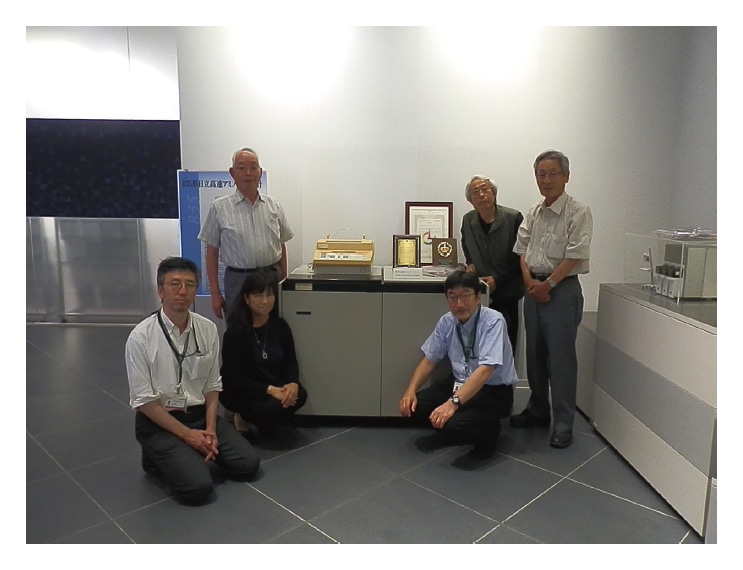
Fig. 5 Hitachi's Model 835 High-Speed Amino Acid Analyzer with its developers and the authors of this article. Back row, from left: Hiroshi Satake (mechanics), Yoshio Fujii (analysis), Akira Numata (testing).
Front row, from left: Norimasa Minamoto, Yoko Inoue, Masahito Matt Ito.
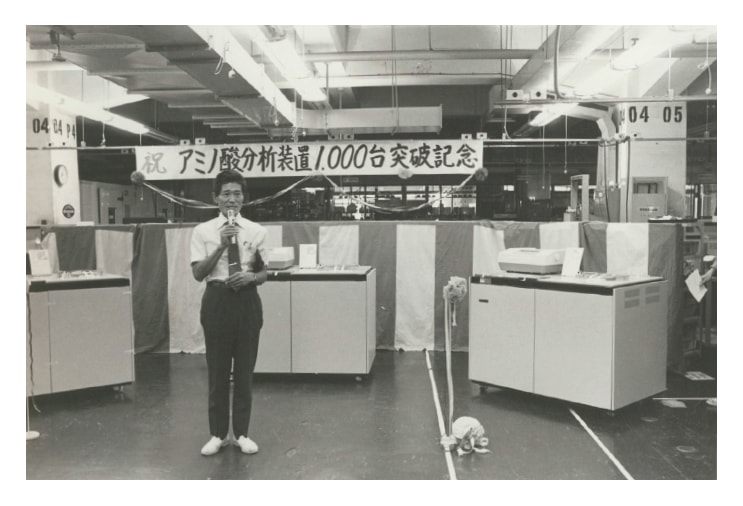
Fig. 6 Dr. Shigetake Ganno congratulating workers at a Hitachi production site during a ceremony commemorating the 1,000th shipped Model 835 unit.
In 2019, a Model-835 user purchased the latest model, the LA8080 AminoSAAYA® high-speed amino acid analyzer17). At that time, the old Model 835 was transferred back to us and was put on display in an exhibition at Hitachi High-Tech. It was during this time that the instrument received its official recognition as an entry in the Chemical Heritage lineup. As we have seen in this article, the Model 835 occupies an intermediate position between the original KLA-1 prototype and today's LA808018-20). It is uncanny to imagine how differently things might have turned out if, over the course of this nearly 60-year saga, any one piece of the puzzle had been misplaced—uncanny, and a reminder of just how fortunate the actual history has been.
As this summary has attempted to demonstrate, the Model 835 is an instrument of great historical value, made all the more precious by dint of its continued existence for us to inspect and appreciate. Today's LA8080, like the Model 835 before it, is still based on the same basic principles of amino-acid analysis outlined by Moore et al.3); by stepping back from the Model 835 to consider the full lineage of amino acid analyzers starting with the earliest KLA-1 prototype, we hope to have convinced readers that the evolution of these remarkable instruments is a story of multiple overlapping technical innovations—and one which qualifies as nothing short of extraordinary.
References
1. AminoSAAYA® is a registered trademark of Hitachi High-Tech Science Corporation in Japan.
About the authors
*1 Masahito Matt Ito, Ph.D., Norimasa Minamoto
Analytical Instruments System Design Department 2
Naka Division
Hitachi High-Tech Science Corporation
*2 Yoko Inoue
Medical System Design Second Department
NAKA Diagnostic Products Division
Healthcare Business Group Diagnostic System Business
Hitachi High-Tech Corporation
See more