


Information Disclosure Based on TNFD Recommendations: Governance
The information disclosed on the website is a digest. For details, please refer to the TNFD Report (PDF format, 1.66 MB).
Environmental Management Promotion Organization
In order to strengthen environmental management across the entire Hitachi High-Tech Group and promote effective environmental activities, we have established a promotion framework and are advancing environmental management.
Initiatives for Sustainability Focus Areas
Regarding "Contributing to a Sustainable Global Environment," which is one of the areas of Sustainability Focus Areas for our group, we are formulating proposals and plans for policies and specific initiatives related to Decarbonization, Circular economy, and Nature positive, and are promoting further effectiveness by evaluating the results at each site. In addition, important matters relating to environmental strategy are discussed by the Sustainability Promotion Committee, which is chaired by the President and has directors and executive officers on its members.
Initiatives for Strategies for Nature-related Issues
The Sustainability Promotion Committee meets at least twice a year to discuss the formulation and implementation of our sustainability strategies, including environmental strategies that include nature-related risks.
Important matters discussed by the Sustainability Promotion Committee are reported to the Board of Directors at least once a year, and the feedback is utilized in sustainability promotion tasks.
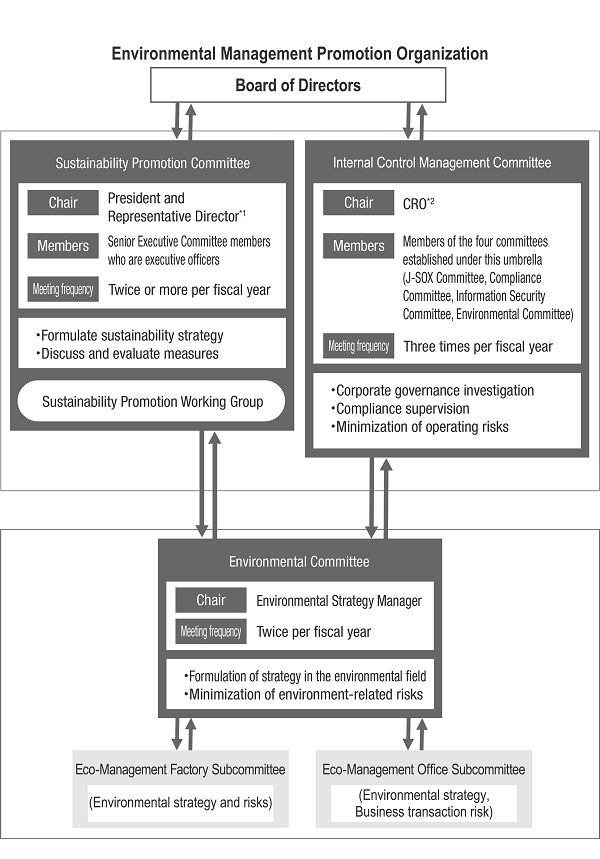
*1 President and Representative Director: The President and Representative Director serves as Chair of the Sustainability Promotion Committee, which has senior management as its members and has the duty of working to promote activities related to sustainability, including climate-related matters.
*2 CRO: The Chief Risk Management Officer (CRO) is the general manager in charge of risk across the entire company, and as Chair of the Internal Control Supervisory Committee is responsible for minimizing operating risks, including environmental risks, and for establishing an emergency response system.
Human Rights Policy
In May 2025, the Hitachi High-Tech Group revised the Hitachi High-Tech Group Human Rights Policy to strengthen efforts to respect human rights, which are essential to conducting business activities globally. Our group established this Policy in 2014 and has been working to strengthen human rights risk management. In light of the increasingly complex business environment and global trends surrounding human rights, the Policy reflects the results of its human rights due diligence, which includes responding to laws and regulations that mandate human rights due diligence *3 and identifying outstanding human rights issues. Our group is committed to fulfilling its responsibility to respect all internationally recognized human rights as set forth below.
- International Bill of Human Right
- ILO Declaration on Fundamental Principles and Rights at Work and its Follow-up
- Guiding Principles on Business and Human Rights
- The Ten Principles of the UN Global Compact
- OECD Guidelines for Multinational Enterprises
Based on these principles, our group will continuously implement human rights due diligence and provide appropriate education. In addition, we will comply with the laws and regulations of the countries and regions in which we conduct business, and seek ways to respect international human rights principles when there is a conflict between internationally recognized human rights and domestic laws. Furthermore, our group respects the human rights not only of its employees but also of all stakeholders involved in its business activities, products and services.
Engagement with Stakeholders
Our Group aims to be a successful enterprise trusted by all our stakeholders and contributing to social progress through business activities that emphasize value creation through high-tech solutions. We are committed to open, transparent, and reliable business practices. As we continue to grow, we will value the environment and strive to build a prosperous community, fulfilling our social responsibility and contributing as a corporate citizen with passion and pride in our work.
Our Group, we are working to promote communication with our stakeholders through information disclosure regarding environmental activities and staff participation in volunteer activities, etc. We consider it important to give our stakeholders an even more readily understandable explanation than before of the effects our own business activities have on the environment. We also think it crucial that we earn an understanding and empathetic response from stakeholders by continuing the cumulative two-way communication of our employees' volunteer activities.
Our Group is working to promote communication with our stakeholders through information disclosure by issuing Sustainability Book and disclosing environmental information online, allowing business site visits and observations, and responding to external surveys. In addition, environmental sections are created during the Naka Area Midsummer Festival and the Hitachi High-Tech Analysis Corporation Fuji Oyama Works Summer Festival (for both events, the business sites are opened to the public to deepen relationships with local residents). At the environmental section, we deepen relationships through introducing our environmental conservation activities in this area and conduct an environment quiz.
Thus, in accordance with the Hitachi Group Code of Ethics and Business Conduct and the Hitachi High-Tech Group Human Rights Policy, in assessing and responding to the organization's nature-related dependencies, impacts, risks, and opportunities, the Group conducts appropriate engagement with indigenous peoples, local communities, affected stakeholders, and all other stakeholders. In addition, a framework has been established to address complaints and suggestions from stakeholders in accordance with a grievance mechanism, which includes such information and is subject to oversight by the Board of Directors and senior management.
*3 Human rights due diligence: Involves identifying, assessing, and responding to business-related human rights impacts, taking measures to prevent, mitigate, and remedy negative impacts, then continuously verifying and disclosing the effectiveness of these measures.