


FOR IMMEDIATE RELEASE
Hitachi High-Tech announces the HT7800II: transmission electron microscope with high-quality data acquisition and high operational efficiency
Accelerating the deployment of Lumada 3.0 by expanding the digitalized assets that support efficient data acquisition in various fields
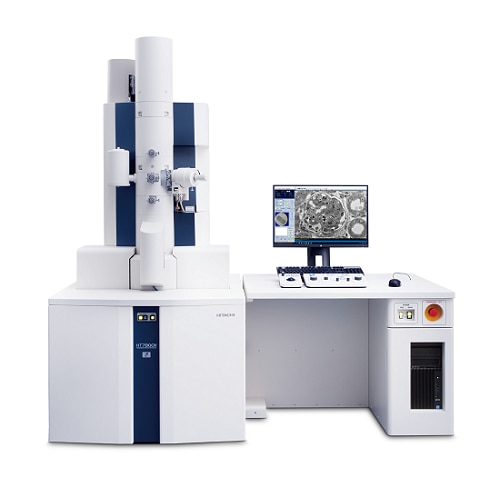
Transmission electron microscope HT7800II
Tokyo, December 19, 2025 Hitachi High-Tech Corporation ("Hitachi High-Tech", part of Hitachi, Ltd.’s Connective Industries Sector), has launched the HT7800II, a 120 kV transmission electron microscope ("TEM") that combines high-quality, reproducible data acquisition with improved efficiency for observation work in a wide range of fields. The HT7800II offers high-resolution, high-contrast performance and excellent operability that defined the previous HT7800 series, along with enhanced automation functions. By automating routine tasks such as alignments, setup, and image acquisition, it enables high-quality and high-efficiency observation that cater to the diverse applications and requirements of our customers.
Hitachi, Ltd.’s Connective Industries Sector ("CI Sector"), to which Hitachi High-Tech belongs, is working to provide "HMAX Industry" which combines data from an abundant installed base of products (Digitalized Assets), domain knowledge, and advanced AI. Through the HT7800II as a digitalized asset that acquires and generates data, Hitachi High-Tech as part of the CI Sector will focus on "Integrated Industry Automation" which aims to expand "HMAX Industry"—a digital service that embodies Lumada 3.0— into growth industries horizontally, including research in the healthcare field and materials, as well as contributing to innovation for frontline workers.
The HT7800II development background
TEMs are used in a wide range of fields for observing the internal structure of substances; 120 kV TEMs are mainly used for research and diagnosis in the fields of medicine and biology along with research and development of high-performance materials. In recent years, these fields have expanded to include academia and medical/testing facilities, resulting in an operator base that has diversified to include both novice and experienced TEM operators. In addition, as AI and data-driven research and analysis progress, there is a need to acquire and analyze large volumes of data, increasing the demand for simple and efficient operations as well as observation quality.
The HT7800II has enhanced automation functions to make observation work easier. It improves productivity in research and inspection work across a wide range of fields by efficiently and stably obtaining high-quality data, regardless of the users TEM operational skills.
Main features of the HT7800II
(1) High-contrast and high-resolution observation in one unit
Hitachi's Dual-Mode objective lens is continuously used in the HT7800II, allowing the operation in both high-contrast mode (long-focal-length) and high-resolution mode (short-focal-length) with just a single objective lens. High contrast mode is suitable for analyses that require wide-field, high-contrast observation, such as biological tissue and polymers, whereas high-resolution mode is suitable for high-magnification and high-resolution observation of nanoparticles, carbon materials, viruses, and similar. The mode can be changed with a single click to match the characteristics of the observation sample and the objective of the observation, allowing the HT7800II to flexibly provide for a wide range of analysis needs in one unit.
(2) Stability and efficiency through intuitive operation and various automation support functions
The GUI allows anyone to perform observation tasks easily by consolidating a series of operations onto the monitor, from searching a field of view to image acquisition, making the necessary operations such as switching cameras and setting magnification more intuitive and smoother. In addition, the automatic beam alignment function, which corrects the alignment of the electron beam, has been incorporated as standard for the first time in this series. Electron beam alignment is an important process that directly influences the quality of the acquired data. Traditionally, this process required manual, time-consuming operations based on the sample and conditions, as well as the knowledge and experience of the user. The new, intuitive one-click, auto-alignment function enables efficient adjustment and the acquisition of stable data, enabling users without TEM expertise to obtain high-quality data. In addition, the system can also be equipped with EM Flow Creator*1, an automation support software that allows users to flexibly build a series of recipes to meet different conditions, such as settings and adjustments based on the observation workflow*2. These automated functions in combination with a simple operation system reduce the burden on all users to support stable observation operations.
*1 EM Flow Creator is an optional function.
*2 Refers to the basic observation workflow of a TEM, which includes searching for a field of view, observation, analysis, and then data analysis.
(3) Combine various functions to support a wide range of needs
A feature that supports electron tomography (three-dimensional structure analysis of samples using incrementally tilted TEM images) is included as standard. There is also a wide range of optional functions available, one of which is the Correlative Light and Electron Microscope (CLEM) System for correlation analysis with optical microscopes. Another is the Cryo System for observing frozen samples such as ice embedded samples*3, as well as the Scanning Transmission Electron Microscope (STEM) and Energy Dispersive X-ray Spectroscopy (EDS) used for elemental analysis. We provide a system that meets customers’ wide range of research objectives and analysis needs.
*3 A method of observing samples that contain water by freezing them rapidly and embedding them in an amorphous ice film. This minimizes damage caused by vacuum and electron beam irradiation, allowing structural observation in close to natural conditions.
Hitachi High-Tech will continue to provide high-quality, reliable microscopes and analytical systems based on our core beam and analysis technologies as digitalized assets, and will contribute to solving social and customers issues.
Web site for the HT7800II
About Hitachi High-Tech
Hitachi High-Tech provides cutting-edge technologies, products and services to society and customers with its corporate vision of "Changing the World and Future with the Power of Knowledge" to contribute to a sustainable global environment, healthy, safe and secure lives, and the sustained development of science and industry. We manufacture and sell clinical analyzers, biotechnology products and radiation therapy systems in the healthcare field, semiconductor manufacturing and inspection equipment in the semiconductor field, as well as analytical systems and electron microscopes used in environmental fields and materials research. We are also engaged in a wide range of business areas globally, providing high added-value solutions in battery, communication infrastructure, railway inspection, digital and other industrial and social infrastructure fields. We provide solutions through a deeper understanding of the issues facing society and our customers to contribute to realizing a sustainable society. The company's consolidated revenues for FY2024 were approx. JPY 756.5 billion.
For further information, visit https://www.hitachi-hightech.com/global/en/
Business Contact
Wayama
Global Sales Strategy Dept.,
Business Strategy Planning Div.,
Core Technology & Solutions Business Group,
Hitachi High-Tech Corporation
e-mail:marina.wayama.jj@hitachi-hightech.com