


Responsible Procurement
We strive to build good co-creation relationships with our procurement partners, work to maintain and enhance mutual understanding and trust, and promote collaboration with partners who are mindful of CSR.
Basic Policy
When selecting suppliers, the Hitachi High-Tech Group conducts risk assessments that include investigating the Corruption Perceptions Index (CPI) and links to negative factors such as human trafficking or money laundering. Based on the Hitachi Group’s common procurement policy, the Group conducts a full assessment of the quality, delivery schedule, and price of the item to be procured, the supplier’s technology development capabilities and acquisition of any environmental certification, and whether or not the partners fulfilltheir social responsibility (environmental conservation, protection of human rights, contribution to society, etc.)
With the cooperation and understanding of our procurement partners, we will promote CSR activities throughout the entire supply chain.
The Hitachi High-Tech Guidelines for Procurement Activities (excerpt)
In selecting suppliers, the Hitachi High-Tech Group will comply with the proper prescribed procedures, giving full consideration not only to the quality, reliability, delivery times, and prices of the materials supplied, and the management stability and technology development capabilities of suppliers, but also to an assessment of whether those suppliers are fulfilling their social responsibility. More specifically, this assessment will focus on the performance of suppliers in terms of fair and transparent disclosure of information, compliance with laws, regulations, and social norms, respect for human rights, the eradication of unjust discrimination relating to employment and occupations, the abolition of child labor and forced labor, environmental conservation activities, activities that contribute to society, the creation of good workplace environments, and a shared sense of social responsibility with their business partners.
Our Guidelines for Procurement Activities are published on the materials procurement page of this website and we undertake widespread disclosure.
Social Background
In order to strengthen business competitiveness, it is essential for companies to take steps to enhance product quality, reduce costs, shorten lead times, establish business continuity plans (BCP), and so forth throughout their supply chains. In addition, companies are being called upon to fulfill their social responsibilities to address social priorities such as ethical conduct, respect for human rights, labor practices, and environmental issues. Moreover, companies are being called upon to ensure that the products they provide to customers are manufactured in line with social priorities by not just evaluating their own activities but also those of all their partners including during the process of selecting them.
Our Group is also receiving growing requests from customers to undertake activities to address its social responsibilities throughout the supply chain, and strengthening supply chain management is a means of minimizing economic, social, and reputational risks.
Hitachi High-Tech's Targeted Direction
Our Group has adopted “Maintain Procurement and Strengthen Product Cost Competitiveness to Prevail against Global Competition, Based on Collaborative Relationships with Partners” as a key basic policy of its procurement strategy. To this end, we are focusing on “Strengthening procurement risk management,” “Strengthening product cost competitiveness,” and “Rigorously enforcing procurement compliance.” We aim to make products that are competitive by unifying global strategies, product strategies, and robust supply chain building.
In addition, we encourage collaborative creation (measures for the manufacture of high-value-added products through the provision of Hitachi Group technology and its integration with procurement partner’s technology) with procurement partners by all design, manufacturing, quality assurance, and procurement divisions and will contribute to local economies through employment of local employees and local procurement from superior procurement partners located near our business sites.
Declaration on Building Partnerships
Since 2020, our group has announced the Declaration on Building Partnerships and has been working to build sustainable relationships that enable growth together with our procurement partners. Based on requests from the Ministry of Economy, Trade and Industry and three major economic organizations (Keidanren, Japan Chamber of Commerce and Industry, and Keizai Doyukai), we will once again ensure compliance with the Promotion Standards and strengthen fair transactions, such as by considering the impact of cost increases for our procurement partners.
1. Compliance with the Declaration on Building Partnerships
Based on the Declaration on Building Partnerships announced in 2020, we will comply with desirable business practices with procurement partners (the Promotion Standards pursuant to the Act on the Promotion of Subcontracting Small and Medium-sized Enterprises), and actively work to correct business practices and commercial customs that hinder the building of partnerships.
2. Setting Appropriate Transaction Prices
Transaction prices will be determined through sufficient consultation with procurement partners, based on a reasonable calculation method, including appropriate profits for procurement partners, and enabling improvements in working conditions such as wage increases and shorter working hours for procurement partners. We will not conduct negotiations that lack objective economic rationality or sufficient consultation procedures. In transactions with our group, if there are cases where cost increases for procurement partners, such as energy costs, raw material costs, and labor costs, are not properly reflected, we inform procurement partners to consult with the relevant procurement department staff.
3. Request for Collaboration and Cooperation with Procurement Departments
- We request even greater collaboration concerning information than in the past regarding social trends and changes in prices.
- In the event of any incident contrary to the Promotion Standards or the Declaration on Partnership Building, please discuss the matter with a contact in a procurement department.
Organization
Supply Chain Management
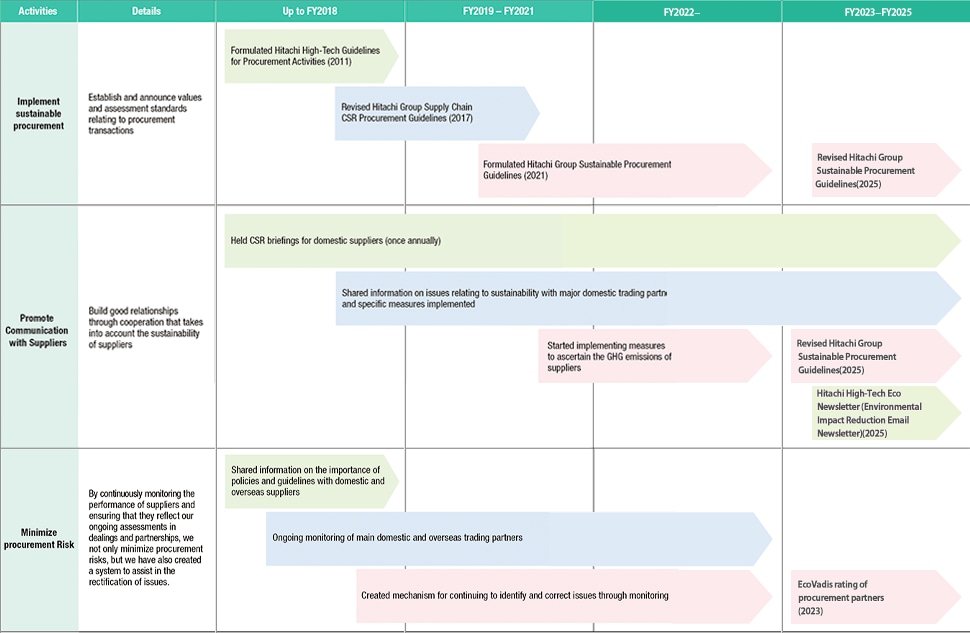
Based on the Group’s basic philosophy, the Hitachi High-Tech Guidelines for Procurement Activities have been released and are steadily being implemented globally. When we start working with a new partner, we use the Hitachi Group Sustainable Procurement Guidelines issued by Hitachi Ltd. as the basis for ascertaining the status of their activities related to social responsibility (ethical behavior, respect for human rights, labor practices, environmental issues, quality, safety, etc.) and confirming whether they are in line with the Group’s procurement and selection policies.
Initiatives for CSR Procurement
Initiatives
Supplier Briefings at Each Manufacturing Base
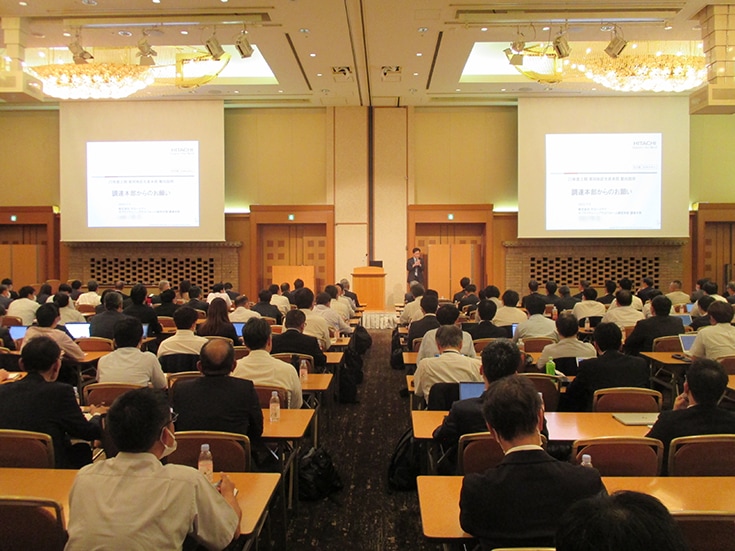
Sharing CSR awareness through information dissemination and mutual communication with procurement partners is essential, so we hold periodic briefing sessions for procurement partners of our product manufacturing division. At each of our group’s manufacturing sites, we explain the initiatives of the entire Hitachi Group for promoting green procurement activities and supply chain CSR activities twice a year. Regarding our group’s policies and approaches, we position the Hitachi Group Sustainable Procurement Guidelines, issued by Hitachi, Ltd., as a code of conduct we want our procurement partners to comply with. We explain social responsibilities (ethical conduct, respect for human rights, labor practices, environmental issues, quality, safety, etc.) based on these guidelines, deepen verification and mutual understanding with procurement partners, and promote CSR procurement activities.
Regarding green procurement activities, at supplier briefing sessions, we request procurement partners to undertake specific activities in line with the Hitachi Group’s environmental vision and policies, such as preventing global warming, cyclical use of resources, and conservation of the ecosystems, and we are working to create mechanisms to fulfill social responsibilities together with procurement partners.
Promoting Procurement Tailored to Environmental CSR
The Group practices green procurement, prioritizing environmentally friendly items in our procurement of products, components, and materials. With legislation such as the RoHS Directive and REACH regulations becoming increasingly stringent, we verify the chemical substances contained in delivered products, and in some cases, even if the final product does not contain these substances, we request investigations into the chemicals used during manufacturing, storage, transportation, and other stages before delivery to ensure the security of the supply chain. In addition, we respond to the extension of regulations governing chemical substances via the Hitachi Group’s A Gree’Net green procurement system.
We are promoting the Hitachi Group’s Environment and CSR-Based MONOZUKURI activities, and in the Hitachi High-Tech, Naka Area, we are encouraging and supporting procurement partners to actively engage in environmental conservation activities. About 90% of all suppliers (Hitachi High-Tech, Naka Area), approximately 1,600 companies, have been certified and registered as green suppliers*. As an opportunity to share activities with procurement partners, we hold supplier briefing sessions (twice a year) for major suppliers on green procurement, explaining the outlines of RoHS and REACH, and methods for managing country of origin. Since fiscal 2022, in addition to the above, we have also held CSR briefing sessions (once a year) for all suppliers to deepen mutual communication and align the direction of our initiatives.
* Suppliers whose environmental management systems have been verified and registered.
Please click here for details of our initiatives to preserve biodiversity in conjunction with all our procurement partners.
Implementation of sustainability Inspection and Monitoring
Our Group sent notices to all of our procurement partners geared to the revision (in January 2017) of the Hitachi Group Supply-Chain CSR Deployment Guidebook (3rd edition), which was the precursor of the Hitachi Group Sustainable Procurement Guidelines and collected written confirmations from them of Hitachi’s approach to CSR supply chain management. We will use the returned confirmations to share issues involved in supply chain management and to minimize the risks.
In addition, since July 2012, in coordination with Hitachi High-Tech’s Procurement Department, we have been visiting our procurement partners’ production bases in China and other Asian countries to conduct inspections of their CSR activities, for the purpose of evaluating existing suppliers in order to identify high-risk businesses. During an inspection, inspectors with RBA* authorization check the status of the supplier’s efforts, mainly with respect to labor and human rights, safety, the environment, and ethics, based on the SA8000 international standard for work environment evaluation developed by Social Accountability International, a U.S. certification body. We have been conducting evaluations since FY2015, inspecting seven companies (six in China and one in Malaysia) as of the end of FY2019 and recognizing no major violations. We have also placed a requirement on each supplier to submit a plan for improvement measures and will continue to follow up until improvement has been completed based on the plan. Since FY2023, we have been using EcoVadis, a third-party evaluation platform, to evaluate and monitor the sustainability performance of procurement partners.
We assess procurement partners with significant procurement amounts that are strategically important based on four evaluation categories to confirm their sustainability initiatives: environment, labor and human rights, ethics, and sustainable procurement.
* Responsible Business Alliance: An industry body composed mainly of large electronics and IT companies.
Distribution of Hitachi High-Tech Eco News
To promote initiatives for reducing environmental burdens in collaboration with procurement partners, we began distributing an email newsletter to procurement partners from fiscal 2025, summarizing information useful for reducing environmental burdens and requests from our group.
Education for Procurement Staff
Our Group seeks to be a business organization that continuously fulfills its social responsibilities throughout the entire value chain and strives at all times, together with all business partners involved in our business activities, to build lawful, ethical, and fair relationships. At the annual kickoff conducted in the Procurement Department, information on CSR procurement activities is disseminate and department personnel undergo training in accordance with an annual curriculum (environmental management, quality control, social responsibility, and other topics) to ensure comprehensive implementation of CSR procurement activities.* In addition, to clarify corporate ethics and approaches regarding compliance that should be shared throughout the Hitachi Group, we established the Hitachi Group Code of Ethics and Business Conduct. By each member of the Hitachi Group putting the Code into practice, we will respond to the trust of society in good faith and with sincerity. There were zero cases of violations or sanctions in procurement in FY2024.
* CSR Procurement Activity Education Results
| Participation rate in CSR procurement activity education | Scope | Unit | 2020 | 2021 | 2022 | 2023 | 2024 |
|---|---|---|---|---|---|---|---|
| Consolidated | % | 100 | 100 | 100 | 100 | 100 |
Response to the Conflict Minerals Issue
The Hitachi High-Tech Group is committed to responsible procurement activities to ensure that its procurement of parts and materials containing conflict minerals (tin, tantalum, tungsten, and gold) and cobalt does not encourage the activity of armed groups, human rights violations including child labor, corruption, and environmental destruction in conflict and high-risk regions.
Our Group also respects the OECD Due Diligence Guidance for Responsible Supply Chains of Minerals from Conflict-Affected and High-Risk Areas and conduct investigations and initiatives based on the Guidance while understanding social issues and the expected roles of companies in the regions.
For its suppliers, our Group will continue to inquire into their supply chains, including their minerals' country of origin and their smelters, using internationally recognized tools such as the Conflict Minerals Reporting Template (CMRT) and Extended Minerals Reporting Template (EMRT) issued by the Responsible Minerals Initiative (RMI). We will request our suppliers to procure minerals from smelters certified under RMI's Responsible Minerals Assurance Process.