

Broad Ion Beam Milling System IM4000II

The Hitachi IM4000II Ion Milling system is multifunctional to support various sample preparation needs. It supports cross-section milling, flat milling, Cooling Temperature Control, Air Protection Holders, and various other options to enable preparation of specimens across a wide range of applications.
Features
-
The cross-section milling rate of the IM4000II is 500 µm/h or greater*1. It renders fast cross-section milling of hard materials that typically require a long processing times.
*1The maximum milling depth in one hour for Si protruding 100 μm from the maskedge.
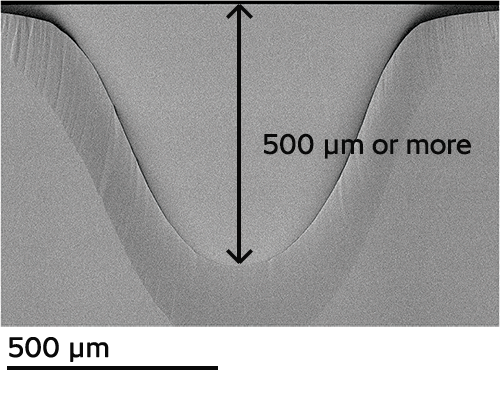
Specimen : Si wafer (2 mm thick)
Accelerating voltage : 6.0 kV (IM4000II)
Swing angle : ±30°
Milling time : 1 hour
The width and depth of cross-section milling can be tuned by varying milling conditions such as the swing angle. The SEM image below shows a Si wafer after one hour cross-section milling. The processing conditions are the same as in the image above except the swing angle has been reduced from ±30˚ to ±15˚. In this case, we can observe a deeper cross-section therefore demonstrating the even faster cross-section milling, useful for when the region of interest is located far away from the specimen/mask interface.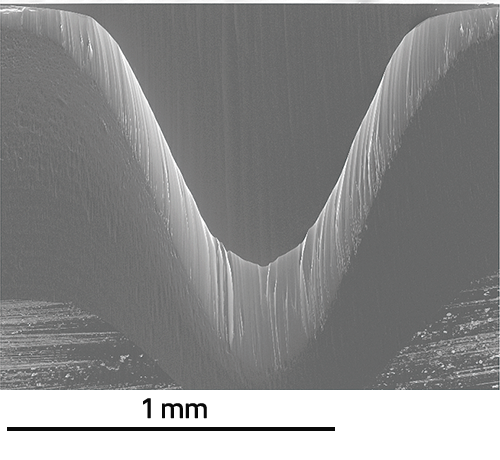
Specimen : Si wafer (2 mm thick)
Accelerating voltage : 6.0 kV (IM4000II)
Swing angle : ±15°
Milling time : 1 hour*The milling depth of a silicon speimen that is aligned with a 100 um protruion over a shielding mask.
-
Cross-section Milling
A pristine cross-section surface can be achieved by precisely milling the portion of the specimen that protrudes over the shielding mask. By irradiating the ion-beam parallel to the mask, flat and smooth milling is possible even with complex material with different compositions.
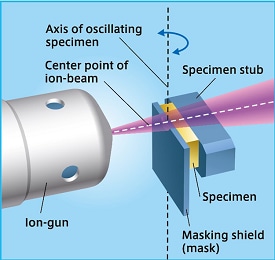
Main Uses
- Prepare a cross section at a specific region of interest (ROI)
- Prepare a cross section of a delicate specimen (composite materials, multi-layer films, polymers, etc.) that is not waterproof or difficult to process through traditional mechanical polishing techniques.
Flat Milling
Flat milling is used for the removal of surface-layer artifacts and defects or for final polishing, after traditional mechanical polishing techniques. A wider area can be processed compared to cross-section milling via eccentricity of the ion-beam while rotating the sample. It is also possible to emphasize or reduce irregularities by changing the irradiation angle of the ion-beam in order to reveal crystal orientation and subtle compositional differences.
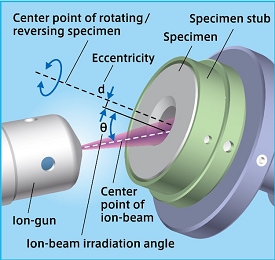
Main Uses
- Fine surface polishing of specimens via removal of scratches and other artifacts from mechanical polishing (max diameter of 50 mm x thickness of 25 mm)
- Delayering: precise layer removal of multi-layered specimens to expose specific underlaying structures.
- Distingusing layers in the cross-section of multi-layered films (emphasizing interfaces)
- Large-area fine polishing (reducing surface roughnes/artifacts) for enhanced EBSD analysis
-
The CTC unit for the IM4000II provides active cooling control of the cross-section milling holder during processing. It features an integrated liquid-nitrogen dewar that utilizes a closed-loop system to effectively dissipate heat from the shielding mask and sample, preventing any sample damage from occuring.
Sensitive specimens can be cooled with liquid nitrogen during processing. The cooling temperature control uses a feedback control loop to maintain a specific temperature during processing in order to prevent phase transitions.
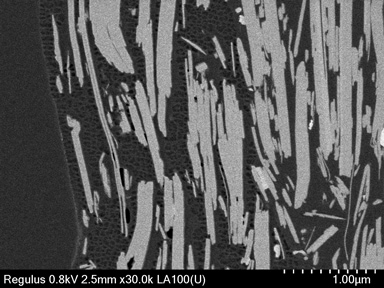
In the example below, specimen cooling suppresses thermal deformation in the heat-sensitive styrene-based latex, resulting in a smooth processed surface.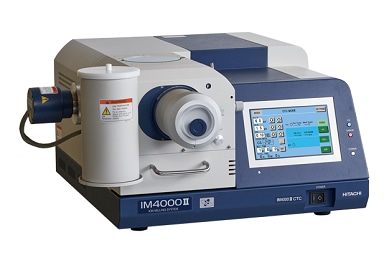
Room temperature milling
Cooling milling (-100 ℃)
Room temperature milling
Cooling milling(-100 ℃)
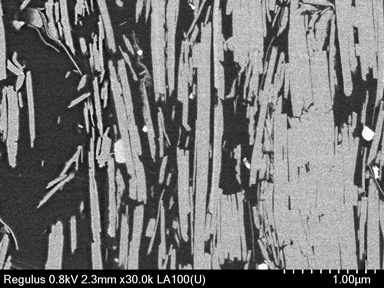
Specimen: Functional material to reduce plastic usage (made of paper)
*Option, CTC is not retrofittable.
-
The Air Protection Holder can be used to keep air-sensitive specimens (such as battery material) isolated from the environment. A specimen fabricated using the IM4000II can be loaded into a SEM and/or Atomic Force Microscope (AFM) without exposure to the outside environment by utilizing the Air Protecion Holder*.
The Air Protection system contains specialized sample holders and mounting hardware with a unique transfer systems to efficiently transfer material between isolated environments. This function can be used in combination with the Cooling Temperature Control unit.
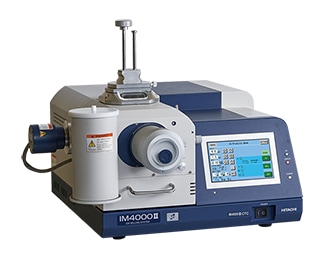
*Compatible only with specific Hitachi High-Tech FE-SEMs or AFMs.
-
A stereo microscope can be outfitted to the ion milling providing real-time observation of samples during the milling process. Both binocular and trinocular microscopes are available. The trinocular version (shown here) allows for viewing on an external monitor when equipped with a CCD camera*.
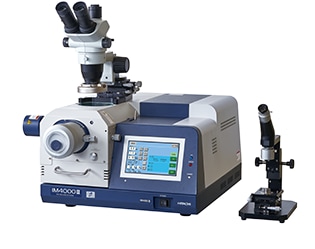
*CCD camera and monitor sold separtely.
-
Article information on Hitachi technical magazine "SI NEWS"
Specification
| Gas used | Ar (argon) gas |
|---|---|
| Ar gas flow control system | Mass flow controller |
| Accelerating voltage | 0.0 to 6.0 kV |
| Size | 616(W)×736(D)×312(H) mm |
| Mass | Main unit : 53 kg+Rotary pump : 30 kg |
| Maximum milling rate(Material : Si) | 500 μm/h*1 or more |
|---|---|
| Maximum specimen size | 20(W)×12(D)×7(H) mm |
| Specimen moving range | X±7 mm, Y 0 to +3 mm |
| Ion-beam intermittent irradiation | ON/OFF setting range 1sec to 59 min 59 sec |
| Swing angle | ±15°, ±30°, ±40° |
| Wide-area cross section milling | - |
*1 The maximum milling depth in one hour for Si protruding 100 μm from the maskedge.
| Maximum milling area | φ32 mm |
|---|---|
| Maximum specimen size | Φ50×25 (H) mm |
| Specimen moving range | ×0 to +5 mm |
| Ion-beam intermittent irradiation | ON/OFF setting range 1sec to 59 min 59 sec |
| Rotation speed | 1 rpm, 25 rpm |
| Swing angle | ±60°, ± 90° |
| Ion-beam irradiation angle | 0 to 90° |
Optional Specification
| Cooling temperature control*2 | Indirect cooling by LN2, Range of set temperature : 0 to -100 ℃ |
|---|---|
| Higher beam tolerance mask | 2× beam tolerance as compared to the standard mask (Cobalt-free) |
| Stereo microscope unit for monitoring the process | 15× to 100×, Binocular type, Trinocular type (correspond to CCD camera) |
*2 Option to deliver with the main unit. Some functions may be restricted during the use of cooling temperature control.