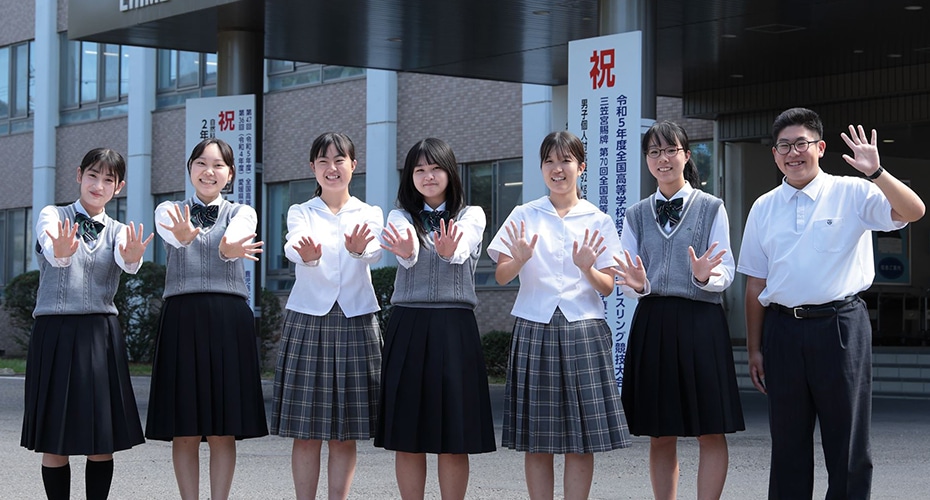
Fukushima Prefectural Aizu Gakuho High School was founded in 1924. The school has a history and tradition spanning over 100 years, during which it has been known by several different names, including Wakamatsu Girls High School, before becoming a coeducational comprehensive high school in 2002. In 2007, Aizu Gakuho Junior High School and Aizu Gakuho High School were linked to form Fukushima Prefecture’s first combined junior and senior high school.
The school has been designated a Super Science High School (SSH) by Japan’s Ministry of Education, Culture, Sports, Science and Technology (MEXT) and has implemented an inquiry-based learning approach covering the six years of junior and senior high school. Students in every grade of the high school take part in inquiry-based learning, focusing on SSH industrial society in the first year and SSH inquiry in the second and third years. This integrated education system develops students’ skills in problem solving, creative thinking, utilizing information, global leadership and communication.
The chemistry group of the school’s SSH Inquiry Club has been researching the topic of “Investigating the red film in an aqueous solution of copper alaninate.” Their results have received acclaim, winning a poster presentation award at the 2024 Super Science High School (SSH) Student Research Presentation. In the natural sciences poster category at the 2024 National High School Cultural Festival in Gifu, the project was awarded the Agency for Cultural Affairs Commissioner’s Award, receiving second-place honors in this national competition. They also received the Minister of Education, Culture, Sports, Science and Technology Award at the 68th Japan Students Science Awards.
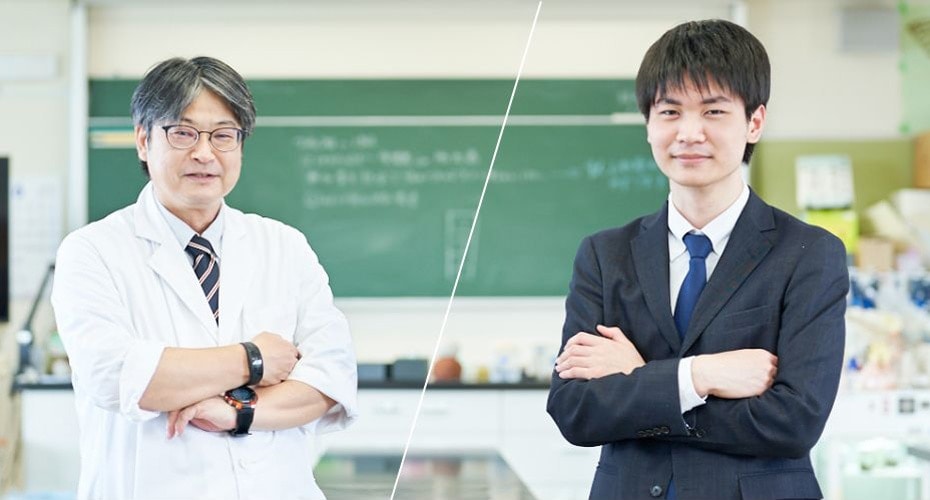
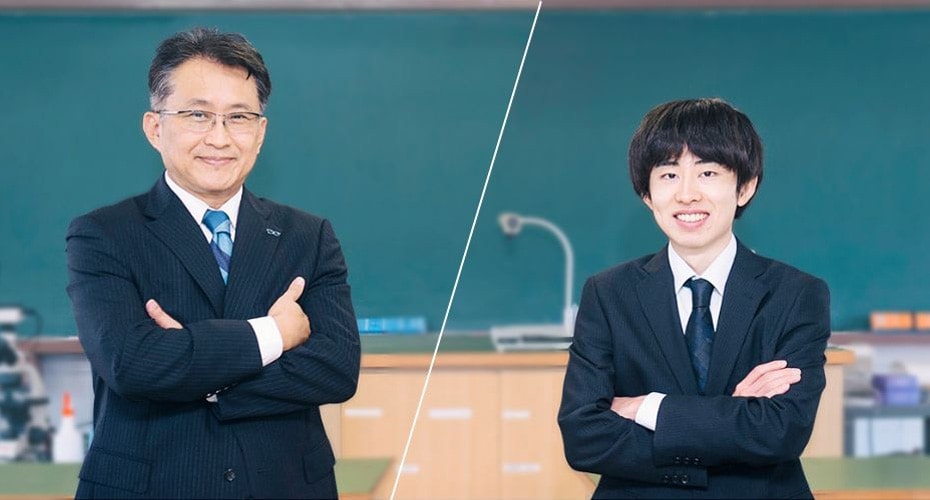
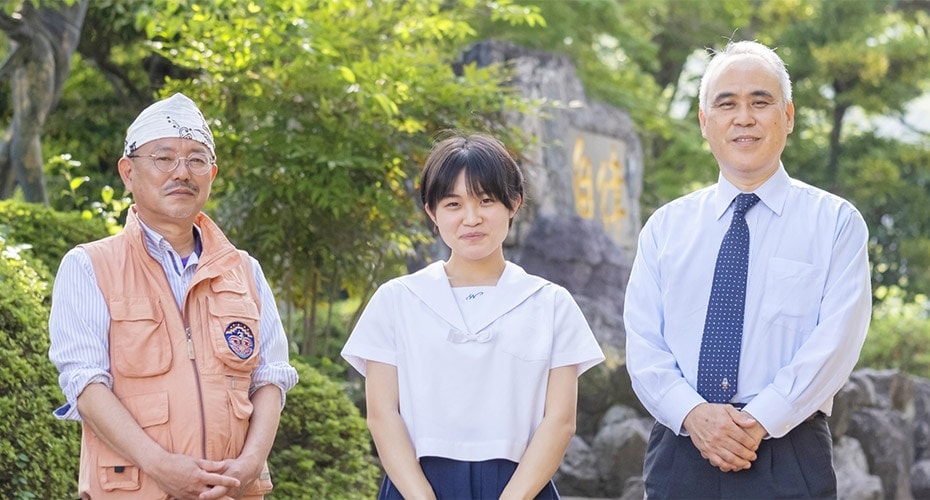
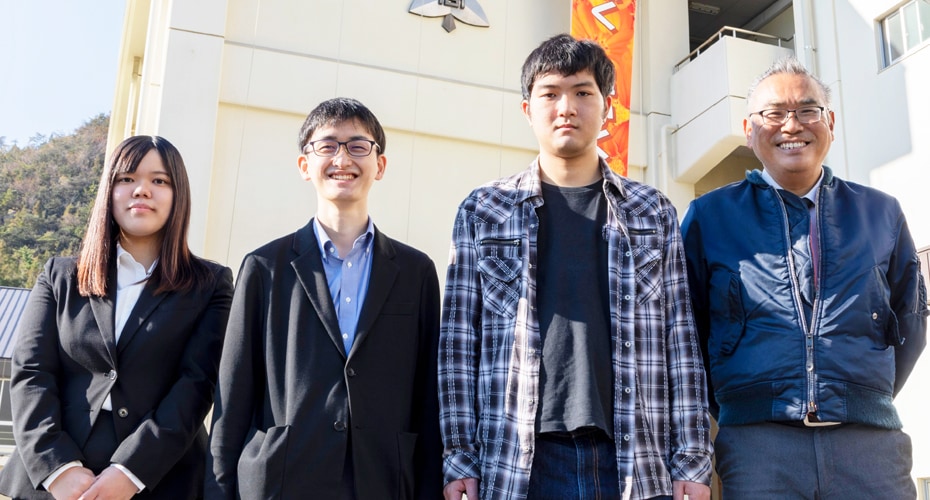
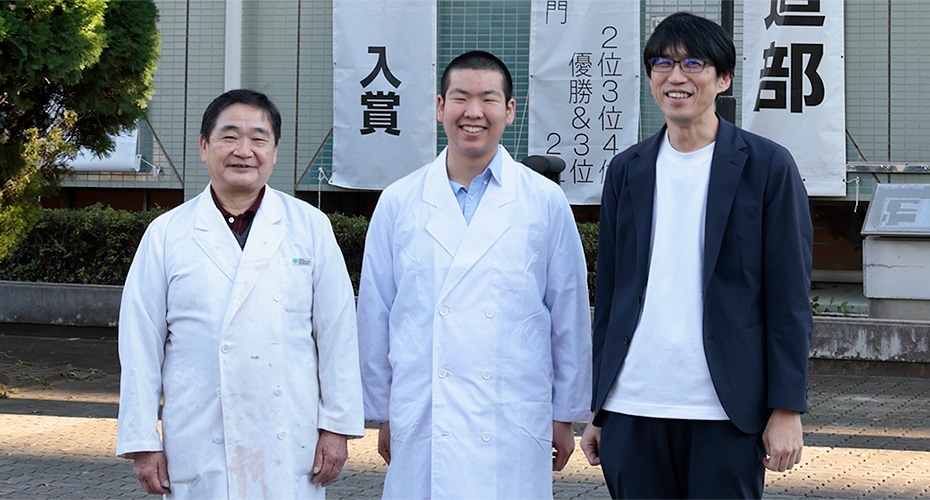
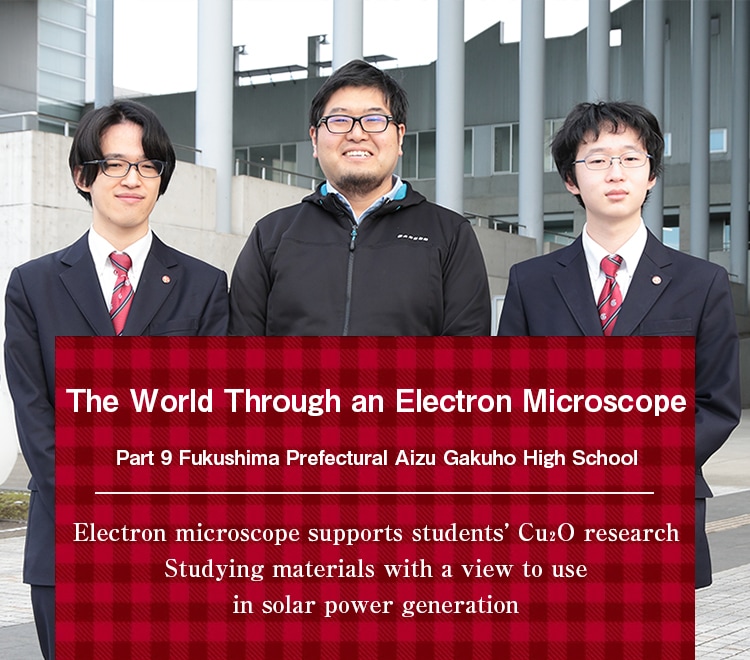
We spoke with two of the students involved in this research project, Taku Nakagawa and Kazuhide Demura of the SSH Inquiry Club chemistry group, along with the teacher and advisor of the SSH Inquiry Club, Kentarou Ohashi, about their research activities and the role of electron microscopes in the project.
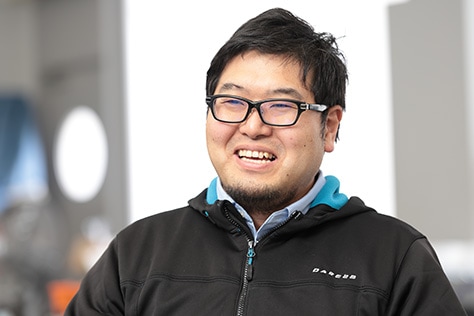
Kentarou Ohashi, SSH Inquiry Club advisor
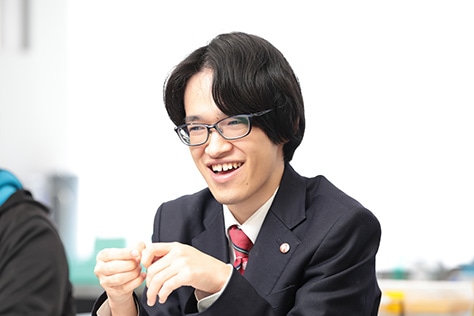
Taku Nakagawa 2nd year, Fukushima Prefectural Aizu Gakuho High School
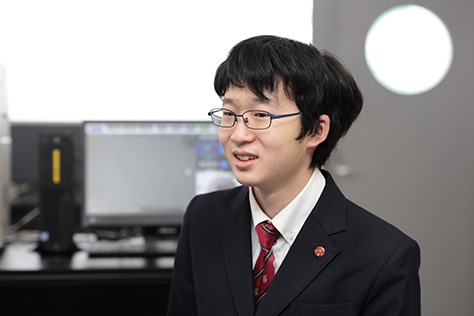
Kazuhide Demura 2nd year, Fukushima Prefectural Aizu Gakuho High School
Ohashi:As the only school with SSH status in the Aizu area, we are working to create an environment where students can immerse themselves in advanced research. Our efforts are enabled by three key pillars: fully-equipped facilities, continuity between junior and senior high school, and a practical curriculum.
One particular feature is that classes involve far more lab work than at a regular school. Students have around four chemistry classes a week, half of which are devoted to experiments, which means they do over twenty experiments a year. This allows them to develop a real “feel” for chemistry, rather than just a bunch of memorized information. Students are also given time for inquiry-based learning in their classes by exploring their own interests.
Nakagawa:We have been researching the characteristics and selective synthesis of Cu₂O crystals formed in aqueous copper alaninate solution. When copper sulfate, sodium hydroxide and alanine are mixed, a red substance is formed. We worked on identifying this substance and the process by which it is produced. This substance was originally discovered by chance by some senior students during their research. It was an unknown substance which had hardly been researched before.
Demura:Our research aimed to dig deeper into the discovery made by the older students. We wanted to identify the substance that they had discovered and complete their work. As a result, we found a safe and low-cost method of producing Cu₂O (copper oxide) crystals.
Ohashi:To identify the crystals that the students had produced in their research, we asked Fukushima University to conduct X-ray diffraction (XRD) analysis, which showed that the crystals were Cu₂O (copper oxide). Cu₂O is an important material in solar power generation, as it absorbs light of specific wavelengths, increasing power generation efficiency. However, conventional methods of producing Cu₂O are expensive and time-consuming. They can also be dangerous. The students discovered a much easier way to produce it, simply by leaving a solution at room temperature. We believe this is a groundbreaking discovery of a safe and low-cost method that could replace the existing industrial process.
Nakagawa:Through our research, we found a simple way to produce a thin film made up of octahedral crystals of Cu₂O. Further increasing the density of this film should make it possible to improve the power generation efficiency of solar cells, which would in turn help to improve the performance of related devices. That is why experts have been so impressed with our research.
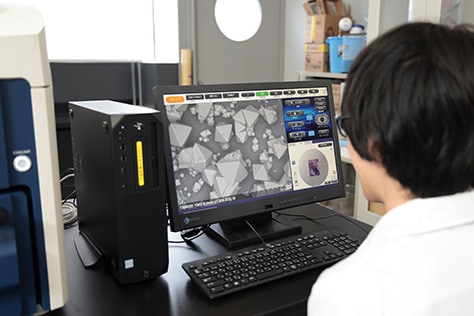
Observing Cu₂O crystals using an electron microscope. The differences in density and shape were made visible.
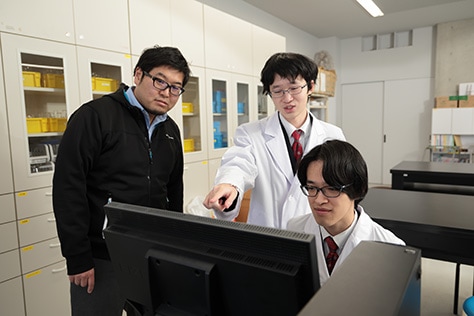
The Cu₂O was grown as octahedral crystals. Checking the structure to form a thin film.
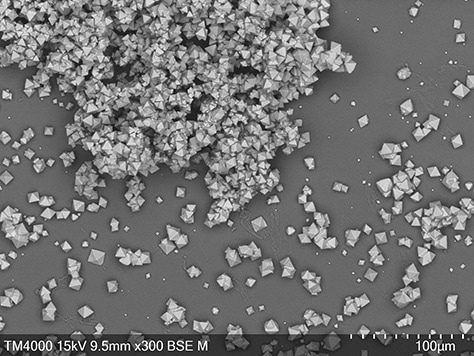
An electron-microscope image(Cu₂O crystals)
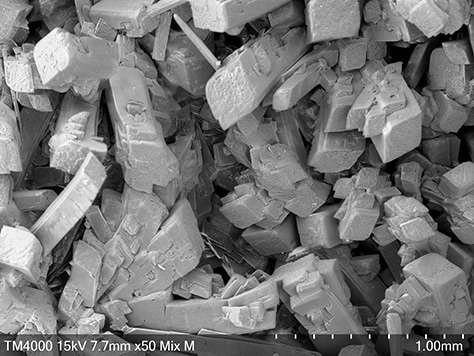
An electron-microscope image(Copper alaninate crystals)
Nakagawa:One of the goals of our research project is applying this technique to solar panels. For Cu₂O to function as a material for solar panels, it needs to have a certain density. Increasing density is a vital step toward next-generation energy technologies, such as safe, low-cost solar cells. To increase the density, we had to repeatedly try out different combinations. Being able to confirm the results using an electron microscope was extremely important for ensuring accurate and reproducible research.
Demura:The electron microscope played an important part in our research. It was only when we observed the Cu₂O using an electron microscope that we were able to confirm that it has a characteristic octahedral crystal shape. The Cu₂O crystals must be fixed as a thin film on a glass slide in order to be usable in practical applications. It is this process that requires a higher density. This involved repeatedly performing experiments and observing the results, so the electron microscope was crucial.
Ohashi:To find out what ratio of substances in the solution would produce the structure with the highest density, they tried every combination of conditions. It was a brute force approach made possible by the tireless energy of high school students. The method of leaving the solution at room temperature was originally discovered through this kind of painstaking work. This kind of brute force approach is probably only possible during the high school years. I think it is really wonderful that electron microscopes were made available to them.
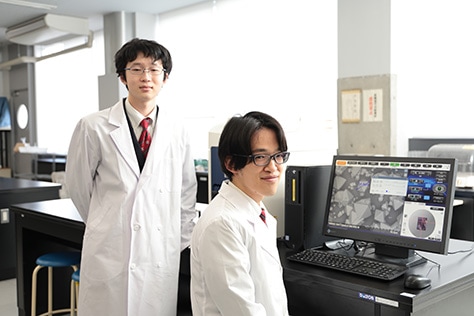
Experiencing the microscopic world encourages new discoveries and a spirit of inquiry.
Nakagawa:Research is a lot of fun. I want to take it further, to find a method to produce a more highly crystallized thin film. Working on this research has taught me to persevere when a problem has no answers, analyze my failures and learn from them next time. Being able to work with Kazuhide was another major factor.
Demura:We bounce ideas off each other: if one of us comes up with a question or issue, the other one will figure it out or fix the problem. Perhaps this was only possible because we have worked together all along. As well as being interesting in itself, this research project has broadened my interest in using information technology to compile research results and how to collect data more efficiently.
Ohashi:The electron microscope has given us many discoveries, in regular classes as well as this research project. After the teacher has demonstrated the basics of how to operate it, the students are free to come and use it to take photographs and make observations during summer vacation and so on. Coming into contact with the microscopic world hidden behind familiar materials is an amazing and awe-inspiring experience for students. This is an important opportunity to deepen their natural inquisitiveness.
The electron microscope is also useful in time allocated for inquiry-based learning. It provides a means to satisfy students’ curiosity, such as researching methods of preserving rice (photographing cracks on the surface of rice grains) and photographing fluorescent parts of clam shells. The microscopic world, so different from the macroscopic world visible to the naked eye, gives students a sense of perfection and awe, like the vastness of space. I think it’s really great that they can experience this sense of wonder during their high school years.

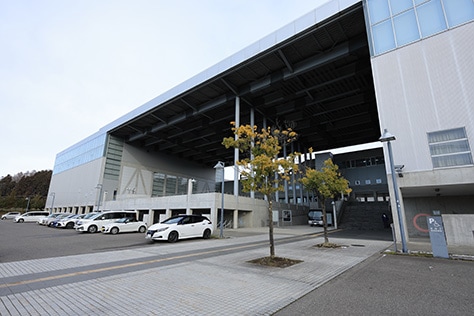
As the only school with SSH status in the Aizu area, the school has created an environment where students can immerse themselves in advanced research, based on three pillars: fully-equipped facilities, continuity between junior and senior high school, and a practical curriculum.
● Fully equipped facilities
Unusually for a high school, students can use university-level analytical instruments in their research, such as electron microscopes and fluorescence spectrophotometers. The teachers follow a policy of introducing the basic operation of these instruments and then leaving the students to it, encouraging them to learn independently by trial and error.
● Continuity between junior and senior high school
Leveraging its strengths as a SSH, the school’s educational system spans the six years from junior high school to high school. There is a tradition of research topics being passed on from senior students to their juniors. This allows students to build on past findings and go on to more advanced research. The school’s SSH Inquiry Club is more research-focused than a science club, and provides an opportunity for students with a keen interest in science to develop their skills together.
● Practical curriculum
One of the main features is that classes involve far more practical experiments than at a regular school. Performing over 20 experiments a year allows students to develop a real “feel” for science, rather than merely memorize information. Students are also given time for inquiry-based learning to explore their own interests as part of classes.