

Broad Ion Beam Milling System ArBlade 5000
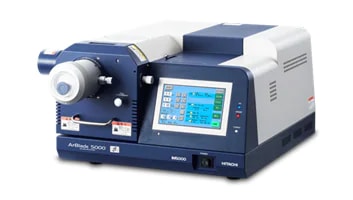
The ArBlade 5000 is the top-line model of Hitachi ion milling systems. It is the most advanced broad ion beam system for producing exceptionally high-quality cross-section or flat milling samples for electron microscopy.
Features
-
Fast cross-section milling rate: 1 mm/h*1
The ArBlade 5000 is equipped with a powerful ion gun that can deliver the cross-milling rate two times faster compared to that of the IM4000II model. High-speed milling dramatically reduces the process time for cross-section preparation.
*1Si protrudes 100 um from the mask edge.
High-speed cross-section milling
Below is an example of the fast milling rate of the ArBlade 5000. Given the same milling conditions, compared to the IM4000Plus, the ArBlade 5000 can achieve complete milling with an artifact-free surface.
Specimen: lead for mechanical pencil; Milling time : 1.5 hours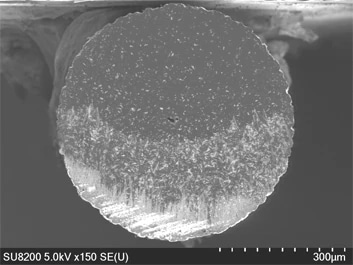
IM4000PLUS 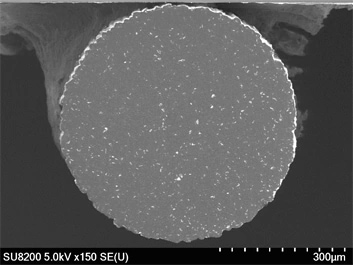
ArBlade 5000 -
Cross-section widths up to 8 mm
To meet the demands of large-scale milling, such as in the case of electronic devices, a specially designed drive unit for horizontal movement has been developed. This enables users to mill much wider areas than is normally possible.
Example of wide-area cross-section milling
Below is an example of the wide-area cross-section milling capabilities of the ArBlade 5000. As shown, a 7 mm section of a printed circuit board has been processed in a single milling run. The artifact-free sufrace allows for accurate high-resolution imaging of the sample.
Specimen: Circuit board; Milling time: 5 hours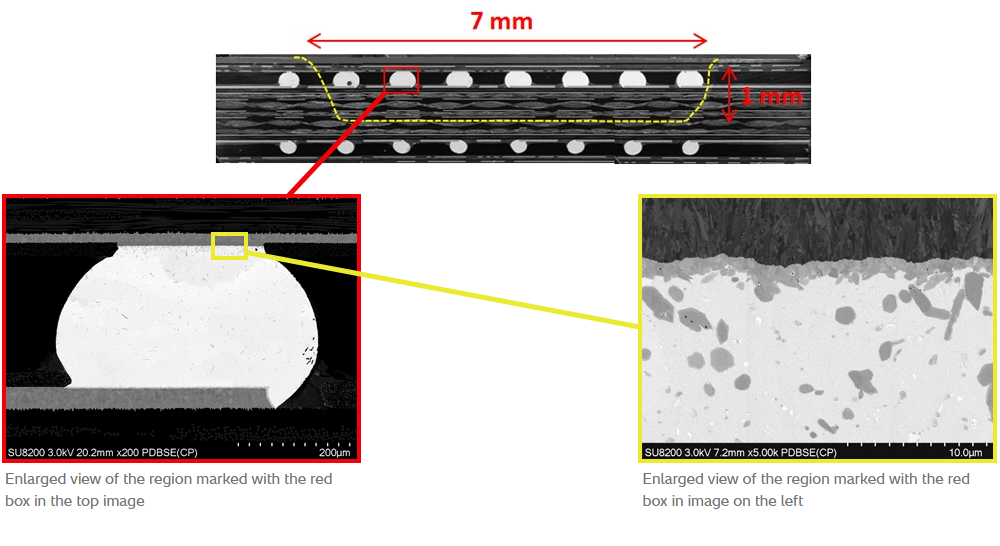
-
Hybrid Model: both cross-section milling and flat milling mode are available
The ArBlade 5000 is equipped with both cross-section and flat milling modes to support the most complex application needs. With multiple holders available, the ArBlade 5000 accomidates a wide range of applications.
Cross-section Milling
Used to generate wide and artifact-free cross sections directly without applying mechanical stress to the sample.
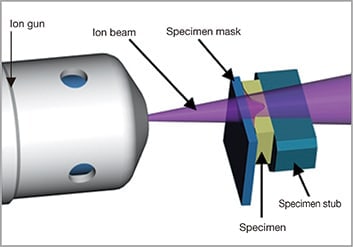
Image of Cross-section Milling Flat Milling
Used for the removal of surface-layer artifacts and defects or for final polishing after traditional mechanical-polishing techniques.
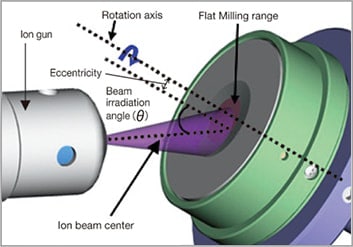
Image of Flat Milling -
Cooling Temperature Control (CTC)*
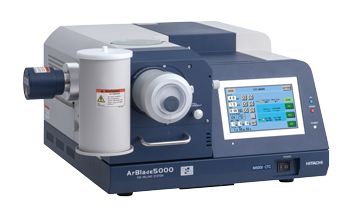
ArBlade 5000 with CTC The CTC unit for the ArBlade 5000 provides active cooling control of the cross-section-milling holder during processing. It features an integrated liquid-nitrogen dewar that utilizes a closed-loop system to effectively dissipate heat from the shielding mask and sample, preventing any sample damage from occuring.
*Option, CTC is not retrofittable.
- The CTC unit allows operators to set a desired cooling temperature. The system accurately maintains that tempearue during the cross-section process via a feedback-control system.
- Upon the completion of cryo cross-section millling, the specimen stage is warmed up to the room temperature to prevent ice/fost buildup or condensation when introducing air into a cold vacuum chamber.
- CTC is applied with the aim of preventing heat-induced sample damage during ion milling of beam-sensitive specimens such as polymers or low- melting-point alloys. To best achieve this goal, CTC can be utilized in conjunction with other beam-control functions, such as intermittent milling, to optimize heat dissipation. This is crucial for samples with low thermal conductivity because the heat generated at the point of the ion beam must first be effectively conducted to the mask/holder. The ArBlade 5000 with CTC allows for the independent control of beam energy, beam current, cooling temperature, as well as other milling parameters, providing comprehensive solutions to achieving damage-free cross sections.
Specimen : wood alloy
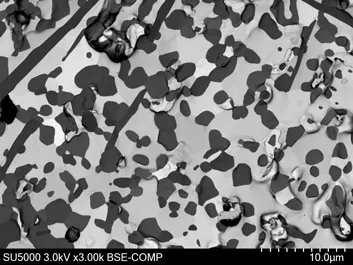
Without cooling 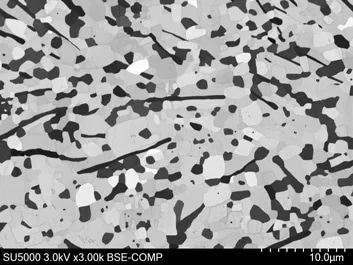
With cooling -
Article information on Hitachi technical magazine "SI NEWS"
Specification
| Description | |
|---|---|
| Gas used | Ar(argon) gas |
| Accelerating voltage | 0 to 8 kV |
| Cross-section Milling | |
| Maximum milling rate(Material: Si) | ≥ 1 mm/h*1 |
| Maximum milling width | 8 mm (with using a wide-area cross-sectional milling holder) |
| Maximum sample size | 20(W) × 12(D) × 7(H) mm |
| Sample moving range | X ±7 mm, Y 0 to +3 mm |
| Ion beam intermittent irradiation | Standard function |
| Swing angle | ±15°, ±30°, ±40° |
| Flat Milling | |
| Milling area | φ32 mm |
| Maximum sample size | φ50 × 25(H) mm |
| Sample moving range | X 0 to +5 mm |
| Ion beam intermittent irradiation | Standard function |
| Rotation speed | 1 rpm, 25 rpm |
| Tilt | 0 to 90° |
*1 Si protrudes 100 µm from the mask edge.
Optional
| Item | Description |
|---|---|
| Cooling temperature control*2 | Indirectly cooling by LN2, Range of set temperature : 0 to -100°C |
| Higher beam tolerance mask | It is twice as hard as the standard mask. |
| Zoom stereo microscope unit | 15 to 100 magnifications, Binocular type, Trinocular tyoe (correspond to CCD camera) |
*2 Factory fit only
Citations
 Powered by Bioz
Photo collections of beauty of metals, minerals, organisms etc. reproduced by the electron microscope and finished more beautifully by computer graphic technology.
Related Product Categories
Related Information

Hitachi High-Tech Social Media